Artificial intelligence (AI) is becoming an important technology in electric vehicle (EV) systems, helping vehicles analyze driving conditions, manage battery performance, improve energy efficiency, and support driver assistance features.
As electric mobility expands, AI is being used to improve the way vehicles operate, communicate with charging infrastructure, and respond to changing road conditions.
An electric vehicle combines several interconnected systems, including an electric motor, battery pack, power electronics, thermal management, braking controls, and onboard software. Traditional vehicle controllers rely on programmed rules and mathematical models to manage these components. AI can complement these methods by analyzing large amounts of data, identifying patterns, and supporting decisions under changing operating conditions.
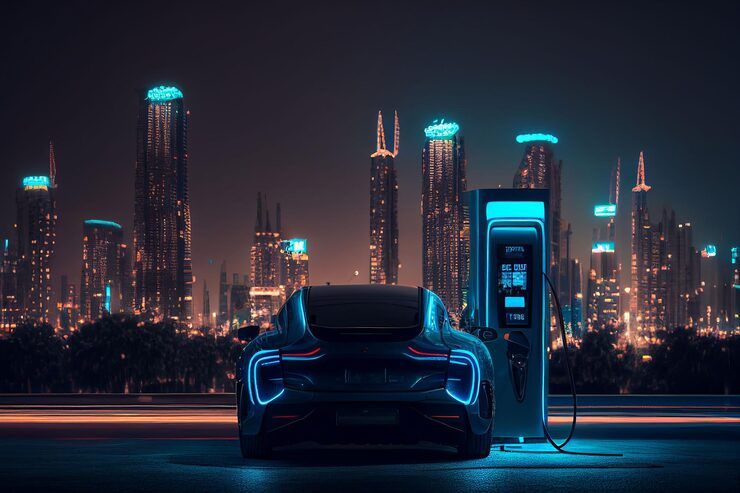
AI applications in electric vehicles include battery health prediction, driving-range estimation, intelligent charging, predictive maintenance, energy management, driver assistance, and fleet optimization. Some vehicles also use AI-powered voice assistants and personalized cabin features.
Machine learning, deep learning, computer vision, and optimization algorithms are among the technologies used in this field. Sensors and vehicle computers collect information about speed, temperature, battery voltage, traffic, and other conditions. AI models analyze relevant data and provide predictions or recommendations to vehicle control systems.
However, not every electric vehicle uses AI in the same way. Many essential functions continue to rely on conventional control algorithms and dedicated electronic systems. AI generally acts as an additional capability rather than a replacement for established vehicle engineering and safety mechanisms.
Importance
AI is important in electric vehicle systems because EV performance depends on efficient energy use, battery condition, driving behavior, and the interaction between multiple electronic components. Intelligent analysis can help manufacturers improve vehicle reliability and support more convenient driving experiences.
1. Battery Management and Health Monitoring
The battery is one of the most important components of an electric vehicle. Its performance changes with temperature, charging patterns, age, and operating conditions.
AI can analyze battery voltage, current, temperature, and historical usage to estimate the state of charge and state of health. These estimates help vehicles display remaining charge, predict degradation, and identify unusual battery behavior.
Better battery monitoring can also support maintenance planning and help manufacturers understand battery performance across different driving environments. Nevertheless, battery protection systems must continue to enforce safe voltage, current, and temperature limits.
2. Improved Driving-Range Estimation
Driving range is a major consideration for EV users. Actual energy consumption varies according to speed, road conditions, weather, passenger load, tire pressure, heating, and air-conditioning use.
AI models can combine information from these factors with previous driving data to estimate how far a vehicle may travel before requiring another charge. More adaptive estimates can help drivers plan routes and charging stops.
These predictions remain estimates rather than guarantees. Sudden weather changes, traffic conditions, and unexpected driving demands can affect the remaining range.
3. Intelligent Charging Management
AI can support charging decisions by considering battery condition, expected journeys, charging availability, electricity demand, and renewable energy generation.
For example, a connected EV may schedule charging during a preferred time window or coordinate charging with an energy management system. Fleet operators can also use optimization tools to schedule multiple vehicles according to their operating requirements.
Charging strategies must remain compatible with the battery's specifications and the capabilities of the charging equipment.
4. Predictive Maintenance
Electric vehicles contain motors, inverters, cooling systems, sensors, electronic controllers, and other components that require monitoring.
AI can analyze diagnostic codes, temperature readings, vibration measurements where available, and operating histories to identify patterns associated with developing faults. Maintenance teams can use these insights to prioritize inspections and investigate unusual behavior.
Predictive maintenance can reduce unexpected interruptions when models are accurate and properly integrated. However, it cannot guarantee that every component failure will be predicted.
5. Energy Efficiency and Regenerative Braking
Regenerative braking allows an electric vehicle to recover part of its kinetic energy during deceleration and return it to the battery. The amount recovered depends on speed, battery charge, temperature, road conditions, and system limitations.
AI-based optimization can help evaluate driving patterns and coordinate energy-management decisions. It may also support smoother transitions between regenerative and friction braking in suitable vehicle designs.
Safety-critical braking controls must remain dependable under all operating conditions, including when sensors or software encounter errors.
6. Driver Assistance and Road Awareness
AI is widely used in advanced driver assistance systems (ADAS). Depending on the vehicle, these features may use cameras, radar, ultrasonic sensors, and other technologies to recognize nearby objects, lane markings, pedestrians, and traffic conditions.
Applications can include automatic emergency braking, lane-departure warnings, adaptive cruise control, and parking assistance.
The capabilities vary considerably among vehicles. Driver assistance does not necessarily mean autonomous driving, and drivers must follow the vehicle manufacturer's instructions and remain attentive whenever required.
Recent Updates
Developments during 2025 and 2026 reflect continued investment in software-defined vehicles, AI-assisted driver systems, connected charging, and data-driven battery management. Specific features depend on manufacturers, model years, regional regulations, and hardware configurations.
1. Growth of Software-Defined Vehicles
Software-defined vehicle architectures allow manufacturers to introduce or improve selected vehicle functions through software updates. Centralized computing and connected electronic systems can make it easier to coordinate functions across different vehicle components.
AI can support data analysis, diagnostics, driver interfaces, and selected vehicle optimization tasks. However, updates involving safety-critical functions require careful validation, cybersecurity controls, and compliance with applicable requirements.
2. Advances in Battery Analytics
Battery analytics continues to develop through machine learning, improved sensor data, and models trained on real-world operating histories. These techniques can help estimate battery health, identify unusual behavior, and predict how performance may change over time.
A major challenge is ensuring that models remain accurate across different battery chemistries, climates, vehicle designs, and usage patterns.
3. Smarter Charging and Energy Coordination
Connected charging systems increasingly support scheduling, energy monitoring, and integration with home or commercial energy management platforms. AI-based forecasts may help coordinate vehicle charging with electricity demand and renewable energy availability.
Vehicle-to-grid technology can allow compatible vehicles to return electricity to the grid under suitable conditions. Availability depends on the vehicle, charger, local electricity infrastructure, and applicable rules.
4. Expansion of AI-Assisted Driver Systems
Computer vision and machine learning continue to influence the development of driver assistance technologies. Improvements in object recognition, sensor integration, and environmental interpretation can support selected driving and parking functions.
However, performance remains dependent on sensor quality, road conditions, weather, software design, and system limitations. Marketing descriptions should not be confused with the actual level of driving automation available in a vehicle.
5. Greater Focus on Cybersecurity
Connected electric vehicles exchange data with mobile applications, charging networks, cloud platforms, and other digital systems. As connectivity increases, manufacturers must protect vehicle software, communication channels, and diagnostic interfaces against unauthorized access.
Security measures can include authenticated access, secure software updates, encryption, and continuous monitoring. AI itself can also introduce risks if models or connected systems are improperly designed or maintained.
Laws or Policies
AI in electric vehicle systems is affected by vehicle safety requirements, cybersecurity expectations, data protection rules, battery regulations, and charging infrastructure standards. The applicable requirements depend on the vehicle category, market, system function, and intended use.
1. Electric Vehicle Safety Regulations in India
Electric vehicles sold or operated in India must meet applicable automotive safety and approval requirements. The Ministry of Road Transport and Highways establishes relevant motor vehicle rules, while authorized testing agencies assess vehicles and components against applicable standards.
Battery safety requirements, including those associated with relevant provisions of AIS-038 and AIS-156, may apply according to vehicle category and configuration. Manufacturers should verify the latest amendments and applicability before developing or approving a vehicle.
2. Battery Waste Management Rules
India's Battery Waste Management Rules, 2022, establish responsibilities concerning covered batteries, including extended producer responsibility and environmentally responsible end-of-life management.
EV manufacturers, battery producers, and other relevant organizations should review current requirements issued by the Ministry of Environment, Forest and Climate Change and the Central Pollution Control Board.
3. Cybersecurity and Software Updates
Connected vehicle systems require appropriate protection against unauthorized access and software manipulation. International automotive frameworks such as United Nations Regulations Nos. 155 and 156 address vehicle cybersecurity management and software update management for applicable vehicle approval contexts.
Their legal applicability depends on the jurisdiction and vehicle category. Manufacturers should confirm which requirements apply to their target markets and approval processes.
4. Data Protection and Privacy
Electric vehicles may collect location information, driving histories, charging records, and information associated with drivers or vehicle accounts. When personal data is processed, applicable data protection laws may impose obligations concerning its collection, use, security, and retention.
In India, the Digital Personal Data Protection Act, 2023, is relevant to the country's digital personal data protection framework. Organizations should check current commencement notifications, rules, and applicable provisions before determining their obligations.
5. Driver Assistance and Automated Driving
Driver assistance and automated driving functions may be subject to specific safety, testing, and approval requirements. Requirements differ between systems that assist a human driver and systems designed to perform more extensive driving tasks.
Manufacturers must clearly communicate system limitations and ensure that safety claims accurately reflect the vehicle's approved capabilities.
Tools and Resources
AI development for electric vehicles involves vehicle data, simulation platforms, machine learning software, embedded computing hardware, and testing environments.
1. MATLAB and Simulink
MATLAB and Simulink are used to model vehicle dynamics, battery behavior, motor controls, and energy management strategies. Engineers can simulate different driving conditions and evaluate how control systems respond before testing them on physical vehicles.
2. Python and Machine Learning Frameworks
Python supports vehicle data analysis, predictive modeling, and machine learning development. Libraries such as scikit-learn, PyTorch, and TensorFlow can be used for battery analytics, fault detection, driving-range prediction, and computer vision research.
Models intended for real vehicles require extensive validation and appropriate safeguards.
3. Automotive Simulation Platforms
Simulation platforms allow engineers to evaluate driving scenarios, sensor behavior, vehicle dynamics, and selected automated driving functions. They can help identify weaknesses before road testing, although simulation alone cannot establish safety under every real-world condition.
4. Battery Management Hardware
Battery management hardware measures voltage, current, and temperature while controlling functions such as cell balancing and protective shutdown. AI models can complement this hardware by estimating battery health or detecting abnormal operating patterns.
The underlying protection mechanisms must remain reliable even if an AI model becomes unavailable.
5. Charging and Energy Management Platforms
Connected charging platforms help manage charging sessions, energy consumption, and charging schedules. When integrated with suitable energy management software, they can support coordinated charging for homes, commercial facilities, and vehicle fleets.
How to Evaluate AI for Electric Vehicle Systems
Before implementing an AI-based feature, manufacturers and fleet operators should:
- Define the intended function, such as range estimation or fault detection.
- Collect accurate and representative vehicle data.
- Test the model under different temperatures, road conditions, and operating loads.
- Evaluate reliability, uncertainty, and failure behavior.
- Protect vehicle data and connected systems.
- Maintain established safety controls independently of uncertain AI predictions.
- Monitor real-world performance and update software through controlled procedures.
FAQs
1. What is AI in electric vehicle systems?
It is the use of artificial intelligence to analyze vehicle data and support functions such as battery monitoring, range estimation, energy optimization, predictive maintenance, and driver assistance.
2. How does AI improve electric vehicle performance?
AI can help estimate energy consumption, optimize selected charging decisions, detect unusual component behavior, and support efficient energy management. Results depend on the model, vehicle design, and available data.
3. Does every electric vehicle use AI?
No. Electric vehicles use electronic control systems, but the extent of AI integration varies. Some models use AI for selected functions, while others rely mainly on conventional algorithms and programmed controls.
4. Can AI increase electric vehicle driving range?
AI can improve range estimates and support energy-efficient strategies. The actual driving range still depends on battery capacity, driving style, temperature, road conditions, and vehicle design.
5. How does AI support EV battery safety?
AI can identify unusual patterns in battery measurements and help detect potential faults. Dedicated hardware protections, temperature monitoring, and validated safety controls remain necessary.
6. Is AI used in electric vehicle charging?
Yes. AI can support charging schedules, energy forecasts, and coordination with renewable energy or electricity demand. These capabilities depend on compatible vehicles, charging equipment, and software.
7. What are the main challenges of AI in electric vehicles?
Challenges include data quality, model reliability, cybersecurity, privacy, computing requirements, testing complexity, and regulatory compliance. Safety-critical applications require especially careful validation.
Conclusion
AI is contributing to the development of more intelligent electric vehicle systems by supporting battery monitoring, driving-range estimation, predictive maintenance, energy optimization, charging coordination, and driver assistance.
Advances in battery analytics, connected vehicle software, and AI-assisted perception are creating new opportunities for improving vehicle performance and user experience. However, AI capabilities differ between manufacturers and vehicle models, and many essential functions continue to rely on conventional engineering controls.