Chocolate coating machines play an important role in modern confectionery production by helping manufacturers apply a consistent layer of chocolate to products such as biscuits, wafers, bars, cakes, cookies, nuts, and other centers.
As production requirements become more demanding, automated coating equipment has evolved to provide greater control over chocolate temperature, thickness, product movement, cooling, and overall process consistency.
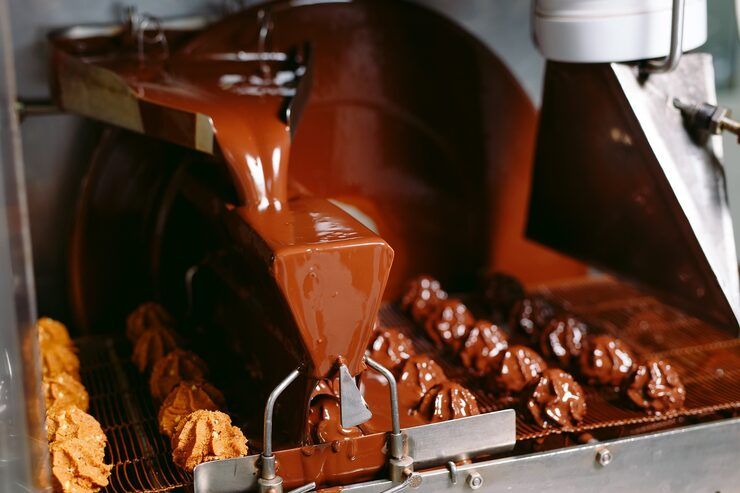
For businesses exploring confectionery processing equipment, understanding how chocolate coating systems work is useful before selecting a machine or planning a production line. The right equipment depends on product characteristics, desired coating thickness, production volume, chocolate formulation, and the level of automation required.
This guide explains the basic operating principles, major components, machine types, process stages, quality considerations, and maintenance requirements associated with modern chocolate coating equipment.
What Are Chocolate Coating Machines?
Chocolate coating machines are industrial food-processing systems designed to cover food products with a controlled layer of chocolate or compound coating. Depending on the equipment configuration, products can be partially coated, fully enrobed, bottom-coated, or decorated with chocolate.
Unlike manual coating methods, automated equipment provides controlled product movement and more consistent chocolate application. This makes the technology particularly useful when manufacturers need repeatable results across larger production batches.
A typical chocolate coating system may include:
- Chocolate melting and tempering equipment
- Product feeding mechanisms
- Coating or enrobing sections
- Chocolate circulation pumps
- Wire-mesh conveyor systems
- Blowers for controlling excess coating
- Cooling tunnels
- Temperature monitoring systems
- Chocolate collection and filtration components
The exact configuration varies according to the product and production requirements.
How Chocolate Coating Equipment Works
The coating process generally begins with preparing chocolate at the appropriate temperature and consistency. The chocolate must remain within a controlled temperature range throughout processing because temperature affects viscosity, flow, appearance, setting behavior, and final texture.
Products are then introduced onto a conveyor and transported through the coating area. Chocolate flows over the product while additional chocolate may be applied from below. This creates a continuous coating around the product.
After coating, controlled air movement can remove excess chocolate and help regulate coating thickness. The coated products then travel through a cooling tunnel where the chocolate gradually sets.
The basic process can therefore be summarized as:
- Product feeding
- Chocolate preparation
- Chocolate application
- Excess coating removal
- Cooling and setting
- Product discharge
Modern systems automate many of these stages to improve consistency and reduce manual handling.
Understanding Chocolate Enrobing
Chocolate enrobing is one of the most common applications of industrial coating equipment. During enrobing, a product passes through a curtain or flow of chocolate that covers its upper and side surfaces. Chocolate may also be applied to the bottom through a coating section beneath the product.
The result is a continuous chocolate shell surrounding much of the product.
Enrobing equipment can be used for products including:
- Biscuits
- Wafer products
- Snack bars
- Cakes
- Cookies
- Nuts
- Confectionery centers
- Filled products
The coating thickness can often be adjusted according to product requirements and machine configuration.
Key Components of Chocolate Coating Machines
Understanding the main components makes it easier to evaluate how different systems perform.
Chocolate Melting and Tempering System
Chocolate needs controlled heating and, in many applications, tempering before coating. Tempering helps establish the appropriate crystal structure in chocolate, contributing to a smooth appearance, good snap, and stable finished coating.
Coating Section
The coating section distributes chocolate across the moving products. Pumps and circulation systems help maintain a continuous supply of coating material.
Conveyor
A food-grade conveyor transports products through each processing stage. Conveyor speed can influence coating thickness, throughput, and the time products spend in different sections.
Blower System
Air blowers help remove excess chocolate from coated products. Adjusting airflow can influence coating thickness and surface appearance.
Cooling Tunnel
The cooling tunnel provides controlled cooling after coating. Proper temperature management helps the chocolate solidify gradually and reduces problems such as uneven surfaces or undesirable texture.
Control System
Modern machines commonly include digital controls for monitoring temperature, conveyor speed, pump operation, airflow, and other process parameters.
Types of Chocolate Coating Equipment
Chocolate coating equipment can be configured for different production needs.
Enrobing Machines
Enrobers are designed for continuous coating of products moving along a conveyor. They are widely used for biscuits, wafers, bars, and similar confectionery products.
Bottom Coaters
Bottom-coating systems apply chocolate primarily to the underside of products. They may be used independently or as part of a larger coating system.
Decorating Systems
Some coating lines incorporate decorating equipment that creates stripes, patterns, lines, or other chocolate designs on product surfaces.
Compact Coating Systems
Smaller systems may be designed for limited production environments, product development, specialty confectionery, or applications where production flexibility is more important than maximum throughput.
Factors That Influence Coating Quality
Achieving a consistent chocolate coating depends on more than the coating machine itself. Several process variables must work together.
Chocolate Temperature
Temperature directly affects chocolate viscosity and flow. Inconsistent temperature can result in uneven coating, poor appearance, or processing difficulties.
Coating Thickness
The desired chocolate layer depends on the product and formulation. Conveyor speed, chocolate flow, air movement, and product characteristics can influence thickness.
Product Shape
Flat biscuits, irregular nuts, filled centers, and rounded products interact differently with flowing chocolate. Machine configuration should therefore match the geometry of the product.
Cooling Conditions
Cooling must be controlled carefully. Excessively rapid or uneven cooling can affect surface quality and chocolate stability.
Chocolate Formulation
Different chocolate types and compound coatings can have different flow characteristics. Equipment settings may need adjustment when formulations change.
Benefits of Automated Chocolate Coating
Automation provides several process advantages for commercial confectionery production.
Consistent Application
Automated systems can apply coating more uniformly than manual processes when operating under properly controlled conditions.
Improved Process Control
Digital monitoring allows operators to observe important parameters and make adjustments during production.
Reduced Manual Handling
Continuous conveyors and automated coating systems reduce the amount of direct product handling required during processing.
Better Production Continuity
Continuous coating systems can support steady production and integration with upstream and downstream equipment.
Repeatability
Once suitable operating parameters are established, automated equipment can help reproduce similar coating results across production runs.
Hygiene and Food Safety Considerations
Because chocolate coating machines process food products, hygienic design is essential.
Important considerations include:
- Food-grade contact surfaces
- Accessible cleaning areas
- Appropriate drainage
- Removable components where practical
- Controlled product handling
- Proper sanitation procedures
- Prevention of chocolate buildup
Regular cleaning is particularly important because residual chocolate can accumulate around conveyors, pumps, nozzles, and other processing components.
Manufacturers should follow appropriate food-safety procedures and equipment-specific cleaning instructions.
Maintenance of Chocolate Coating Equipment
Routine maintenance helps preserve reliable operation and consistent coating quality.
Maintenance activities may include:
- Checking pumps and motors
- Inspecting conveyor components
- Monitoring temperature sensors
- Cleaning chocolate circulation paths
- Checking blowers
- Inspecting belts and chains
- Examining seals and moving components
- Verifying control-system operation
Preventive maintenance can also help identify developing mechanical or electrical problems before they interfere with production.
Selecting Chocolate Coating Equipment
Choosing suitable chocolate coating equipment requires an understanding of the complete production process rather than focusing on a single machine specification.
Important considerations include:
- Product dimensions and shape
- Required coating type
- Desired coating thickness
- Production capacity
- Chocolate formulation
- Conveyor configuration
- Cooling requirements
- Available floor space
- Automation level
- Cleaning requirements
- Integration with other equipment
A machine intended for one product category may not provide the same results for another. Product trials and technical evaluation can therefore be valuable when determining the appropriate configuration.
Future Developments in Chocolate Coating Technology
Chocolate processing continues to move toward greater automation, precision, and resource efficiency.
Future developments are likely to emphasize:
- More precise temperature control
- Automated process adjustment
- Improved energy efficiency
- Advanced production monitoring
- Reduced chocolate waste
- Easier cleaning
- Digital production records
- Flexible equipment configurations
- Improved integration with complete confectionery lines
Data monitoring and automation may increasingly help operators identify process variations and maintain consistent production conditions.
Frequently Asked Questions
What are chocolate coating machines used for?
Chocolate coating machines apply controlled layers of chocolate or compound coating to products such as biscuits, wafers, bars, cakes, cookies, nuts, and confectionery centers.
What is a chocolate enrober?
A chocolate enrober is a machine that passes products through a controlled chocolate flow or curtain to cover their surfaces with a consistent coating.
Why is chocolate tempering important?
Tempering helps establish a stable chocolate crystal structure, which can improve the finished coating's appearance, texture, stability, and snap.
What affects chocolate coating thickness?
Coating thickness can be influenced by chocolate viscosity, temperature, conveyor speed, chocolate flow, product shape, and air-blower settings.
How should chocolate coating machines be maintained?
Routine maintenance generally includes cleaning food-contact areas, inspecting conveyors and pumps, checking temperature-control components, and following the equipment manufacturer's maintenance procedures.
Conclusion
Chocolate coating machines have become an important part of modern confectionery processing because they provide controlled, repeatable, and efficient chocolate application. From melting and tempering through coating, excess removal, and cooling, each stage contributes to the quality of the finished product.
Understanding the relationship between chocolate characteristics, machine configuration, temperature control, conveyor movement, airflow, and cooling conditions is essential when evaluating chocolate coating equipment. With appropriate equipment selection, hygienic practices, preventive maintenance, and careful process control, manufacturers can create consistent coated products while adapting production systems to changing product requirements.
As confectionery manufacturing becomes increasingly automated, chocolate coating technology is expected to continue developing around precision, flexibility, efficiency, digital monitoring, and improved process control.