
Distillation equipment separates components in a liquid mixture by using differences in volatility and boiling behavior. It is widely used in chemical processing, petroleum refining, pharmaceutical production, food manufacturing, water treatment, and industrial solvent recovery. Depending on the application, distillation can purify liquids, recover useful chemicals, concentrate solutions, or separate mixtures into several fractions.
The process generally involves heating a liquid mixture to produce vapor and then cooling that vapor to form a liquid again. Because different substances vaporize more readily under particular conditions, the vapor may contain a different proportion of components than the original mixture. Repeated vaporization and condensation can improve separation when the equipment and operating conditions are suitable.
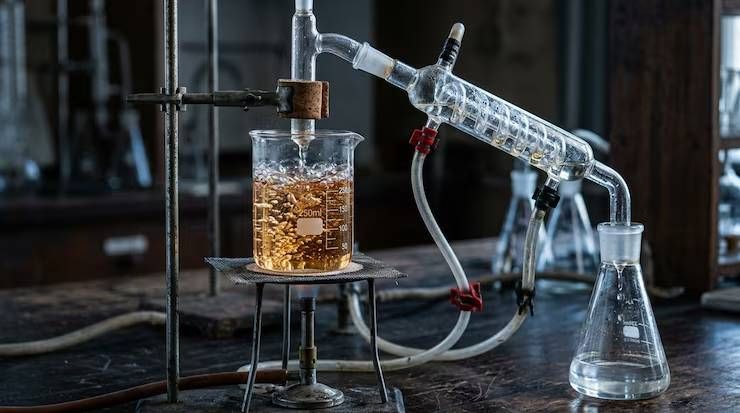
Industrial distillation systems range from simple batch units to large continuous processing plants. Their design depends on the mixture being separated, the required product purity, operating pressure, temperature sensitivity, production capacity, and safety requirements.
How distillation works
Distillation relies on vapor-liquid equilibrium, which describes how components distribute between liquid and vapor phases under specified conditions. A component with greater volatility generally becomes more concentrated in the vapor, although the actual separation depends on the properties of the mixture.
A basic distillation system contains several essential components:
Feed vessel: Holds the liquid mixture before processing.
Reboiler or heating system: Supplies the thermal energy required to vaporize part of the mixture.
Distillation column: Provides contact between rising vapor and descending liquid in many industrial systems.
Condenser: Removes heat from vapor to convert it into liquid.
Reflux system: Returns some condensed liquid to the column to improve separation.
Receiver or storage vessel: Collects the separated product.
Control instruments: Monitor temperatures, pressures, flow rates, and liquid levels.
Not every distillation unit contains all these components. Simple batch systems may use a heated vessel, condenser, and receiver, while complex industrial installations may include multiple columns, vacuum equipment, pumps, and automated control systems.
Main Distillation Technologies
Different distillation technologies are designed to handle particular separation challenges. The choice depends on how easily the mixture separates, whether its components are sensitive to heat, and the purity and throughput required.
Simple distillation
Simple distillation is used when the components have sufficiently different volatility or when a volatile liquid must be separated from dissolved, nonvolatile substances. The mixture is heated, the vapor passes through a condenser, and the condensed liquid is collected separately.
This technique is used in laboratory work, solvent recovery, and certain water purification processes. It is generally less suitable for separating liquids with similar boiling behavior.
Fractional distillation
Fractional distillation separates mixtures containing multiple volatile components, including substances with relatively close boiling points. The column contains trays, structured packing, or random packing that promotes repeated contact between vapor and liquid.
As vapor rises and liquid flows downward, components redistribute between the two phases. This repeated interaction allows the column to produce different fractions at selected heights. Petroleum refineries use fractional distillation to separate crude oil into streams with different boiling ranges.
Vacuum distillation
Vacuum distillation operates at a pressure below atmospheric pressure. Lower pressure reduces the temperature at which a liquid boils, making the technique useful for heat-sensitive materials or substances with high normal boiling points.
It is used in petroleum refining, specialty chemical processing, and the purification of certain oils and chemical compounds. Vacuum systems require suitable seals, pressure controls, and equipment designed to withstand the operating conditions.
Steam distillation
Steam distillation introduces steam into a system containing materials that may be difficult to distill at their normal boiling temperatures. It is commonly used to extract essential oils and separate certain heat-sensitive organic compounds.
The process depends on the behavior of the substances in the presence of steam. It is not suitable for every mixture, and the resulting condensate may require additional separation or purification.
Short-path and molecular distillation
Short-path distillation minimizes the distance vapor travels between the evaporating surface and the condenser. Molecular distillation is a specialized high-vacuum technique used for selected materials that are sensitive to heat or have very low volatility.
These methods are applied in certain specialty chemical, oil, and pharmaceutical-related processes. Their operation requires careful control of pressure, temperature, residence time, and surface conditions.
Batch and continuous distillation
Distillation systems can also be classified by how material moves through the process.
Batch distillation: A fixed quantity of feed is processed during a defined operating cycle. It is suitable for varied formulations, smaller production runs, and some specialty chemicals.
Continuous distillation: Feed enters and product streams leave the equipment during ongoing operation. It is common in large-scale chemical plants and refineries where steady production is required.
The choice between batch and continuous operation depends on production volume, product variation, process stability, and the required separation sequence.
Distillation Equipment Types and Their Applications
Industrial distillation systems combine several equipment types to perform heating, vapor-liquid contact, condensation, separation, and product collection.
Equipment type | Main function | Typical application |
|---|---|---|
Packed column | Provides vapor-liquid contact through packing | Chemical separation and solvent recovery |
Tray column | Uses trays to promote contact between vapor and liquid | Petroleum refining and chemical processing |
Reboiler | Supplies heat to the column's liquid stream | Continuous distillation systems |
Condenser | Converts vapor into liquid by removing heat | Product collection and reflux generation |
Vacuum distillation unit | Enables operation at reduced pressure | High-boiling or heat-sensitive materials |
Batch still | Processes a charge of liquid mixture | Specialty chemicals and laboratory production |
Thin-film evaporator or distillation unit | Spreads liquid into a thin film for heat transfer | Concentration and selected high-viscosity materials |
Packed columns and tray columns
Packed columns contain materials arranged to provide a large surface area for contact between vapor and liquid. Packing may be structured into ordered shapes or loaded as individual pieces. These columns are often used where pressure drop, separation efficiency, and liquid distribution are important design considerations.
Tray columns use internal plates or trays to support vapor-liquid interaction. Their performance depends on factors such as tray design, vapor flow, liquid flow, and column diameter. Both packed and tray columns can be used in a variety of industrial separation processes.
Reboilers, condensers, and auxiliary equipment
Reboilers transfer heat into the liquid at the bottom of a column, generating vapor that rises through the separation section. Condensers remove heat from overhead vapor, allowing liquid collection and reflux return.
Auxiliary equipment may include feed pumps, heat exchangers, storage tanks, vacuum pumps, cooling systems, instrumentation, and automated control panels. These components must be compatible with the process fluids and the pressure and temperature conditions.
Manufacturing Processes for Distillation Equipment
Manufacturing distillation equipment involves mechanical fabrication, material selection, precision assembly, and testing. The production method depends on the unit's dimensions, design pressure, operating temperature, process fluid, and applicable engineering standards.
Material selection
Stainless steel is widely used in chemical and food-processing equipment because certain grades provide corrosion resistance and can support hygienic design requirements. Carbon steel may be suitable for some industrial applications, while nickel alloys and other specialized materials may be selected for demanding chemical or temperature conditions.
Material selection considers corrosion, erosion, thermal expansion, pressure loading, and compatibility with the process mixture. Material certificates and traceability records may be required for regulated or safety-critical installations.
Fabrication and assembly
The manufacturing process commonly includes several stages:
Engineering design: Engineers determine vessel dimensions, column internals, operating conditions, and mechanical requirements.
Cutting and forming: Metal plates, pipes, and structural sections are cut, rolled, bent, or otherwise shaped into the required components.
Welding and joining: Qualified fabrication procedures are used to assemble vessels, piping, supports, and other components.
Internal installation: Trays, packing supports, distributors, and other column internals are fitted according to the design.
Surface finishing: Surfaces may undergo cleaning, polishing, pickling, passivation, or other treatments appropriate to the material and application.
Inspection and testing: Welds, dimensions, pressure boundaries, and operating systems are examined according to the applicable design and inspection requirements.
The finished equipment may also undergo instrumentation installation, insulation, control-system integration, and factory acceptance testing before delivery to the plant.
Quality control and equipment verification
Quality control helps establish whether the equipment meets its specified requirements. Depending on the design, verification may include dimensional inspection, weld examination, material checks, pressure testing, leak testing, and functional testing of instruments.
Pressure testing must follow the applicable engineering code and approved procedure. The test method, pressure level, and acceptance criteria depend on the equipment classification and design. Commissioning at the installation site may involve checking piping connections, control loops, utilities, alarms, and operating sequences.
Industrial Applications of Distillation
Distillation is used wherever liquid mixtures need to be separated, purified, or processed according to differences in volatility.
Major industries
Petroleum refining: Atmospheric and vacuum distillation separate crude oil into fractions that can undergo further processing. These fractions have different boiling ranges and serve as feedstocks for downstream operations.
Chemical manufacturing: Distillation separates solvents, purifies chemical intermediates, and recovers selected compounds from process mixtures.
Pharmaceutical production: Specialized distillation systems can purify solvents, recover processing liquids, and support certain manufacturing steps. Equipment design must reflect applicable contamination-control and product-quality requirements.
Food and beverage processing: Distillation is used in applications such as flavor extraction, aroma recovery, and the concentration or separation of selected liquid components.
Essential oil production: Steam distillation is commonly used to extract volatile aromatic compounds from suitable plant materials.
Water treatment: Distillation can separate water from dissolved salts and other nonvolatile substances. Thermal desalination systems use this principle, although energy demand and equipment design influence their suitability.
Industrial solvent recovery: Distillation can separate and recover usable solvents from selected waste or process streams, subject to mixture composition and applicable environmental and safety requirements.
Operational challenges
Distillation performance can be affected by several factors:
Fouling and deposits that reduce heat transfer or restrict flow.
Corrosion that damages wetted surfaces and pressure boundaries.
Excessive pressure drop through columns and internal components.
Unstable feed composition or changing operating conditions.
High energy demand for heating, cooling, and vaporization.
Foaming, flooding, or poor liquid distribution within columns.
Operators manage these issues through process monitoring, suitable equipment design, preventive maintenance, and operating procedures. Energy integration, heat recovery, and improved process control can also help reduce unnecessary thermal demand.
Recent Developments in Distillation Technology
Distillation equipment continues to evolve through process automation, energy integration, advanced materials, and improved monitoring. Developments across 2024–2026 reflect growing attention to efficient operation, product consistency, and the recovery of useful materials from industrial streams.
Automation and digital monitoring
Modern distillation plants use sensors and control systems to monitor temperature, pressure, liquid levels, flow rates, and product composition. Automated controls can adjust heating, reflux, and feed conditions to maintain the required operating range.
Digital monitoring systems can also help identify abnormal pressure changes, unstable column operation, and equipment deterioration. Their effectiveness depends on accurate instruments, reliable process data, and appropriate operating procedures.
Energy efficiency and process integration
Distillation can require substantial thermal energy because it involves vaporization and condensation. Heat integration allows energy from one process stream to support another heating requirement, while improved column design can reduce unnecessary energy use under suitable conditions.
Research and industrial development also examine hybrid separation systems that combine distillation with membrane separation, adsorption, or other technologies. These arrangements may be appropriate when conventional distillation alone has limitations.
Laws, Standards, and Safety Requirements
Distillation equipment may be subject to requirements covering pressure vessels, boilers, hazardous chemicals, workplace safety, electrical systems, emissions, and waste handling. The applicable rules depend on the equipment's design, process materials, installation location, and industrial sector.
Regulatory considerations in India
In India, manufacturers and plant operators must identify applicable factory safety requirements, environmental approvals, and pressure equipment regulations. Depending on the installation, relevant requirements may involve the Boilers Act, 2025, applicable pressure equipment provisions, the Petroleum Act, 1934, or rules governing hazardous chemicals and industrial emissions.
Not every distillation column is classified as a boiler or falls under the same regulatory category. Equipment classification and the applicable legal requirements must be established for the specific installation.
Common technical standards
ASME Boiler and Pressure Vessel Code: Relevant to specified pressure equipment and associated construction requirements.
API 520 and API 521: Address pressure-relieving devices and overpressure protection in applicable petroleum and process-industry installations.
ISO 9001: Provides requirements for quality management systems.
IEC 61511: Addresses safety instrumented systems used in the process industries.
Standards may be required by regulations, contracts, or project specifications, or adopted as part of an organization's engineering practices. Compliance depends on the applicable edition, equipment scope, and jurisdiction.
Tools and Resources for Distillation Systems
Engineers and plant operators use technical tools to design, evaluate, and monitor distillation processes.
Process simulation software: Models vapor-liquid equilibrium, column performance, material balances, and energy requirements.
Equipment sizing tools: Help estimate column dimensions, condenser duty, reboiler duty, and other design parameters.
Analytical instruments: Chromatography and other composition-measurement techniques help determine whether separated products meet specified purity requirements.
Process monitoring systems: Track operating variables and support troubleshooting, performance assessment, and production records.
Engineering documentation: Equipment datasheets, piping and instrumentation diagrams, operating procedures, inspection records, and maintenance schedules help support safe and consistent plant operation.
Frequently Asked Questions
What is distillation equipment used for?
Distillation equipment separates liquid mixtures based on differences in volatility. It is used in chemical manufacturing, petroleum refining, solvent recovery, pharmaceutical processing, essential oil extraction, and water treatment.
What is the difference between batch and continuous distillation?
Batch distillation processes a fixed quantity of material during each operating cycle. Continuous distillation receives feed and removes product streams during ongoing operation, making it suitable for many large-scale industrial processes.
Which materials are used to manufacture distillation equipment?
Common materials include stainless steel and carbon steel, with specialized alloys selected for particular corrosive or high-temperature conditions. The selection depends on fluid chemistry, pressure, temperature, and applicable design requirements.
How does vacuum distillation work?
Vacuum distillation lowers the operating pressure, allowing a liquid to boil at a lower temperature than it would under atmospheric pressure. This is useful for certain high-boiling or heat-sensitive materials.
How can industrial distillation energy consumption be reduced?
Potential approaches include heat integration, suitable column design, improved insulation, optimized operating conditions, and recovery of heat from process streams. The results depend on the mixture, plant configuration, and operating requirements.
Conclusion
Distillation equipment separates and purifies liquid mixtures across chemical processing, petroleum refining, pharmaceuticals, food production, and other industries. Simple, fractional, vacuum, and steam distillation methods address different separation requirements. Equipment performance depends on appropriate engineering design, material selection, process control, maintenance, and compliance with applicable safety requirements. Automation and energy integration continue to shape the development of industrial distillation systems.