Dough kneading machines are food-processing machines designed to mix and knead flour, water, yeast, fats, salt, and other ingredients into a consistent dough.
They are widely used in bakeries, restaurants, food-production units, hotels, and other commercial kitchens where dough preparation is repeated at different scales.
The main purpose of a dough kneading machine is to reduce manual effort while producing more consistent mixing and kneading. Depending on the design, machines can handle different dough types, batch sizes, and production requirements.
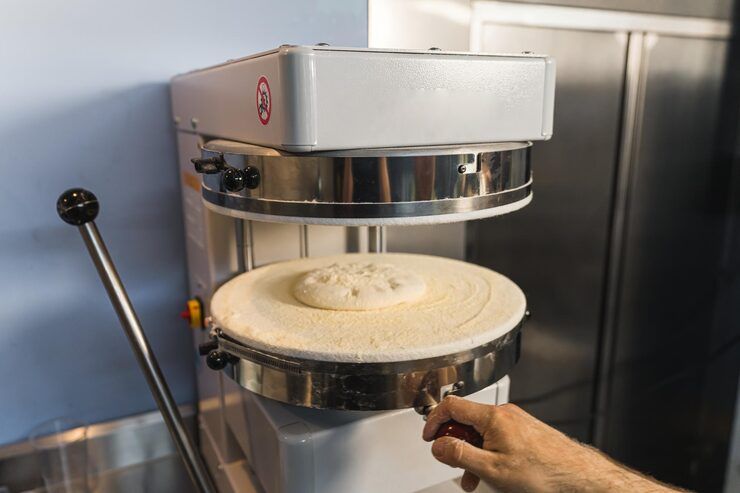
Traditional dough preparation involves combining ingredients and working the mixture by hand. While this method remains useful for small batches, mechanical kneading provides controlled movement and repeatability.
Common machine configurations include:
- Spiral dough mixers: Use a spiral-shaped hook and rotating bowl to develop dough efficiently.
- Planetary mixers: Use interchangeable attachments and are suitable for several bakery and food-preparation tasks.
- Horizontal dough mixers: Have a horizontal mixing chamber and are commonly used for larger dough batches.
- Twin-arm mixers: Use two mixing arms to replicate certain hand-kneading movements.
- Automatic dough kneading machines: Integrate programmed mixing or timed operating functions for repeatable production.
The appropriate design depends on the dough formulation, batch size, hydration level, mixing time, available floor space, and production process.
Why Dough Kneading Machines Matter
Consistency is one of the main reasons mechanical kneading is important in modern food production. Dough properties can change when ingredients are mixed for different durations or when manual pressure varies between batches.
A controlled kneading process can help food businesses manage:
- Mixing and kneading consistency
- Batch-to-batch uniformity
- Production scheduling
- Operator workload
- Dough development
- Ingredient distribution
- Workplace organization
- Repeatability across multiple batches
For bakeries producing bread, pizza bases, buns, rolls, pastries, or other yeast-based products, consistent dough preparation can influence later stages such as fermentation, shaping, proofing, and baking.
The equipment also affects hygiene practices. Food-contact surfaces should be designed and maintained so that they can be cleaned effectively. Flour accumulation, dough residue, moisture, and poorly maintained components can create sanitation challenges.
Main Selection Factors
When evaluating an industrial dough mixer or commercial dough kneading machine, several technical characteristics are relevant.
| Factor | Why it matters |
|---|---|
| Batch capacity | Determines the quantity of dough processed in one cycle |
| Mixing mechanism | Influences kneading action and dough development |
| Motor capacity | Affects the machine's ability to handle demanding dough formulations |
| Bowl design | Influences loading, unloading, and cleaning |
| Speed control | Allows different mixing stages where supported |
| Safety features | Helps reduce exposure to moving components |
| Food-contact materials | Supports hygienic food production |
| Cleaning access | Influences routine sanitation procedures |
| Control system | Determines how timing and operating functions are managed |
Capacity should not be considered independently. A machine may have a particular bowl volume, but the practical dough load depends on flour characteristics, hydration, formulation, and the manufacturer's operating specifications.
Recent Developments and Trends
The dough-processing sector is increasingly influenced by automation, food-safety expectations, energy awareness, and improved process control. Recent developments do not necessarily mean that every bakery requires advanced automation. Instead, the trend is toward equipment that can provide predictable operation while fitting into existing food-production workflows.
In India, regulatory activity has also continued during 2025 and 2026. The Bureau of Indian Standards maintains IS 14366:1996, Food Processing Machinery — Dough Mixers — Safety and Hygiene Requirements. BIS records show that the standard was reviewed in 2024 and remains a relevant reference for dough mixers, with certification listed as voluntary.
BIS also continued updating and reviewing standards for food-related electrical equipment during 2025. For example, IS 4250:2025 covers electric food mixers, liquidizers, grinders, and centrifugal juicers, illustrating continued standards activity around electrical food-processing equipment.
FSSAI activity has also remained significant. During 2026, the authority published several notifications affecting food businesses, including updates relating to licensing and registration regulations and laboratory procedures.
Another continuing trend is greater attention to food-safety training. FSSAI's FoSTaC programme continued training-related activities throughout 2025–26, including quarterly training-of-trainers programmes and additional programme notices during 2026.
These developments indicate that modern dough-processing equipment is increasingly considered as part of a wider food-safety and production system rather than as an isolated machine.
Laws, Standards, and Policies in India
Dough kneading machines used in Indian food businesses are affected by several layers of food-safety, hygiene, electrical-safety, and machinery standards.
The Food Safety and Standards Authority of India (FSSAI) administers regulations under the Food Safety and Standards Act, 2006. Its regulatory framework includes the Food Safety and Standards (Licensing and Registration of Food Businesses) Regulations, 2011 and related hygiene requirements.
For equipment specifically, IS 14366:1996 is an important Indian Standard covering safety and hygiene requirements for bakery and pastry dough mixers with rotating bowls. BIS identifies the standard as voluntary.
Food businesses should also consider Schedule 4 hygiene requirements under the applicable FSSAI framework. FSSAI's Hygiene Rating Scheme states that participating bakery businesses must maintain an active FSSAI licence or registration and follow Schedule 4 requirements.
Food-safety training is another relevant policy area. FSSAI states that food businesses holding Central or State licences should have at least one trained and certified Food Safety Supervisor for every 25 food handlers, or part thereof, on their premises.
For equipment manufacturers and users, the practical lesson is that machine safety, hygienic design, electrical safety, cleaning procedures, operator training, and food-business compliance should be considered together. Applicable requirements can vary according to the machine type and the nature of the food operation.
Useful Tools and Resources
Several official resources can help businesses and technical teams understand requirements related to dough kneading machines and food production.
- BIS Standards Portal: Useful for searching Indian Standards by product name or IS number. BIS states that its Know Your Standard platform provides access to standard information, amendments, testing details, and related documentation.
- FSSAI Regulations: Provides the current regulatory framework for food businesses, including licensing, hygiene, and product-related requirements.
- FSSAI FoSTaC: Supports food-safety training and certification for food business personnel.
- FSSAI Hygiene Rating: Provides information about hygiene requirements and assessment for eligible food establishments, including bakeries.
- Production worksheets: Batch records can track flour quantity, water ratio, mixing duration, dough temperature, and fermentation conditions.
- Maintenance checklists: Routine checklists can help monitor cleaning, lubrication where applicable, electrical inspection, guards, switches, and unusual vibration or noise.
Frequently Asked Questions
What is a dough kneading machine?
A dough kneading machine is mechanical food-processing equipment that mixes and kneads ingredients to produce a uniform dough. Different models use spiral hooks, horizontal paddles, twin arms, or planetary mixing systems.
Which industries use dough kneading machines?
They are commonly used in bakeries, restaurants, hotels, institutional kitchens, pizza production, food-processing facilities, and other operations that prepare dough in repeated batches.
What is the difference between a spiral mixer and a planetary mixer?
A spiral mixer is primarily designed for dough mixing and kneading, using a spiral hook and bowl movement. A planetary mixer uses a rotating attachment and can perform several functions, depending on the attachment and machine design.
Are dough kneading machines covered by Indian Standards?
Yes. BIS lists IS 14366:1996 for food-processing machinery, specifically dough mixers and their safety and hygiene requirements. BIS currently identifies this standard as voluntary.
How should a dough kneading machine be maintained?
Routine maintenance should follow the manufacturer's instructions and applicable workplace procedures. Operators should clean food-contact areas, inspect guards and controls, check for unusual noise or vibration, and ensure that the machine is isolated from power before maintenance that requires access to moving parts.
Conclusion
Dough kneading machines have become an important part of organized bakery and food-production operations because they provide a controlled method for mixing and developing dough. Their value extends beyond reducing manual kneading: consistent processing can support predictable production, standardized workflows, and better process control.
Choosing an industrial dough mixer requires attention to dough formulation, batch requirements, mixing mechanism, safety features, food-contact surfaces, cleaning access, and control systems. Regulatory considerations are equally important in India, particularly FSSAI food-safety requirements and relevant BIS standards.
As food production becomes more focused on consistency, hygiene, traceability, and controlled processing, dough kneading equipment is likely to remain an important component of modern bakery equipment and food-processing machinery.