Electronic parts are the building blocks that allow modern devices to sense, process, control, store, and transfer electrical energy and information. From a simple circuit board to sophisticated industrial equipment, different electronic parts work together to perform specific electrical functions.
As electronic systems become more compact and capable, understanding individual components has become increasingly useful. Circuit designers, technicians, engineers, students, and equipment users often need to recognize how components interact rather than viewing a circuit board as a collection of unrelated pieces.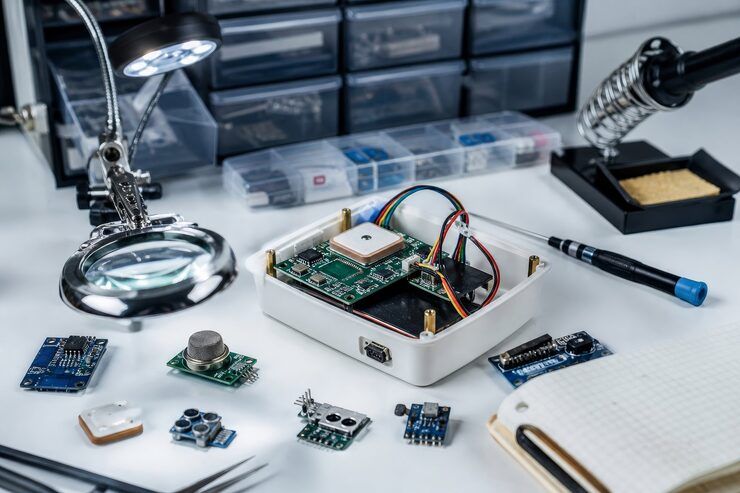
Understanding the purpose of common electronic parts makes it easier to follow circuit operation, identify component roles, interpret schematics, and understand why particular components are selected. It also provides a foundation for learning how complete electronic systems function.
How Electronic Parts Work Together
An electronic system rarely depends on one component alone. A circuit typically combines components that control current, regulate voltage, process signals, store electrical energy, or connect different sections of the system.
The behavior of a circuit depends on the relationship between these components. A resistor may limit current, while a capacitor stores and releases electrical energy. A semiconductor device may control the flow of current or process an electrical signal.
Components can also be grouped according to their function. Some primarily manage electrical energy, while others perform switching, amplification, sensing, communication, or computational tasks.
This functional approach is often more useful than memorizing component names because it helps explain why a particular part exists within a circuit.
Passive Components and Their Roles
Passive components generally do not provide electrical gain or perform active amplification. They are nevertheless essential because they shape voltage, current, timing, filtering, and energy storage within electronic circuits.
Resistors
Resistors oppose the flow of electrical current. Their resistance is measured in ohms, and their value determines how strongly they limit current under a given voltage.
Resistors are commonly used for current limiting, voltage division, signal conditioning, biasing, and protecting other components. Their physical characteristics also matter because resistors have power ratings that determine how much heat they can safely dissipate.
Different resistor technologies are available for different applications. Fixed resistors provide a defined resistance, while variable resistors allow resistance to be adjusted.
Capacitors
Capacitors store electrical energy in an electric field and can release that energy when circuit conditions change. Their capacitance is measured in farads, although practical electronic components commonly use microfarad, nanofarad, or picofarad values.
Capacitors are frequently found in power supplies, filtering circuits, timing networks, signal coupling stages, and energy-storage applications. Their voltage rating, capacitance, tolerance, and construction type all influence where they can be used.
Inductors
Inductors store energy in a magnetic field when current passes through them. They resist rapid changes in current and are particularly important in power conversion and filtering circuits.
Inductors appear in switching power supplies, radio-frequency circuits, electromagnetic filtering, and energy-storage systems. Their characteristics include inductance, current rating, resistance, and magnetic behavior.
Semiconductor Components Control Electronic Behavior
Semiconductors form the foundation of many modern electronic systems. Unlike simple passive components, semiconductor devices can switch, rectify, amplify, regulate, detect, and process electrical signals.
Diodes
A diode primarily allows current to flow more readily in one direction than the other. This property makes diodes useful for rectification, reverse-polarity protection, signal detection, voltage regulation, and switching applications.
Different diode types are designed for different functions. Light-emitting diodes, commonly called LEDs, produce light when current passes through them. Zener diodes are commonly used in voltage regulation and reference applications, while photodiodes respond to light.
Transistors
Transistors are semiconductor devices capable of controlling current. They are fundamental to amplification and switching and are used extensively in digital electronics, power electronics, communications, and control systems.
Common transistor families include bipolar junction transistors and field-effect transistors. Metal-oxide-semiconductor field-effect transistors, or MOSFETs, are especially common in digital circuits and power-management applications.
A transistor can operate as a switch or as part of an amplifier. In a digital circuit, enormous numbers of transistors can work together to represent and manipulate binary information.
Integrated Circuits
An integrated circuit, or IC, combines multiple electronic functions within a semiconductor package. Depending on its design, an IC can contain anything from a small number of components to billions of transistors.
Microcontrollers, memory devices, operational amplifiers, voltage regulators, communication interfaces, and processors are examples of integrated circuits. Their high level of integration allows complex electronic functions to be implemented within relatively compact assemblies.
Components Used for Control and Processing
Electronic systems often need to interpret inputs, make decisions, and generate outputs. Several component categories support these functions.
Microcontrollers combine processing capabilities with memory and input/output interfaces on a single integrated circuit. They are commonly used in embedded systems such as appliances, industrial controllers, instruments, automotive electronics, and connected devices.
Microprocessors are designed primarily around computational processing and generally work with additional components such as memory and peripheral interfaces. They are found in systems requiring more substantial computing capability.
Operational amplifiers are another important category. These integrated circuits can amplify and condition analog signals and are used in filtering, measurement, sensor interfaces, and signal-processing circuits.
Sensors Convert Physical Conditions Into Electrical Signals
Many electronic systems need to respond to physical conditions. Sensors provide the interface between the physical environment and electronic circuitry.
Depending on the application, sensors can detect temperature, pressure, light, motion, humidity, acceleration, proximity, or other physical characteristics.
For example, a temperature sensor converts changes in temperature into an electrical signal that another circuit can interpret. A light sensor can respond to changes in illumination, allowing an electronic system to adjust its behavior.
Sensors are particularly important in automation because they allow controllers to obtain information about machines, processes, and surrounding conditions.
Connectors, Switches, and Protection Components
Not every electronic part processes a signal or controls current. Many components provide physical connections or protect circuits from abnormal electrical conditions.
Connectors establish removable or permanent electrical connections between circuit boards, cables, power sources, and other equipment. Their design can vary considerably depending on voltage, current, signal type, environmental conditions, and mechanical requirements.
Switches provide a way to open, close, or redirect an electrical circuit. They can be operated manually or integrated into automated control systems.
Protection components help reduce the effects of electrical disturbances. Fuses, transient-voltage protection devices, and circuit-protection components can help prevent excessive current or voltage from damaging sensitive electronics.
How Component Selection Affects a Circuit
Choosing an electronic part involves more than matching a component name to a circuit diagram. Electrical and physical characteristics must correspond to the requirements of the application.
Important specifications can include:
- Voltage rating
- Current rating
- Power dissipation
- Resistance or capacitance
- Operating temperature
- Tolerance
- Frequency characteristics
- Physical dimensions
- Package type
- Reliability requirements
A component that performs correctly under one set of conditions may not be appropriate under another. For example, a capacitor must have an appropriate voltage rating, while a transistor used for power switching must be able to handle the expected current and thermal load.
Engineers therefore evaluate components within the complete circuit rather than considering specifications in isolation.
Electronic Parts Within a Typical System
A practical electronic system may contain several component categories simultaneously. A power-management section can use capacitors, inductors, diodes, transistors, and voltage regulators to provide appropriate electrical conditions.
A control section might contain a microcontroller, memory, sensors, communication interfaces, and supporting passive components. Meanwhile, connectors and protection devices provide physical integration and electrical safeguards.
The circuit board itself provides conductive pathways between these components. Printed circuit boards, or PCBs, use copper traces, vias, pads, and other structures to establish controlled electrical connections.
This combination of components and interconnections creates the functional architecture of the system. Individual parts are important, but their interaction determines the behavior of the complete circuit.
Why Component Identification Matters
Recognizing electronic parts is useful for circuit analysis, maintenance, troubleshooting, assembly, and technical education. Component markings, package shapes, schematic symbols, and physical characteristics can provide clues about a part's identity and function.
However, physical appearance alone is not always enough. Components with similar packages can have very different electrical characteristics. Part numbers, datasheets, circuit diagrams, and manufacturer specifications provide more reliable information when exact identification is required.
Understanding these details also helps explain common circuit problems. A damaged capacitor, failed semiconductor, overheating resistor, poor connection, or degraded protection component can affect the behavior of an entire electronic system.
Frequently Asked Questions
What are the main categories of electronic parts?
Common categories include passive components, semiconductor devices, integrated circuits, sensors, connectors, switches, and protection components. Each category performs different functions within electronic systems.
What is the difference between passive and active components?
Passive components generally influence electrical energy without providing amplification, while active semiconductor devices can control signals, switch current, or provide amplification. The exact classification can vary depending on the technical context.
Why are capacitors used in electronic circuits?
Capacitors can store and release electrical energy and are widely used for filtering, signal coupling, decoupling, timing, and energy-management functions.
Why are transistors important?
Transistors provide controlled switching and amplification. They are fundamental to digital logic, power electronics, signal processing, and modern computing systems.
How can an electronic component be identified accurately?
Identification can involve examining markings, package characteristics, schematic symbols, circuit position, and manufacturer documentation. For an exact identification, the component's part number and technical specifications are usually more reliable than appearance alone.
Conclusion
Electronic parts work together to create the functions found in everything from basic circuits to complex industrial and computing systems. Resistors, capacitors, inductors, diodes, transistors, integrated circuits, sensors, connectors, and protection devices each contribute distinct electrical or physical capabilities.
Understanding these components becomes much easier when they are considered in terms of their role within a complete circuit. Once their functions, specifications, and interactions are clear, circuit diagrams and electronic systems become more understandable and easier to analyze.