Modern manufacturing depends on a complex combination of machinery, automation, skilled operators, digital systems, and carefully planned production processes.
Factory machines perform essential tasks such as cutting, forming, assembling, packaging, transporting, inspecting, and processing materials. Together, these systems create the foundation of efficient and consistent industrial production.
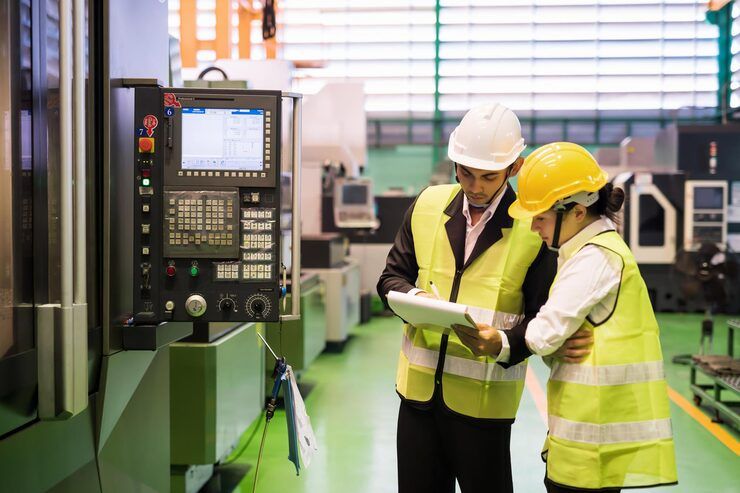
As manufacturing requirements become more precise, factories are increasingly integrating automated controls, sensors, robotics, data monitoring, and connected production equipment. However, modern industrial equipment is not simply about automation. The right machine must also match the material, production process, operating environment, quality requirements, maintenance capabilities, and overall workflow.
This guide explains the role of factory machines, major categories of industrial equipment, how production systems work, and the technologies shaping modern manufacturing.
What Is a Factory Machine?
A factory machine is mechanical, electrical, hydraulic, pneumatic, or computer-controlled equipment designed to perform a specific manufacturing or production task.
Machines may operate independently or as part of a larger production line. Some handle raw materials, while others transform, assemble, inspect, or package finished products.
Common examples include:
- CNC machines
- Industrial presses
- Injection molding machines
- Conveyor systems
- Packaging machines
- Welding equipment
- Industrial robots
- Cutting machines
- Mixing and processing equipment
- Inspection systems
The role of each machine depends on the manufacturing process and the type of product being produced.
How Modern Production Systems Work
A modern factory usually operates as an interconnected production system rather than a collection of independent machines.
A typical production workflow may involve:
- Raw material preparation
- Material processing
- Component manufacturing
- Assembly
- Quality inspection
- Packaging
- Material handling
- Finished-product movement
Each stage affects the next. A problem with one machine can create delays elsewhere in the production line.
This is why factory planning increasingly focuses on workflow coordination, machine synchronization, quality monitoring, and equipment reliability.
Major Types of Industrial Equipment
Industrial equipment covers a broad range of machines, each designed for particular manufacturing requirements.
CNC Machines
Computer numerical control machines use programmed instructions to control machining operations. They are commonly used for cutting, drilling, milling, turning, and other precision manufacturing processes.
Their computerized control allows manufacturers to produce components with consistent dimensions and repeatable machining sequences.
Injection Molding Machines
Injection molding equipment is used to produce plastic components by injecting molten material into a mold.
These systems are widely used for producing components with repeatable shapes and detailed geometries.
Industrial Presses
Press machines apply controlled force to shape, form, compress, or assemble materials. Different press configurations are used for metal forming, stamping, bending, and other manufacturing operations.
Welding Equipment
Industrial welding machines join materials through controlled heat, pressure, or related processes. Automated welding systems can combine robotic movement with carefully controlled welding parameters.
Packaging Machines
Packaging equipment performs tasks such as filling, sealing, labeling, wrapping, and container handling. Automated packaging lines can connect multiple operations into a continuous process.
Material Handling Equipment
Material movement is an important part of factory operations. Materials and components must move between production stages without unnecessary delays or handling risks.
Common material handling systems include:
- Conveyors
- Industrial lifts
- Automated guided vehicles
- Pallet handling systems
- Cranes
- Hoists
- Robotic handling systems
Efficient material handling can help reduce unnecessary movement and improve the overall flow of a manufacturing facility.
The design of the handling system should consider product dimensions, weight, production speed, factory layout, and workplace safety requirements.
Automation in Modern Factory Machines
Automation has transformed industrial production by allowing machines to perform repetitive or precisely controlled tasks with limited manual intervention.
Modern automation may involve:
- Programmable logic controllers
- Industrial robots
- Sensors
- Machine vision
- Automated material handling
- Motion-control systems
- Industrial software
Automation does not necessarily mean eliminating human involvement. Operators, engineers, and technicians remain important for supervision, programming, quality management, maintenance, and decision-making.
The most effective automated production environments typically combine machine capabilities with human expertise.
Smart Manufacturing and Connected Equipment
The development of connected industrial equipment has introduced a new approach to factory management.
Sensors installed on machines can collect information about operating conditions such as temperature, vibration, pressure, speed, and energy consumption.
This information can be analyzed to identify unusual operating patterns and support maintenance planning.
Connected equipment can also provide production data that helps managers understand:
- Machine utilization
- Production throughput
- Downtime
- Quality patterns
- Energy consumption
- Maintenance requirements
This transition from isolated machinery to connected production systems is an important part of modern industrial development.
Quality Control and Inspection Systems
Quality control is closely connected to factory machine performance. Even small variations in machine operation can influence product dimensions, appearance, strength, or consistency.
Modern factories may use automated inspection technologies such as:
- Machine vision
- Dimensional measurement
- Sensor-based inspection
- Automated testing
- Digital monitoring systems
Inspection equipment can identify variations earlier in the production process, allowing manufacturers to investigate problems before they affect larger quantities of products.
Energy Efficiency in Industrial Equipment
Energy consumption is an important consideration when designing and operating manufacturing systems.
Modern factory machines may incorporate variable-speed drives, efficient motors, improved control systems, and energy monitoring technologies.
Factories can also evaluate energy use across an entire production line rather than focusing on individual machines.
Improving energy efficiency can involve:
- Reducing unnecessary machine idle time
- Monitoring energy-intensive processes
- Improving motor control
- Maintaining equipment properly
- Optimizing production schedules
- Identifying inefficient operating conditions
Energy management is increasingly viewed as part of overall production performance.
Maintenance and Machine Reliability
Regular maintenance is essential for keeping industrial equipment operating safely and consistently.
Maintenance approaches generally include preventive, predictive, and corrective activities.
Preventive Maintenance
Scheduled inspections, lubrication, component replacement, cleaning, and calibration can help reduce unexpected equipment problems.
Predictive Maintenance
Sensor data and machine monitoring can help identify changes in operating conditions that may indicate developing equipment problems.
Corrective Maintenance
Corrective work addresses identified equipment faults and restores the machine to appropriate operating condition.
A structured maintenance program should consider manufacturer requirements, operating conditions, machine age, workload, and maintenance history.
Choosing the Right Factory Machine
Selecting industrial equipment requires more than comparing technical specifications.
Important considerations include:
| Factor | Why It Matters |
|---|---|
| Production volume | Determines required machine capacity |
| Material type | Influences machine design and tooling |
| Precision | Defines acceptable manufacturing variation |
| Factory layout | Affects installation and material flow |
| Automation level | Determines operator involvement |
| Maintenance | Influences long-term reliability |
| Safety | Supports responsible machine operation |
| Integration | Determines compatibility with existing systems |
The appropriate choice depends on the specific production environment. A machine designed for high-volume automated production may not be suitable for a facility focused on small batches and frequent product changes.
Common Challenges in Factory Automation
Modern industrial systems can improve production capabilities, but they also introduce technical challenges.
Integration between old and new equipment can be complicated, particularly when machines use different communication standards.
Staff may also require training to operate computerized systems, troubleshoot automation equipment, interpret machine data, and perform specialized maintenance.
Cybersecurity is another consideration for connected factories. As industrial equipment becomes increasingly networked, manufacturers need appropriate controls to protect operational technology and production data.
Successful modernization therefore requires attention to technology, people, processes, and facility infrastructure.
Future Trends in Industrial Equipment
Factory machinery continues to develop as manufacturers pursue greater flexibility, efficiency, and data visibility.
Important trends include:
- Artificial intelligence-assisted inspection
- Collaborative robots
- Digital twins
- Industrial Internet of Things technologies
- Advanced machine vision
- Automated material movement
- Real-time production monitoring
- Predictive maintenance
- Flexible manufacturing systems
- Greater energy monitoring
Future factories are likely to combine physical machinery with increasingly sophisticated software and data systems. This creates production environments capable of responding more quickly to changing requirements while maintaining consistent manufacturing processes.
Frequently Asked Questions
What is a factory machine?
A factory machine is industrial equipment designed to perform a specific manufacturing task, such as machining, forming, assembling, processing, inspecting, or packaging materials.
What are common types of industrial equipment?
Common categories include CNC machines, presses, molding equipment, welding systems, packaging machines, conveyors, robots, inspection systems, and material handling equipment.
How does automation improve manufacturing?
Automation can support repeatable processes, consistent machine operation, faster material movement, automated inspection, and improved production monitoring.
Why is machine maintenance important?
Regular maintenance helps support equipment reliability, operating safety, production consistency, and early identification of developing mechanical or electrical problems.
What is the future of factory machinery?
Future industrial equipment is expected to become increasingly connected, automated, data-driven, flexible, and capable of integrating technologies such as machine vision, artificial intelligence, robotics, and predictive maintenance.
Conclusion
Modern factory machines form the physical foundation of industrial production, while automation, sensors, software, and data systems increasingly determine how effectively those machines operate within a complete manufacturing environment.
Understanding industrial equipment requires looking beyond individual machines and considering the entire production system. Machine capability, material handling, quality control, maintenance, energy management, automation, and workforce expertise all contribute to reliable manufacturing performance.
As factories continue adopting connected technologies and intelligent production systems, the role of industrial equipment will continue to evolve. The future of manufacturing is therefore not simply about more automation, but about creating better-connected, adaptable, efficient, and carefully managed production environments.