Food mixing machines are mechanical systems designed to combine two or more food ingredients into a uniform mixture.
They are used across food processing operations involving dry ingredients, liquids, semi-solid materials, pastes, doughs, sauces, fillings, powders, and other food products.
The basic purpose is straightforward: ingredients need to be distributed consistently throughout a mixture. Manual mixing can be suitable for small quantities, but larger food-processing operations require controlled equipment that can handle repeatable batches and different material characteristics.
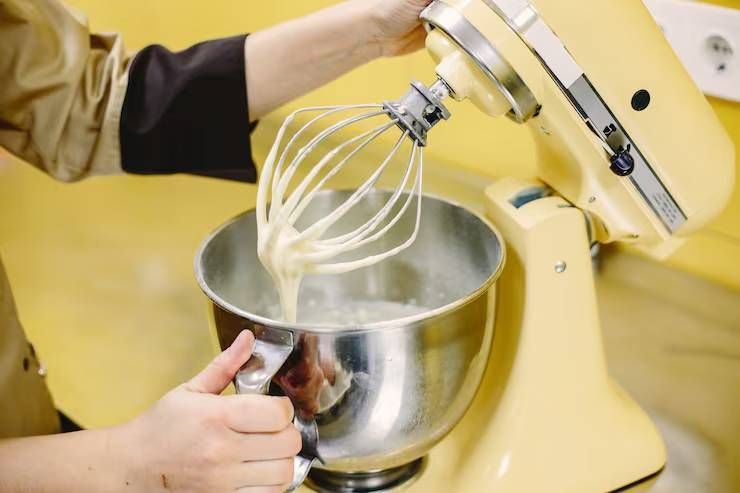
A food mixing machine generally consists of a mixing vessel, motor, drive system, mixing tool, controls, and supporting components. The mixing element may be a paddle, ribbon, blade, agitator, whisk, or another specialized design.
Different products require different mixing actions. For example, a dough mixture may require kneading, while a liquid formulation may need agitation without excessive air incorporation.
Common Types of Food Mixing Machines
Food mixing machines can be classified according to their mixing mechanism, operating method, and the materials they process.
| Machine Type | Typical Application | Main Mixing Action |
|---|---|---|
| Ribbon mixer | Dry powders and granular ingredients | Folding and blending |
| Paddle mixer | Semi-solid and dry mixtures | Gentle agitation |
| Planetary mixer | Doughs, creams and thick mixtures | Multiple-direction mixing |
| High-shear mixer | Emulsions and fine formulations | Intensive dispersion |
| Vertical mixer | Powders and dry ingredients | Vertical circulation |
| Horizontal mixer | Large-volume food formulations | Horizontal blending |
| Liquid mixer | Sauces, beverages and liquid formulations | Agitation |
| Continuous mixer | Large-scale production processes | Continuous blending |
The appropriate design depends on ingredient viscosity, particle size, moisture level, batch volume, desired texture, and the required degree of uniformity.
How Food Mixing Machines Work
The operating principle varies according to the machine, but most systems use mechanical movement to circulate ingredients through a mixing chamber.
Ingredients are introduced into a vessel or processing chamber. A motor transfers mechanical energy to the mixing mechanism. As the blades or agitators move, ingredients are lifted, folded, dispersed, or sheared.
Important operating factors include:
- Mixing speed
- Mixing duration
- Batch volume
- Ingredient sequence
- Temperature
- Moisture content
- Viscosity
- Particle size
- Mixer geometry
- Blade or agitator design
Controlling these variables helps manufacturers produce consistent batches. Excessive mixing, however, can sometimes affect texture, temperature, particle structure, or other product characteristics.
Why Food Mixing Machines Matter
Food mixing equipment plays an important role in modern food manufacturing because consistency is difficult to maintain when large quantities are mixed manually.
The equipment can help standardize the distribution of ingredients and make production processes more repeatable. It can also support hygienic processing when the machine is appropriately designed, installed, cleaned, and maintained.
Food mixing machines are used in many areas, including:
- Bakery and confectionery production
- Dairy and dairy-alternative products
- Sauce and dressing preparation
- Spice and seasoning blends
- Processed meat products
- Snack foods
- Prepared meals
- Nutritional food formulations
- Beverage ingredients
- Powdered food products
The wider food-processing machinery sector is also being influenced by automation, sensor technologies, data analytics, robotics, modular equipment, and sustainability initiatives. A Ministry of Food Processing Industries sector profile published in 2025 identified automation, robotics, advanced sensors, data analytics, and machine learning among major trends affecting food-processing machinery.
Factors That Influence Machine Selection
Selecting appropriate industrial food mixing equipment requires more than considering the size of the mixing vessel. The characteristics of the food itself are particularly important.
Ingredient characteristics: Powders, liquids, viscous pastes, sticky doughs, and fibrous materials behave differently during mixing.
Batch size: Equipment should be appropriate for the quantity being processed. Very small or very large batches can affect mixing performance.
Mixing intensity: Some formulations require gentle blending, while others need high-shear action for dispersion or emulsification.
Temperature control: Certain food formulations require controlled temperatures during processing.
Hygiene requirements: Food-contact surfaces should be suitable for hygienic processing and practical cleaning.
Automation: Modern systems may incorporate programmable controls, sensors, automated ingredient handling, and monitoring systems.
Maintenance: Accessible components and appropriate cleaning procedures can simplify routine inspection and sanitation.
Recent Developments in Food Mixing Technology
Recent developments in food-processing machinery increasingly emphasize automation, data collection, energy efficiency, hygiene, and process control.
The Ministry of Food Processing Industries currently highlights smart and sustainable processing, including AI, IoT, robotics, real-time monitoring, energy-efficient technologies, and reduced water use.
This direction is relevant to food mixing because connected equipment can potentially monitor variables such as speed, temperature, operating time, load, and other process parameters.
Another development is the use of modular and flexible equipment. Food manufacturers may handle a wider variety of formulations, making equipment that can accommodate different recipes and operating conditions increasingly relevant.
Technology trend overview
| Trend | Relevance to Food Mixing |
|---|---|
| Automation | More consistent process control |
| Sensors | Monitoring of operating conditions |
| IoT connectivity | Collection and transmission of process data |
| Robotics | Automated material handling |
| Data analytics | Identification of process patterns |
| Hygienic design | Easier sanitation and contamination control |
| Energy efficiency | Reduction of unnecessary energy consumption |
| Flexible equipment | Support for different formulations |
Recent government activity also shows continued attention to India's broader food-processing infrastructure. In August 2026, the Ministry of Food Processing Industries published guidelines for a refinance scheme supporting food-processing units, while its ongoing programmes include PMKSY and other food-processing infrastructure initiatives.
Indian Laws and Food Safety Requirements
Food mixing machines used in India are part of a wider food-processing environment governed by food-safety requirements. The Food Safety and Standards Authority of India (FSSAI) administers regulations under the Food Safety and Standards Act, 2006. Its regulatory framework covers areas including licensing, food standards, contaminants, packaging, labelling, and other food-safety matters.
For food businesses, hygiene and food-contact considerations are important when operating mixing equipment. Equipment should be appropriate for its intended food-processing environment and managed in accordance with applicable food-safety procedures.
There have also been several recent regulatory updates. FSSAI lists a Food Safety and Standards (Licensing and Registration of Food Businesses) Amendment Regulations, 2026, dated March 2026, along with a further amendment dated June 2026.
In September 2026, FSSAI also notified amendments concerning laboratory and sample-analysis procedures, including timelines, methods of analysis, and testing-report formats.
These changes do not represent a single regulation specifically governing every food mixing machine. Instead, businesses using such equipment need to consider the food-safety regulations applicable to their particular food products and operations.
Useful Tools and Resources
Several official and technical resources can help businesses, engineers, students, and food-processing professionals understand food mixing and related requirements.
- FSSAI Food Laws and Regulations: Useful for checking current food-safety rules, amendments, notifications, and standards.
- Ministry of Food Processing Industries: Provides information on food-processing schemes, infrastructure, technology, reports, and sector developments.
- MoFPI Food Processing Reports: Includes studies on food-processing machinery, infrastructure, logistics, and plants and machinery requirements.
- Mixing calculations: Basic calculations involving batch volume, mixing time, density, and production throughput can help with process planning.
- Equipment maintenance checklists: Useful for recording inspections, cleaning, lubrication where applicable, component checks, and preventive maintenance activities.
- Process-control records: Digital or spreadsheet-based records can help track mixing time, temperature, batch identification, and other relevant parameters.
Frequently Asked Questions
What is a food mixing machine?
A food mixing machine is equipment designed to combine food ingredients into a more uniform mixture. Depending on the machine, it can handle powders, liquids, doughs, pastes, sauces, fillings, and other materials.
What are the main types of food mixing machines?
Common types include ribbon mixers, paddle mixers, planetary mixers, high-shear mixers, vertical mixers, horizontal mixers, liquid mixers, and continuous mixers. Each is designed for particular material and process characteristics.
What factors should be considered when selecting food mixing equipment?
Important factors include ingredient properties, viscosity, particle size, batch quantity, mixing intensity, temperature requirements, cleaning requirements, automation needs, and the desired characteristics of the final product.
Are food mixing machines covered by Indian food-safety regulations?
The machines themselves are not governed by one universal FSSAI rule covering every model. However, food businesses using mixing equipment must comply with applicable food-safety, hygiene, licensing, product, and processing requirements. FSSAI maintains the relevant regulations and amendments.
Is automation becoming more common in food mixing?
Automation is an important trend in food-processing technology. Current industry developments include sensors, IoT systems, robotics, data analytics, and real-time monitoring, with the objective of improving process control and operational efficiency.
Conclusion
Food mixing machines are an important part of modern food-processing equipment. They provide controlled mechanical mixing for a wide range of ingredients and formulations, from dry powders and spices to doughs, sauces, pastes, and liquid products.
The right machine depends on the properties of the ingredients, required mixing action, production scale, hygiene requirements, and process conditions. At the same time, developments in automation, sensors, data analytics, robotics, and sustainable processing are changing how food-processing machinery is designed and operated.
In India, food businesses must also consider applicable FSSAI regulations and maintain appropriate food-safety practices. Because regulations can change, current FSSAI notifications and official Ministry of Food Processing Industries resources are useful references when evaluating food-processing operations and equipment.