Hydraulic press machines are industrial machines that use fluid pressure to generate force for pressing, shaping, forming, compressing, and assembling materials.
They operate according to Pascal's law, which states that pressure applied to a confined fluid is transmitted throughout the fluid. This principle allows a relatively small input force to produce a much larger output force through a hydraulic cylinder.
Hydraulic presses are used in manufacturing plants, metalworking facilities, automotive production, aerospace engineering, recycling operations, and material testing laboratories. Their ability to deliver controlled force makes them suitable for applications involving metals, plastics, rubber, composites, and other materials.
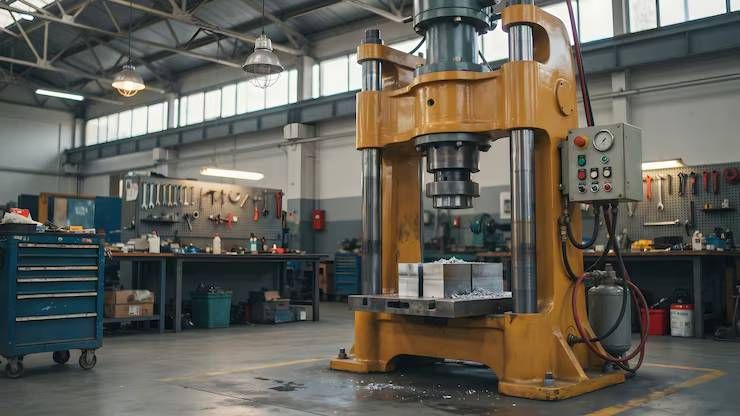
A typical hydraulic press consists of a hydraulic pump, reservoir, cylinder, piston, control valves, frame, and pressing tools. The pump moves hydraulic fluid through the system, while valves regulate its direction and pressure. The cylinder converts hydraulic pressure into mechanical movement, allowing the machine to perform a specific operation.
Hydraulic press systems are available in different configurations, including C-frame presses, H-frame presses, four-column presses, and specialized deep-drawing presses. Each configuration is designed to accommodate particular workpiece dimensions, force requirements, production volumes, and operating conditions.
How Hydraulic Press Machines Work
The operation of a hydraulic press begins when a motor drives the hydraulic pump. The pump moves fluid from the reservoir into the hydraulic circuit. When the control system directs pressurized fluid into the cylinder, the piston moves and applies force to the workpiece.
The force produced by the cylinder depends on the hydraulic pressure and the effective piston area. A larger piston area produces greater force at the same pressure, although the required fluid volume and movement speed also change.
The basic relationship is:
Force = Pressure × Effective Piston Area
For example, a cylinder with an effective piston area of 0.01 square metres operating at 20 megapascals of pressure theoretically produces 200,000 newtons of force, equivalent to approximately 20.4 metric tonnes-force. Actual performance depends on system losses, cylinder design, operating conditions, and machine limitations.
Once the required pressing operation is complete, the hydraulic controls release or redirect pressure to retract the piston. Modern systems may use programmable logic controllers (PLCs), pressure sensors, position sensors, and automated controls to improve repeatability and process monitoring.
Major Types of Hydraulic Press Machines
Different hydraulic press designs support different industrial requirements.
| Machine type | Main characteristics | Common applications |
|---|---|---|
| C-frame press | Open-sided structure with convenient access | Assembly, punching, and light forming |
| H-frame press | Rigid frame with a broad working area | Straightening, pressing, and maintenance work |
| Four-column press | Guided moving platen supported by columns | Moulding, compression, and material forming |
| Deep-drawing press | Designed for controlled sheet-metal deformation | Automotive panels and metal containers |
| Hydraulic forging press | Applies substantial compressive force | Forging and shaping metal components |
| Lamination press | Applies controlled pressure across layered materials | Composite panels and laminated products |
The appropriate machine depends on required tonnage, stroke length, working area, production rate, material properties, and the level of automation needed.
Importance of Hydraulic Press Machines in Modern Manufacturing
Hydraulic press technology plays an important role in manufacturing because many industrial processes require substantial, consistent, and adjustable force. It helps manufacturers shape materials, join components, compress substances, and produce parts with defined dimensions.
These machines are particularly useful when materials need to be formed gradually rather than struck rapidly. Operators can control pressure, stroke, and dwell time, depending on the machine's design and the process requirements.
Key industrial applications include:
- Automotive manufacturing: Forming metal panels, producing structural components, and assembling selected parts.
- Metal fabrication: Bending, punching, stamping, straightening, and shaping metal workpieces.
- Plastic and rubber processing: Compression moulding and shaping materials inside moulds.
- Aerospace engineering: Forming specialised metal components and composite structures under controlled conditions.
- Recycling and waste management: Compressing suitable scrap metal, paper, and other materials into manageable bundles.
- Research and testing: Applying controlled loads to evaluate material strength, deformation, and compression behaviour.
Hydraulic presses can also support manufacturing consistency by maintaining defined pressure and movement settings. However, the quality of the finished product depends on tooling, material preparation, machine condition, process settings, and operator competence.
Benefits and Operational Limitations
Hydraulic press machines offer several practical advantages, but they also have limitations that influence equipment selection.
| Factor | Advantages | Limitations |
|---|---|---|
| Force generation | High pressing force from a compact actuator | Maximum force is limited by the rated system capacity |
| Process control | Pressure, stroke, and dwell time can be adjusted | Poor calibration can affect repeatability |
| Versatility | Supports different tools and forming operations | Tool changes and setup can require additional time |
| Operation | Suitable for gradual, controlled forming | Some systems operate more slowly than mechanical presses |
| Maintenance | Hydraulic components can be inspected and replaced | Fluid leaks, contamination, and seal wear require attention |
| Energy use | Variable-speed drives can reduce unnecessary pumping | Conventional systems may consume energy while waiting between cycles |
Equipment selection should consider the entire production process rather than pressing force alone. Cycle time, energy consumption, tooling requirements, floor space, operator safety, and maintenance arrangements also affect performance.
Recent Updates and Technology Trends
Hydraulic press technology continues to develop through automation, electronic monitoring, energy management, and improved control systems. These developments are relevant to factories seeking more consistent production and better visibility into machine performance.
Servo-hydraulic systems and energy efficiency
Servo-driven hydraulic systems adjust pump output according to operating demand. Compared with conventional systems that maintain relatively constant pump operation, appropriately designed servo-hydraulic systems can reduce energy use during idle periods or lower-demand stages. Actual savings vary with the machine, operating cycle, and production conditions.
Industrial automation and digital monitoring
Modern hydraulic press installations may incorporate PLCs, human-machine interfaces (HMIs), pressure transducers, position sensors, and production data systems. These features can help operators monitor pressing force, stroke position, cycle time, and operating faults.
When connected to a factory monitoring system, machine data can support maintenance planning and production analysis. Predictive maintenance techniques may also help identify developing problems, although their effectiveness depends on sensor quality, data availability, and the reliability of the analysis.
Robotics and automated material handling
Robots and automated transfer systems can load workpieces, position components, and remove finished parts. Integrating these systems can reduce repetitive manual handling and improve production flow. However, automation requires suitable guarding, interlocks, and coordinated safety controls.
Developments during 2025–2026
Through 2025 and into 2026, energy efficiency, connected manufacturing equipment, and condition monitoring remain relevant engineering priorities. These are continuing industry trends rather than evidence of a single new hydraulic press regulation or a universal technology breakthrough. Buyers and plant engineers should evaluate documented machine specifications and independently verified performance data rather than assume that every new machine includes advanced automation.
For safety guidance, ISO 16092-3:2017 remains a relevant international standard for hydraulic presses used in cold-metalworking applications. The International Organization for Standardization confirmed the standard in 2023, and its published status can be checked on the official standards page. <Cite refs={["turn879712search0"]}/>
Laws, Policies, and Industrial Safety Requirements
Hydraulic press machines are subject to workplace safety, machinery, electrical, and environmental requirements that vary by country and application. Manufacturers, plant owners, and operators must identify the rules that apply to their particular equipment and workplace.
Safety requirements in India
In India, industrial hydraulic presses must be considered within the applicable occupational safety and factory regulatory framework. Relevant requirements may include:
- Occupational safety legislation: The Occupational Safety, Health and Working Conditions Code, 2020, and applicable commencement notifications, rules, and transitional provisions should be checked to determine the current legal requirements.
- Factory safety requirements: Applicable factory legislation and state-specific rules may address machine guarding, safe operation, maintenance, worker training, and workplace conditions.
- Electrical safety: Motors, control panels, earthing systems, and electrical installations must comply with the relevant requirements and applicable technical standards.
- Environmental management: Hydraulic oil storage, spill prevention, used-fluid handling, and waste disposal must follow applicable environmental and hazardous-waste requirements.
- Import and conformity requirements: Imported machinery may be subject to applicable customs, product-safety, or mandatory conformity requirements, depending on the equipment and current notifications.
Because legal provisions and implementation dates can change, businesses should verify current requirements with the relevant central and state authorities rather than rely on general summaries.
International standards and workplace safety
ISO 16092-3:2017 addresses safety requirements for hydraulic presses used in cold-metalworking applications. It covers hazards associated with press design, construction, and foreseeable use. The standard is a useful technical reference, but its legal status depends on the jurisdiction and how the relevant requirements are adopted.
In the United States, the Occupational Safety and Health Administration (OSHA) regulates workplace machinery hazards. OSHA's 29 CFR 1910.217 primarily addresses mechanical power presses and explicitly excludes hydraulic power presses from that standard's scope. Therefore, facilities must identify the OSHA provisions that actually apply to their hydraulic equipment rather than assume that every mechanical-press rule applies directly.
Essential hydraulic press safety practices
- Install appropriate guards, barriers, and interlocked access systems.
- Keep hands away from the pressing area while the machine is operating.
- Use suitable procedures for isolating electrical and hydraulic energy before maintenance.
- Release or safely restrain stored hydraulic pressure before opening a system.
- Inspect hoses, seals, fittings, valves, and pressure-relief devices regularly.
- Train operators to recognise abnormal pressure, fluid leakage, unusual noise, and control faults.
- Never exceed the machine's rated capacity or the safe working limits of its components.
Safety measures should be established through a documented risk assessment and verified by competent personnel.
Frequently Asked Questions
1. What is the main purpose of a hydraulic press machine?
A hydraulic press generates compressive force using pressurised fluid. It is used for metal forming, moulding, pressing, straightening, assembly, and other operations that require controlled force.
2. How is hydraulic press tonnage calculated?
The theoretical pressing force is calculated by multiplying hydraulic pressure by the effective piston area. The result can be converted from newtons to metric tonnes-force by dividing by approximately 9,806.65. Actual usable force depends on system efficiency and the machine's rated capacity.
3. What is the difference between a hydraulic press and a mechanical press?
A hydraulic press uses fluid pressure to move a cylinder, allowing controlled force across its working stroke. A mechanical press generally uses a motor-driven mechanical system, such as a flywheel and crank mechanism. Their operating speeds, force characteristics, control methods, and suitable applications differ.
4. How often should a hydraulic press be maintained?
Maintenance frequency depends on the manufacturer's instructions, operating hours, workload, environmental conditions, and component specifications. Regular checks should cover hydraulic fluid condition, leaks, filters, hoses, seals, safety devices, and control systems.
5. Are hydraulic press machines safe to operate?
They can be operated safely when properly designed, installed, guarded, maintained, and used by trained personnel. However, high pressing forces and stored hydraulic energy create serious hazards. Risk assessments, suitable safeguards, energy-isolation procedures, and regular inspections are essential.
Conclusion
Hydraulic press machines are important industrial tools for forming, compressing, assembling, and shaping materials. Their operation is based on hydraulic pressure, which enables controlled force generation across a wide range of manufacturing applications.
Different press configurations support different workpieces and production requirements. Selecting suitable equipment involves evaluating force capacity, working dimensions, cycle time, energy efficiency, automation, maintenance, and operator safety.
Developments in servo-hydraulic technology, digital monitoring, and automated material handling are expanding the ways these machines can be integrated into modern production systems. At the same time, safe operation depends on correct machine selection, competent maintenance, appropriate guarding, and compliance with applicable regulations.