Industrial AI agents are artificial intelligence systems designed to analyze industrial data, understand operational goals, coordinate tasks, and support or perform selected actions within manufacturing and other industrial environments. Unlike traditional automation that generally follows predefined rules, AI agents can combine data analysis, reasoning, planning, and interaction with connected systems.
The development of industrial AI agents is closely associated with Industry 4.0, smart manufacturing, industrial IoT, robotics, digital twins, and advanced analytics. These technologies allow factories to connect machines, sensors, production software, and operational data within increasingly integrated environments.
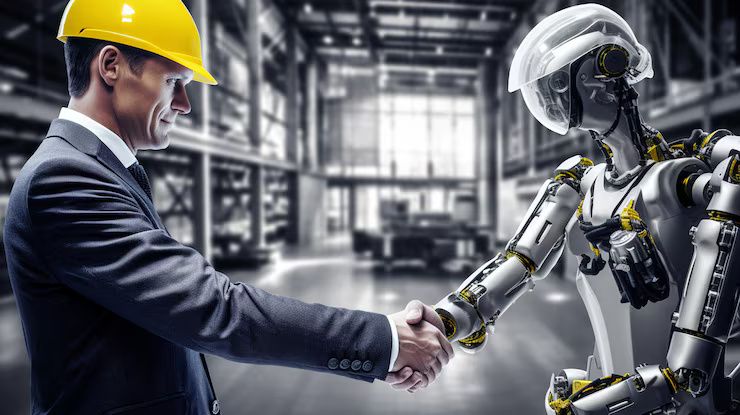
AI agents are now being explored for applications such as predictive maintenance, production scheduling, quality monitoring, supply chain coordination, process optimization, and industrial knowledge management. However, industrial environments involve physical equipment and safety requirements, so autonomous decision-making requires appropriate testing, controls, and human oversight.
Context
Understanding Industrial AI Agents
An industrial AI agent is a software-based system that can perceive information from an industrial environment, interpret a defined objective, determine possible actions, and interact with connected systems within established boundaries.
For example, an agent may receive information from machine sensors, compare current conditions with historical patterns, identify an abnormal condition, and recommend or initiate a predefined response.
Common capabilities include:
- Industrial data analysis
- Anomaly detection
- Workflow coordination
- Production planning
- Equipment monitoring
- Quality analysis
- Decision support
The level of autonomy varies considerably. Some systems only provide recommendations, while others can execute selected actions after predefined conditions are satisfied.
How Intelligent Automation Systems Work
Intelligent automation systems combine AI models with industrial software, databases, sensors, control systems, and communication interfaces.
A simplified workflow involves:
- Sensors and software systems collect operational information.
- The AI agent interprets the available data.
- The system identifies a task, condition, or operational objective.
- The agent evaluates possible actions.
- A recommendation or authorized action is produced.
- Operators or connected systems review or execute the response.
In a highly automated environment, several agents may coordinate different activities. Human operators can remain responsible for decisions that involve safety, unusual conditions, or significant operational consequences.
Core Technologies Behind Industrial AI
| Technology | Industrial Function |
|---|---|
| Machine learning | Identifies patterns in industrial data |
| Generative AI | Processes complex information and generates responses |
| Industrial IoT | Connects machines and sensors |
| Computer vision | Analyzes images and visual conditions |
| Digital twins | Represents physical systems digitally |
| Edge computing | Processes selected information near equipment |
| Robotics | Performs physical industrial tasks |
| Industrial databases | Store operational and historical information |
Industrial AI Agents Versus Traditional Automation
Traditional automation typically follows predefined logic. An industrial AI agent can process broader information and adapt its response within its designed operating boundaries.
For example, a conventional system may trigger an alarm when a temperature exceeds a fixed threshold. An AI agent may examine temperature trends, vibration data, production conditions, maintenance history, and other relevant information before determining whether an abnormal pattern exists.
This additional flexibility also introduces new requirements for validation, data quality, cybersecurity, and operational control.
Agent Architecture in Manufacturing
An industrial AI agent generally contains several functional layers.
| Layer | Purpose |
| Perception | Collects information from sensors and software |
| Knowledge | Provides access to industrial data and rules |
| Reasoning | Interprets information and evaluates possibilities |
| Planning | Determines a sequence of actions |
| Execution | Interacts with authorized systems |
| Monitoring | Evaluates results and identifies changes |
Importance
Role in Smart Manufacturing
Smart manufacturing connects production equipment, digital systems, people, and data. Industrial AI agents can act as software-based coordinators within this environment.
The National Institute of Standards and Technology describes AI and machine learning as important technologies for smart manufacturing, while also identifying challenges involving industrial data, heterogeneous sensing and control systems, reliability, explainability, and trustworthy operation.
AI agents may help manufacturers interpret information from multiple systems rather than requiring operators to examine every data source separately.
Industrial AI Applications
Industrial AI agents can be applied to several areas of production.
Predictive Maintenance: An agent can examine equipment information, operating history, and sensor patterns to identify conditions that may require inspection.
Quality Monitoring: AI systems can analyze production data or images to identify deviations from expected quality characteristics.
Production Scheduling: Agents can evaluate production requirements, machine availability, material conditions, and other constraints when supporting scheduling decisions.
Supply Chain Coordination: AI systems can process information about inventory, production requirements, transportation, and supplier conditions.
Energy Management: Agents can analyze energy-related data and identify operational patterns that may require attention.
Manufacturing Process Automation
Industrial AI agents can extend existing manufacturing automation by connecting different software systems.
For example, an agent may coordinate information between:
- Manufacturing execution systems
- Enterprise resource planning platforms
- Industrial IoT networks
- Maintenance databases
- Quality management systems
- Warehouse systems
The purpose is not necessarily to replace existing automation. Instead, AI can provide an additional decision and coordination layer above established industrial systems.
Human-Machine Collaboration
Industrial environments require cooperation between people and automated systems. AI agents can support engineers, technicians, supervisors, and operators by organizing information and presenting relevant findings.
NIST's 2026 manufacturing workshop specifically examined human-machine teaming, agentic AI, physical AI, digital twins, and standards for reliable manufacturing systems.
Human involvement remains particularly important when an AI-generated decision could affect worker safety, equipment integrity, product quality, or regulatory compliance.
Industrial Knowledge Management
Factories often contain large amounts of technical information distributed across manuals, maintenance records, engineering documents, production histories, and databases.
AI agents can help organize and retrieve this information. For example, an industrial knowledge agent could identify relevant maintenance documentation or summarize historical equipment events for an engineer.
The quality of the result depends on the accuracy, completeness, and relevance of the underlying information.
Recent Updates
Growth of Agentic AI in Manufacturing
From 2024 through 2026, attention has increasingly shifted from conventional predictive AI toward agentic systems capable of planning and executing multi-step activities.
NIST's manufacturing research materials describe agentic AI systems as capable of perceiving, reasoning, and acting within manufacturing environments. Potential applications include process monitoring, predictive maintenance, quality control, supply chain optimization, and production scheduling.
New Focus on AI Manufacturing Standards
Manufacturing organizations are increasingly examining how AI systems should be evaluated for reliability, interoperability, and safety.
NIST's 2026 AI for Manufacturing workshop included discussions of agentic AI, physical AI, human-machine teaming, standards, and methods for validating AI decisions in manufacturing environments.
Expansion of Industrial AI Research
NIST published a 2026 roadmap covering artificial intelligence and machine learning in smart manufacturing. The roadmap identifies industrial big-data analytics, advanced sensing, autonomous systems, digital twins, robotics, logistics optimization, and sustainable manufacturing among important areas of development.
Greater Attention to Industrial Data
AI agents depend heavily on the quality of the information they receive. NIST has highlighted data availability, representation, variation, and completeness as important considerations when developing industrial AI systems.
This means implementing an AI agent is not only an AI-model challenge. Data infrastructure, sensor quality, system integration, and operational knowledge are also important.
Development of AI Agent Standards
NIST announced an AI Agent Standards Initiative in 2026 focused on secure, interoperable, and reliable agentic AI systems. Although the initiative covers AI agents broadly, its principles are relevant to industrial environments where agents may interact with multiple digital systems.
Laws or Policies
AI Governance
Industrial AI systems may be affected by AI governance rules, privacy requirements, cybersecurity regulations, product safety requirements, and industry-specific standards.
Organizations deploying AI agents generally need to understand which regulations apply to their particular application and location.
European Union AI Act
The European Union's AI Act is being implemented progressively. According to the EU's implementation timeline, the majority of its rules begin applying from August 2026, with additional requirements for certain high-risk AI systems applying at later stages.
Whether a particular industrial AI system is subject to specific requirements depends on its function, classification, deployment environment, and role within a regulated product or process.
Industrial Safety Requirements
AI agents connected to physical machinery can create additional safety considerations. A software recommendation may influence equipment operation, production parameters, or maintenance decisions.
Organizations therefore need appropriate safeguards around:
- Authorized system access
- Emergency controls
- Human oversight
- Testing and validation
- Failure handling
- Change management
AI should not be assumed to operate safely simply because a model performs well in a digital testing environment.
Cybersecurity Policies
Industrial AI agents can interact with operational technology, enterprise software, databases, and connected devices. Cybersecurity therefore becomes an important part of deployment planning.
Security controls may include:
- Identity management
- Network segmentation
- Access restrictions
- Activity logging
- Software updates
- Incident response procedures
The appropriate controls depend on the industrial environment and the systems being connected.
Tools and Resources
Industrial IoT Platforms
Industrial IoT platforms connect sensors, machines, and digital applications.
They can provide information about:
- Machine conditions
- Production activity
- Energy use
- Environmental conditions
- Equipment events
This data can provide input for AI-based analysis.
Manufacturing Execution Systems
Manufacturing execution systems, commonly called MES platforms, manage production information and workflows. AI agents can potentially interact with MES data to analyze production status and support scheduling or operational decisions.
Digital Twin Platforms
Digital twins create digital representations of physical equipment, processes, or facilities.
They can support:
- Process simulation
- Equipment analysis
- Scenario testing
- Performance monitoring
Digital twins are an important research area in smart manufacturing and industrial AI.
AI Development and Orchestration Tools
AI development tools help organizations create models, connect data sources, establish workflows, and manage AI applications.
For industrial environments, important considerations include:
- Data access
- Model evaluation
- System integration
- Monitoring
- Version control
- Human approval mechanisms
Industrial Data and Monitoring Systems
Sensors, historians, SCADA platforms, and monitoring systems provide operational information that AI agents may use for analysis.
The quality and context of this data strongly influence the reliability of AI-generated results.
FAQs
What are industrial AI agents?
Industrial AI agents are artificial intelligence systems designed to analyze industrial information, reason about defined objectives, and support or execute authorized tasks within manufacturing and other industrial environments.
How are AI agents used in smart manufacturing?
AI agents can support predictive maintenance, production scheduling, quality monitoring, supply chain coordination, equipment analysis, and other manufacturing workflows.
What is the difference between AI agents and traditional automation?
Traditional automation generally follows predefined rules, while AI agents can interpret broader information, plan multi-step activities, and adapt their responses within defined boundaries.
Can industrial AI agents control factory equipment?
Some AI systems can interact with connected industrial equipment, but the level of control depends on system architecture, safety requirements, authorization rules, and validation. Physical actions generally require appropriate safeguards and oversight.
Why is data important for industrial AI?
AI agents depend on accurate and relevant information. Incomplete, poorly structured, or unrepresentative industrial data can reduce the reliability of AI analysis and decisions. NIST specifically identifies data quality and real-world representation as important considerations for industrial AI.
Conclusion
Industrial AI agents combine artificial intelligence, industrial data, automation, and connected systems to support increasingly complex manufacturing workflows. Their applications include predictive maintenance, quality monitoring, production scheduling, supply chain coordination, and industrial knowledge management. Recent developments are placing greater emphasis on agentic AI, digital twins, human-machine collaboration, reliable data, and standards for trustworthy industrial deployment. Because these systems can interact with physical operations, appropriate validation, cybersecurity, safety controls, and human oversight remain important.