Industrial cleaning is an important part of maintaining safe, efficient, and reliable operations across manufacturing plants, food-processing facilities, warehouses, workshops, healthcare environments, and other commercial settings.
Unlike household cleaning, industrial cleaning often involves removing heavy oils, grease, mineral deposits, residues, dirt, and process contaminants from large surfaces and specialized equipment.
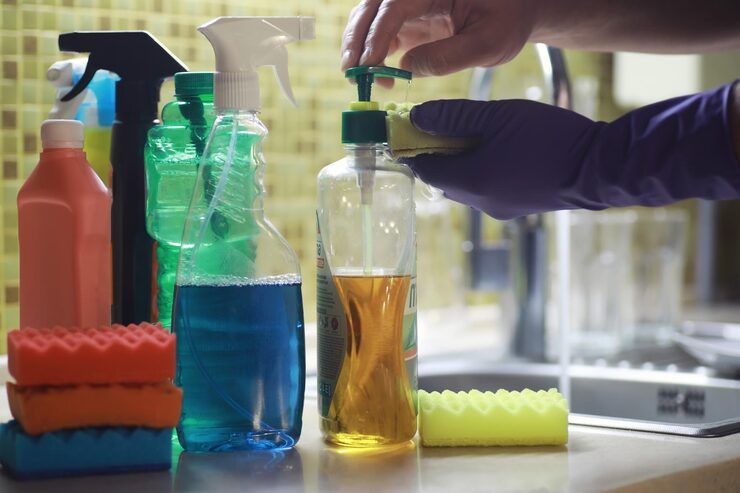
The effectiveness of an industrial cleaning chemical depends on much more than its strength. Formulation, soil type, surface material, concentration, temperature, contact time, mechanical action, and rinsing conditions all influence cleaning performance. Choosing an appropriate formulation therefore requires an understanding of both the contaminant and the surface being cleaned.
This guide explains how industrial cleaning chemicals work, the major formulation categories, important performance factors, and practical considerations for selecting and using cleaning systems responsibly.
What Are Industrial Cleaning Chemicals?
Industrial cleaning chemicals are formulated substances used to remove contaminants from equipment, machinery, floors, tanks, production areas, tools, and other industrial surfaces. They are designed for specific cleaning challenges that may be difficult to address with ordinary household products.
Common targets include:
- Oils and lubricants
- Grease
- Dust and particulate matter
- Protein residues
- Food residues
- Mineral deposits
- Carbon-based soils
- Adhesive residues
- Rust-related deposits
- General industrial dirt
Different contaminants require different chemical approaches. A degreaser designed to break down heavy oils may not be appropriate for removing mineral scale, while an acidic formulation used for deposits may be unsuitable for certain metals.
How Industrial Cleaning Formulations Work
A cleaning formulation typically combines several functional components that work together to loosen, dissolve, suspend, or remove contaminants.
The main principles include chemical action, physical action, and surface interaction.
Chemical ingredients may alter the structure of a contaminant, while surfactants help water spread across surfaces and interact with oily or particulate soils. Builders can improve cleaning efficiency by controlling water hardness and supporting the performance of other ingredients.
Mechanical action, such as spraying, brushing, agitation, or circulation, then helps physically remove loosened contamination.
Effective cleaning is therefore usually the result of multiple factors working together rather than one ingredient acting alone.
Major Types of Industrial Cleaning Chemicals
Industrial cleaning chemicals can be grouped according to their chemical characteristics and intended applications.
Alkaline Cleaners
Alkaline cleaners are commonly associated with the removal of grease, oils, fats, and other organic residues. They are frequently used in industrial environments where heavy organic contamination needs to be removed from compatible surfaces.
The alkalinity of a formulation influences how it interacts with different soils. However, stronger alkalinity does not automatically mean better cleaning. Surface compatibility and application conditions must also be considered.
Acidic Cleaners
Acidic formulations are commonly used for mineral deposits, scale, oxidation-related residues, and certain inorganic contaminants.
Because acids can react with metals and other materials, surface compatibility is particularly important. Appropriate formulation selection and controlled application help reduce the risk of unwanted surface reactions.
Neutral Cleaners
Neutral formulations are generally selected when routine cleaning is required and aggressive chemical action is unnecessary.
They may be suitable for general-purpose maintenance, light soil removal, and surfaces where material compatibility is a major consideration.
Solvent-Based Cleaners
Some industrial contaminants, particularly certain oils, adhesives, coatings, and residues, may require solvent-based cleaning technologies.
These products require careful handling because solvent characteristics can influence worker safety, ventilation requirements, material compatibility, and environmental considerations.
Specialty Cleaners
Specialized formulations may be developed for particular industries or contamination types. Examples include cleaners for food-processing equipment, electronic components, precision machinery, vehicle maintenance, and specialized manufacturing systems.
The formulation should always match the intended application rather than being selected solely based on cleaning strength.
The Role of Surfactants
Surfactants are important components in many industrial cleaning formulations. They help reduce surface tension, allowing cleaning solutions to spread more effectively across contaminated surfaces.
They can also assist with lifting oily soils and keeping loosened particles dispersed in the cleaning solution.
Different surfactants have different properties, which means formulation designers select them according to the type of soil, water conditions, temperature, foam requirements, and cleaning method.
Low-foam formulations, for example, may be preferred for certain automated cleaning equipment where excessive foam can interfere with circulation or machinery operation.
Understanding the Cleaning Performance Equation
Cleaning performance depends on several interacting variables. A useful way to understand this is through four major factors: chemical action, temperature, mechanical action, and time.
If one factor is reduced, another may sometimes need to compensate. For example, lower-temperature cleaning may require additional contact time or mechanical action to achieve comparable results.
Water quality also matters. Hard water contains minerals that can interfere with cleaning performance or contribute to deposits. Formulations may therefore contain ingredients designed to manage water hardness and maintain effective cleaning conditions.
Surface Compatibility Matters
A cleaning chemical that effectively removes contamination can still be inappropriate if it damages the underlying material.
Industrial surfaces may include:
- Stainless steel
- Aluminum
- Carbon steel
- Plastics
- Rubber
- Glass
- Painted surfaces
- Coated materials
- Specialized alloys
Factors such as pH, temperature, concentration, exposure duration, and repeated use can influence material compatibility.
Before applying a chemical to an unfamiliar surface, organizations should follow the product's technical and safety documentation and conduct appropriate compatibility evaluation where necessary.
Concentration, Contact Time, and Temperature
Using more chemical does not necessarily produce better cleaning results.
Concentration should be appropriate for the specific application. Excessive concentration can increase chemical consumption, rinsing requirements, residue formation, and potential surface or handling concerns.
Contact time is equally important. A cleaning solution may need sufficient time to penetrate and loosen contamination before mechanical removal or rinsing.
Temperature can also influence cleaning performance by affecting chemical reactions, viscosity, and the behavior of oils and other contaminants. However, higher temperatures are not universally appropriate because some surfaces, materials, and contaminants can be adversely affected.
Foam and Rinsing Considerations
Foam can be useful in certain cleaning applications because it can increase surface contact and make treated areas easier to identify. However, excessive foam may create problems in automated or circulation-based cleaning systems.
Rinsing is another important part of the process. After contamination has been removed, residual cleaning chemicals may need to be thoroughly rinsed from equipment or surfaces, particularly where residues could affect subsequent production processes.
The appropriate rinsing method depends on the formulation, surface, cleaning process, and application requirements.
Choosing the Right Industrial Cleaning Chemical
Selection should begin with the cleaning problem rather than the chemical itself.
Consider the following questions:
- What type of contaminant needs to be removed?
- What material is being cleaned?
- Is the process manual, automated, sprayed, foamed, or circulated?
- What temperature is available?
- How much contact time is practical?
- What water conditions exist?
- Is low foaming required?
- How important are residue control and rinsing?
- What workplace handling requirements apply?
- How will the chemical waste be managed?
Answering these questions helps narrow the available formulation options and supports more consistent cleaning results.
Safe Handling and Responsible Use
Industrial cleaning chemicals should always be handled according to their safety documentation and workplace procedures. Appropriate labeling, storage, ventilation, protective equipment, spill response procedures, and employee training are important elements of responsible chemical management.
Different chemicals should not be mixed unless the formulation is specifically designed for that combination. Uncontrolled mixing can produce undesirable reactions or hazardous conditions.
Organizations should also consider wastewater management and environmental requirements when developing industrial cleaning processes.
Improving Cleaning Efficiency
A successful cleaning program should be evaluated as a complete process rather than by chemical performance alone.
Useful performance indicators may include:
- Cleaning consistency
- Chemical consumption
- Water usage
- Cleaning cycle duration
- Equipment downtime
- Residue levels
- Surface condition
- Worker handling requirements
Regular evaluation can identify opportunities to improve concentration control, process timing, equipment settings, and chemical selection.
Frequently Asked Questions
What are industrial cleaning chemicals used for?
They are used to remove oils, grease, mineral deposits, production residues, dirt, and other contaminants from industrial equipment, machinery, floors, tanks, and work surfaces.
Are stronger cleaning chemicals always more effective?
No. Cleaning performance depends on the soil, surface, concentration, temperature, contact time, and mechanical action. A highly aggressive formulation may be unsuitable for a particular material.
Why is surface compatibility important?
Different materials respond differently to chemical exposure. An unsuitable formulation can cause discoloration, corrosion, degradation, or other surface damage.
What is the difference between alkaline and acidic cleaners?
Alkaline cleaners are commonly used for organic soils such as grease and oils, while acidic cleaners are often used for mineral deposits and certain inorganic residues. The appropriate choice depends on the specific contamination and surface.
How can industrial cleaning performance be improved?
Performance can often be improved by matching the formulation to the contaminant, controlling concentration, optimizing temperature and contact time, applying suitable mechanical action, and ensuring effective rinsing.
Conclusion
Industrial cleaning chemicals are an essential part of maintaining equipment, production areas, and industrial facilities. Their effectiveness depends on formulation chemistry as well as practical factors such as soil type, surface material, concentration, temperature, contact time, mechanical action, and water quality.
A well-designed cleaning process focuses on compatibility, consistency, safety, and measurable performance rather than simply choosing the strongest available chemical. By understanding how different formulations work and matching them to specific cleaning requirements, industrial organizations can develop more reliable cleaning practices while supporting equipment condition, operational efficiency, and responsible chemical management.