
Industrial CNC machines have transformed modern manufacturing by enabling highly precise, automated, and efficient production processes. These machines are widely used across industries where accuracy, repeatability, and complex component production are essential.
From automotive parts and aerospace components to medical equipment and industrial machinery, CNC technology supports the creation of high-quality products with advanced engineering requirements.
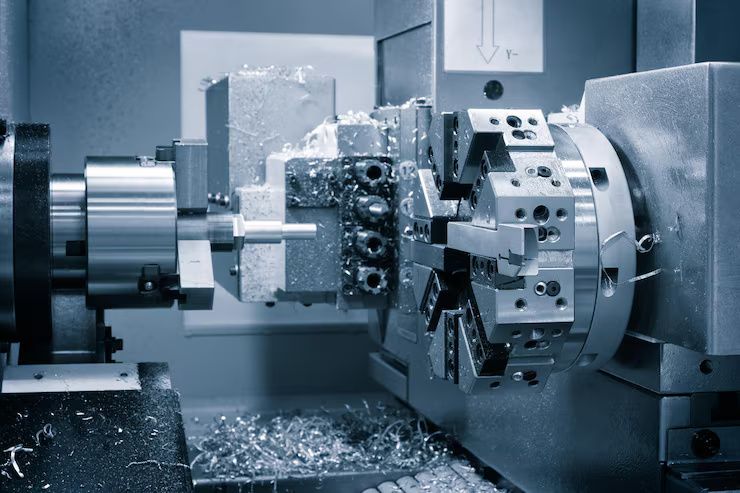
Unlike traditional machining methods that rely heavily on manual operation, CNC machines use computer-controlled systems to guide cutting tools and manufacturing processes. This allows industries to produce complex designs with consistent accuracy.
This guide explains the different types of industrial CNC machines, their working principles, advanced machining technologies, and applications across modern manufacturing industries.
What Are Industrial CNC Machines?
Industrial CNC machines are automated manufacturing systems controlled by computer programs. CNC stands for Computer Numerical Control, which means machine movements are directed through coded instructions created from digital designs.
These machines perform operations such as cutting, drilling, milling, turning, and grinding with high precision.
A typical CNC machine includes:
- Control unit
- Machine structure
- Cutting tools
- Drive motors
- Work holding system
Each component works together to transform digital designs into accurately manufactured physical parts.
Importance of CNC Machines in Modern Manufacturing
CNC machines play a major role in modern industrial production because they improve accuracy, efficiency, and manufacturing consistency.
Industries use CNC technology because it helps produce complex components while maintaining strict quality requirements.
Key advantages include:
- High machining precision
- Consistent production quality
- Ability to create complex designs
- Reduced production errors
For example, aerospace manufacturers use CNC machines to produce aircraft components with extremely precise dimensions because even small variations can affect performance.
Working Principle of CNC Machines
The working process of CNC machines begins with a digital design that is converted into machine instructions.
The machine controller reads these instructions and directs motors, tools, and mechanical systems to perform specific operations.
Design and Programming Stage
The process starts with a Computer-Aided Design (CAD) model. Engineers create a digital representation of the required component.
This design is then converted into machine-readable instructions using Computer-Aided Manufacturing (CAM) software.
Machine Control Process
The CNC controller receives programmed instructions and controls machine movements.
It manages:
- Tool movement direction
- Cutting speed
- Feed rate
- Operation sequence
This automated control allows precise manufacturing with minimal manual adjustment.
Material Removal Process
During machining, cutting tools remove material from a workpiece to create the required shape.
The process continues until the final component matches the programmed design specifications.
Types of Industrial CNC Machines
Different CNC machines are designed for specific manufacturing operations and materials.
CNC Milling Machines
CNC milling machines are among the most commonly used industrial CNC systems.
They use rotating cutting tools to remove material from a stationary workpiece.
These machines can perform operations such as:
- Surface milling
- Drilling
- Slot cutting
- Complex contour machining
CNC milling machines are widely used in automotive, aerospace, and engineering industries.
CNC Turning Machines
CNC turning machines are designed for producing cylindrical components.
In this process, the workpiece rotates while a cutting tool removes material to create the desired shape.
Common applications include manufacturing:
- Shafts
- Bushings
- Cylindrical parts
- Rotating components
CNC Grinding Machines
CNC grinding machines use abrasive wheels to achieve highly accurate surface finishes.
They are commonly used when components require exceptional precision and smooth surfaces.
These machines are important in industries such as automotive, aerospace, and precision engineering.
CNC Laser Cutting Machines
CNC laser cutting machines use focused laser beams to cut materials with high accuracy.
They are commonly used for sheet metal fabrication, industrial manufacturing, and custom component production.
CNC Plasma Cutting Machines
CNC plasma cutting systems use high-temperature plasma to cut electrically conductive materials.
They are widely used in metal fabrication and heavy industrial applications.
CNC Routers
CNC routers are commonly used for cutting materials such as wood, plastics, composites, and lightweight metals.
They are popular in industries involving furniture manufacturing, signage, and specialized fabrication.
Advanced Machining Technologies
Modern CNC machines incorporate advanced technologies that improve automation, precision, and production capabilities.
Multi-Axis CNC Machining
Traditional CNC machines often operate along three axes, while advanced systems can operate across four, five, or more axes.
Multi-axis machining allows tools to approach components from multiple angles, making it possible to manufacture complex shapes in fewer operations.
This technology is widely used in aerospace, medical equipment, and precision engineering.
Automated Tool Management
Modern CNC systems include automated tool-changing systems that allow machines to switch between different cutting tools without manual intervention.
This improves production efficiency and reduces downtime between operations.
Artificial Intelligence and Smart CNC Systems
Artificial intelligence is becoming increasingly important in CNC manufacturing.
AI-based systems can analyze machine performance, detect unusual patterns, and improve machining processes.
Smart CNC systems use sensors and data analysis to monitor:
- Machine conditions
- Tool performance
- Production quality
These technologies support predictive maintenance and improved manufacturing efficiency.
Robotics Integration
Robotic systems are increasingly combined with CNC machines to automate material handling and production workflows.
Robots can assist with loading, unloading, inspection, and movement of components.
This creates more efficient and connected manufacturing environments.
CNC Machining Materials
CNC machines can process a wide range of materials depending on machine capabilities and cutting tools.
Metals
Metals are among the most common materials used in CNC machining.
Examples include:
- Aluminum
- Steel
- Stainless steel
- Titanium
- Brass
These materials are widely used in automotive, aerospace, and industrial equipment manufacturing.
Plastics
CNC machines can also process engineering plastics used in electronics, medical devices, and consumer products.
Composite Materials
Advanced composites are increasingly used in aerospace and specialized industries due to their lightweight and durable properties.
Manufacturing Applications of Industrial CNC Machines
CNC machines support many industries by enabling accurate and efficient component production.
Automotive Industry
Automotive manufacturers use CNC machines to produce engine components, transmission parts, molds, and precision mechanical systems.
CNC technology helps maintain consistency across large-scale vehicle production.
Aerospace Industry
The aerospace sector requires extremely precise components made from advanced materials.
CNC machining is used for aircraft structures, engine parts, and specialized aerospace components.
Medical Equipment Manufacturing
Medical equipment requires high precision and reliability.
CNC machines are used to produce surgical components, implants, diagnostic equipment parts, and specialized medical devices.
Electronics Industry
Electronic devices often require small, precise components.
CNC machining supports the production of housings, connectors, and specialized mechanical parts.
Industrial Machinery Production
Manufacturers use CNC machines to create machine components, tools, and replacement parts used in industrial systems.
The accuracy of CNC technology helps improve equipment performance and reliability.
Quality Control in CNC Manufacturing
Quality control is an essential part of CNC machining.
Manufacturers use advanced measurement systems to verify that components meet design specifications.
Common inspection methods include:
- Dimensional measurement
- Surface quality analysis
- Automated inspection systems
- Performance testing
These processes ensure consistent manufacturing quality.
Challenges in CNC Machining
Although CNC machines provide many advantages, industries also face certain challenges.
One challenge is the requirement for skilled professionals who understand programming, machine operation, and maintenance.
Other challenges include:
- Equipment maintenance requirements
- Programming complexity
- Initial setup planning
- Material selection considerations
Continuous training and technological improvements help manufacturers overcome these challenges.
Future Trends in CNC Manufacturing
The future of CNC machining is closely connected with automation, artificial intelligence, and digital manufacturing.
Smart factories are increasingly using connected CNC systems that communicate with other production equipment and provide real-time performance information.
Future developments are expected to include:
- More autonomous machining systems
- Advanced robotics integration
- AI-based process optimization
- Sustainable manufacturing technologies
These innovations will continue to improve manufacturing efficiency and precision.
Conclusion
Industrial CNC machines have become a foundation of modern manufacturing by providing exceptional accuracy, automation, and production flexibility. Their ability to create complex components with consistent quality makes them essential across industries such as automotive, aerospace, healthcare, electronics, and industrial engineering.
With advancements in smart technology, robotics, and artificial intelligence, CNC machining continues to evolve toward more intelligent and efficient manufacturing systems. Understanding CNC machine types, working principles, and applications highlights their importance in shaping the future of global industrial production.