Industrial machinery depends on hundreds of interconnected components working together to perform repetitive, precise, and demanding tasks.
From bearings and gears to motors, sensors, controllers, and hydraulic assemblies, every part contributes to the reliability and performance of a larger machine. Understanding these components is therefore essential for maintenance teams, engineers, plant managers, and anyone involved in industrial operations.
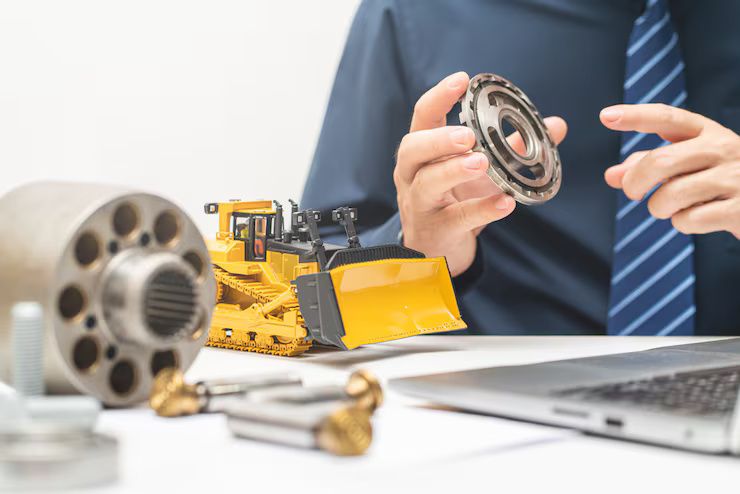
Industrial machine components have also evolved as manufacturing becomes more automated and data-driven. Modern equipment combines mechanical assemblies with electronics, software, sensors, and control systems. Technologies such as CNC machining, Industrial PLC programming, and Industrial Automation Engineering have changed how machines are designed, operated, monitored, and maintained.
This guide explains the major types of industrial machine components, their functions, maintenance considerations, replacement strategies, and the role they play in modern manufacturing environments.
What Are Industrial Machine Components?
Industrial machine components are individual mechanical, electrical, electronic, hydraulic, or pneumatic parts that work together to form functional machinery. Some components transmit motion, others provide power, control movement, detect operating conditions, or support structural loads.
Common examples include:
- Bearings and bushings
- Gears and gearboxes
- Shafts and couplings
- Motors and drives
- Pumps and valves
- Belts and chains
- Hydraulic and pneumatic cylinders
- Sensors and switches
- Industrial controllers
- Seals and fasteners
The appropriate combination depends on the machine's purpose, operating environment, load requirements, and level of automation.
Major Categories of Industrial Machine Components
Understanding components by function makes it easier to identify their role within a machine.
Mechanical Components
Mechanical parts transfer motion, support loads, and connect moving assemblies. Bearings reduce friction between moving surfaces, while shafts transmit rotational movement from one component to another.
Gears and gearboxes modify speed, torque, or direction. Couplings connect rotating shafts while allowing controlled movement and, in some designs, accommodating minor alignment differences.
Belts, chains, pulleys, sprockets, and linear motion components also play important roles in industrial equipment.
Electrical Components
Electrical components supply, control, and distribute power.
Motors convert electrical energy into mechanical movement, while motor starters, contactors, circuit protection devices, and variable frequency drives help control electrical operation.
Modern machinery may also include servo motors and servo drives when highly precise movement is required.
Hydraulic and Pneumatic Components
Hydraulic systems use pressurized fluid to generate controlled mechanical force. Pumps, cylinders, valves, filters, hoses, and reservoirs form the primary elements of many hydraulic systems.
Pneumatic equipment uses compressed air to produce movement. Cylinders, air preparation units, valves, tubing, and fittings are common components.
These technologies are particularly useful where controlled linear motion, force, or rapid actuation is required.
Electronic and Control Components
Modern industrial machinery increasingly relies on electronic control systems.
Sensors monitor conditions such as temperature, position, pressure, speed, and proximity. Controllers interpret this information and coordinate machine actions.
Programmable logic controllers are especially important because they allow automated machines to execute programmed sequences while responding to sensor inputs and operating conditions.
The Role of Industrial PLC Programming
Industrial PLC programming connects physical machine components with automated control logic.
A PLC receives signals from sensors and other devices, processes programmed instructions, and sends commands to actuators, motors, valves, and other equipment.
For example, a production machine may use a position sensor to confirm that a component has reached a specific location. The PLC can then instruct a motor or actuator to perform the next operation.
This relationship between hardware and software is central to modern automation. Effective Industrial PLC programming can improve process consistency, monitoring, sequencing, and fault detection.
CNC Machining and Component Manufacturing
CNC machining is an important manufacturing technology used to produce precise industrial machine components.
Computer-controlled machining equipment can manufacture parts with carefully controlled dimensions and repeatable geometries. Components such as shafts, housings, brackets, gears, and precision fixtures may be produced through processes including milling, turning, drilling, and grinding.
The quality of a machined component depends on factors such as material selection, dimensional tolerances, machine capability, tooling, surface requirements, and inspection procedures.
For machinery operating under demanding conditions, dimensional accuracy is particularly important because even small deviations can affect alignment, vibration, friction, or component life.
Industrial Automation Engineering and Component Integration
Industrial Automation Engineering focuses on integrating mechanical, electrical, control, and software technologies into coordinated production systems.
A modern automated machine may contain:
- Servo motors
- PLCs
- Industrial sensors
- Variable frequency drives
- Safety systems
- Human-machine interfaces
- Communication networks
- Mechanical transmission systems
These components must work together reliably. A problem with one element can affect the performance of an entire production process.
For this reason, component selection should consider system compatibility rather than evaluating individual parts in isolation.
OEM Parts vs Aftermarket Industrial Components
When a component needs replacement, organizations may encounter a choice between original equipment manufacturer components and aftermarket alternatives.
OEM parts are produced according to the specifications associated with the original equipment manufacturer. They may provide direct compatibility with the machinery for which they were designed.
Aftermarket components are produced by other manufacturers and may be designed to meet equivalent or compatible specifications.
The decision should consider factors such as:
- Dimensional compatibility
- Material specifications
- Operating conditions
- Performance requirements
- Certification requirements
- Manufacturer documentation
- Installation considerations
- Expected service conditions
The most suitable choice depends on the machine, component, operating environment, and applicable technical requirements rather than simply the component category.
Industrial Spare Parts Inventory Management
Maintaining the right spare components is an important part of industrial maintenance.
Industrial Spare Parts Inventory Management involves identifying critical components, monitoring stock levels, organizing storage, and planning replacement requirements.
Not every component needs to be stored in the same quantity. Critical parts that could cause extended production interruptions may require greater attention than commonly available components.
A structured inventory system can track:
- Component identification numbers
- Equipment compatibility
- Stock quantities
- Storage locations
- Usage history
- Replacement intervals
- Criticality levels
Accurate records also help maintenance teams avoid confusion between visually similar components with different specifications.
Preventive Maintenance of Machine Components
Regular maintenance helps identify component degradation before it develops into a larger equipment problem.
Maintenance activities may include inspection, lubrication, cleaning, alignment checks, electrical testing, vibration monitoring, and replacement of worn components.
Different components require different maintenance approaches. Bearings may require lubrication and condition monitoring, while belts require inspection for wear, tension, and alignment.
Electrical and electronic components may require inspection of connections, operating temperatures, fault codes, and control signals.
Following manufacturer-recommended maintenance procedures and relevant workplace safety requirements is essential.
Signs of Component Wear or Failure
Recognizing early warning signs can help maintenance teams investigate problems before equipment performance deteriorates significantly.
Common indicators include:
- Unusual vibration
- Excessive noise
- Overheating
- Unexpected movement
- Reduced production consistency
- Hydraulic or pneumatic leakage
- Repeated electrical faults
- Increased motor load
- Abnormal machine cycles
These symptoms do not always identify a single failed component. A qualified technician may need to inspect several interconnected systems to determine the underlying cause.
Choosing Suitable Industrial Machine Components
Component selection should begin with a clear understanding of the machine and its operating requirements.
Important factors include load, speed, temperature, environmental exposure, operating cycles, dimensional requirements, material compatibility, and maintenance conditions.
For automated systems, electrical and communication compatibility is equally important. A sensor or drive must work correctly with the machine's control architecture, while mechanical components must fit within required tolerances.
Documentation is also valuable. Component drawings, technical specifications, maintenance records, and equipment manuals help teams make informed decisions.
Future Trends in Industrial Machine Components
Industrial machinery is becoming increasingly connected and intelligent. This trend is influencing component design as well as maintenance practices.
Smart sensors can collect information about temperature, vibration, position, and other operating conditions. Connected controllers can transmit equipment data to monitoring systems, while predictive maintenance technologies can analyze trends to identify potential problems.
Other developments include:
- More efficient electric motors
- Advanced servo systems
- Compact automation components
- Condition-monitoring sensors
- Digitally connected controllers
- Improved materials and coatings
- Greater use of modular machine architectures
These developments are gradually changing components from passive mechanical parts into elements capable of generating useful operational data.
Frequently Asked Questions
What are the most common industrial machine components?
Common components include bearings, shafts, gears, motors, couplings, belts, chains, pumps, valves, sensors, controllers, seals, and fasteners.
Why are industrial machine components important?
They enable machines to transmit power, control movement, support loads, monitor conditions, and perform automated processes reliably.
What is the role of CNC machining in industrial components?
CNC machining produces precise components with controlled dimensions and repeatable geometries for machinery and manufacturing equipment.
How does Industrial PLC programming relate to machine components?
PLC programming allows controllers to interpret sensor signals and coordinate motors, valves, actuators, and other machine components according to programmed processes.
What should be considered when replacing a machine component?
Compatibility, dimensions, materials, operating conditions, performance requirements, documentation, safety considerations, and maintenance requirements should all be evaluated.
Conclusion
Industrial machine components form the foundation of modern manufacturing equipment. Mechanical parts provide movement and structural support, electrical components deliver and control power, hydraulic and pneumatic systems generate force, and electronic controls coordinate increasingly sophisticated automated processes.
Technologies such as CNC machining, Industrial PLC programming, and Industrial Automation Engineering are making these systems more precise, connected, and adaptable. At the same time, effective maintenance and Industrial Spare Parts Inventory Management remain essential for reliable operation.
Understanding how individual components interact within a complete machine provides a stronger foundation for equipment maintenance, replacement decisions, troubleshooting, and long-term industrial planning. As machinery continues to become smarter and more integrated, knowledge of both traditional machine parts and modern control technologies will remain increasingly important.