Industrial process manufacturing is the production of materials and products through controlled physical, chemical, thermal, or biological processes. Unlike discrete manufacturing, which typically creates individual items from separate parts, process manufacturing often transforms raw materials into products that may be liquids, powders, gases, chemicals, food products, medicines, or other continuous materials.
The process usually follows a defined sequence. Raw materials enter a production system, undergo controlled operations, and emerge as a finished or partially finished material.
Common examples include:
- Chemical processing and petrochemicals
- Food and beverage production
- Pharmaceutical manufacturing
- Cement and building materials
- Oil and gas processing
- Paper and pulp production
- Steel and metal processing
- Paints, coatings, and specialty chemicals
Industrial process manufacturing exists because many materials cannot be produced efficiently through simple assembly. They require precise control of temperature, pressure, flow, mixing, reaction time, moisture, or other production conditions.
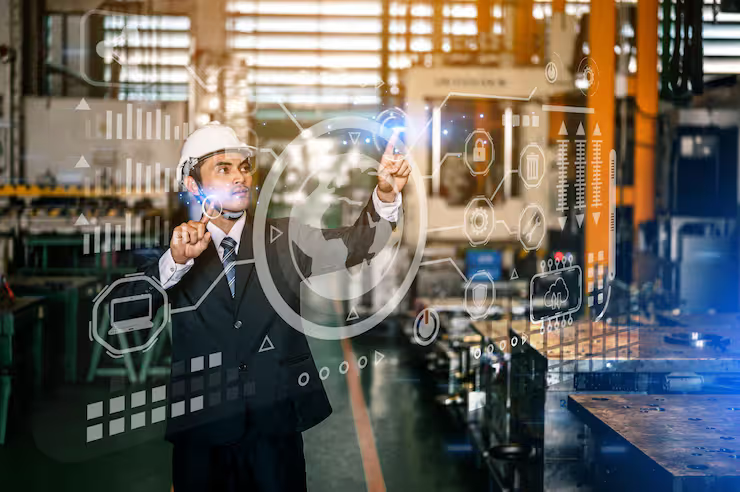
Why Industrial Process Manufacturing Matters
Modern manufacturing depends on consistent processes. Small variations in raw materials or operating conditions can affect product quality, production efficiency, equipment reliability, and environmental performance.
Industrial process manufacturing is important to manufacturers, engineers, plant managers, quality teams, maintenance personnel, regulators, and industries that depend on reliable material production.
Key areas where process manufacturing helps include:
- Process control: Automated systems continuously monitor production conditions.
- Quality management: Measurements and testing help maintain consistent specifications.
- Industrial automation: Controllers, sensors, and software reduce manual process intervention.
- Predictive maintenance: Equipment data can help identify abnormal operating conditions.
- Energy management: Monitoring electricity, steam, fuel, compressed air, and other utilities can identify areas for improvement.
- Production planning: Manufacturing software can coordinate materials, equipment, production schedules, and inventory.
- Industrial safety: Monitoring systems can detect potentially unsafe pressure, temperature, chemical, or equipment conditions.
Process Manufacturing Compared With Discrete Manufacturing
| Area | Process Manufacturing | Discrete Manufacturing |
|---|---|---|
| Production method | Continuous or batch processes | Individual units or assemblies |
| Typical materials | Liquids, powders, gases, mixtures | Components and finished products |
| Key controls | Temperature, pressure, flow, composition | Dimensions, assembly, positioning |
| Common industries | Chemicals, food, pharmaceuticals | Automotive, electronics, machinery |
| Production tracking | Batches, formulas, recipes | Parts, units, serial numbers |
The distinction is useful because the production software, quality controls, equipment, and measurement systems can differ significantly between the two approaches.
Recent Trends in Industrial Process Manufacturing
Industrial process manufacturing is increasingly influenced by automation, digitalization, energy efficiency, advanced analytics, and domestic manufacturing policies.
India's Economic Survey 2025–26 reported that manufacturing gross value added grew by 7.72% in the first quarter and 9.13% in the second quarter of FY2025–26. It also reported that medium- and high-technology activities represented 46.3% of India's manufacturing value added.
On 1 February 2025, India's Union Budget announced the National Manufacturing Mission, covering small, medium, and large industries. The initiative focuses on technology availability, quality products, MSMEs, workforce readiness, and clean-technology manufacturing.
The Union Budget 2026–27, announced on 1 February 2026, continued the emphasis on strategic manufacturing sectors, including advanced industries and technology-intensive production.
Electronics manufacturing has also expanded rapidly. A government update published on 1 April 2026 reported substantial growth in domestic electronics production and highlighted continued development of the electronics manufacturing value chain.
These developments show a broader movement toward automated production, advanced manufacturing technology, domestic supply chains, and higher-value industrial production.
Major Technology Trends
- Industrial Internet of Things (IIoT)
- Digital twins and production simulation
- Manufacturing execution systems (MES)
- Enterprise resource planning (ERP) integration
- Artificial intelligence and machine learning
- Predictive maintenance
- Advanced process control
- Robotics and automated material handling
- Energy monitoring systems
- Real-time production analytics
Laws, Standards, and Policies in India
Industrial process manufacturing in India is affected by several categories of regulation. Requirements vary according to the industry, location, materials handled, equipment used, environmental impact, and product category.
The Occupational Safety, Health and Working Conditions Code, 2020 is part of India's labour-code framework. The Ministry of Labour and Employment also lists central rules and notifications associated with implementation of the labour codes.
Environmental requirements can apply to emissions, wastewater, hazardous materials, waste handling, and pollution control. Industrial facilities should therefore identify the environmental permissions and standards applicable to their specific activity and location.
Product standards can also be important. The Bureau of Indian Standards (BIS) develops and publishes Indian Standards and operates conformity-assessment systems. Some products have mandatory requirements established through government notifications and Quality Control Orders.
For regulatory planning, India's National Single Window System (NSWS) provides guidance for identifying approvals across central departments and participating states. Its Know Your Approvals module was updated in July 2026 and covers a broad range of industrial categories.
Because regulations differ by industry and state, manufacturers should verify current requirements with the relevant government authority before making compliance decisions.
Tools and Resources for Process Manufacturing
Technology plays an important role in planning, monitoring, controlling, and improving industrial processes.
Manufacturing Software
Manufacturing Execution Systems (MES) connect production activities with operational data. They can track batches, production stages, quality information, equipment status, and manufacturing records.
Enterprise Resource Planning (ERP) platforms can connect manufacturing with inventory management, procurement, finance, production planning, and supply-chain information.
Process Control Systems
Distributed Control Systems (DCS), Programmable Logic Controllers (PLC), Supervisory Control and Data Acquisition (SCADA), sensors, and industrial networks are commonly used to monitor and control production processes.
Industrial Analytics
Manufacturers can use dashboards, statistical process control, production analytics, and machine-learning models to identify trends and unusual operating conditions.
Useful Indian Resources
- Bureau of Indian Standards (BIS) — Indian Standards, conformity assessment information, and technical resources.
- BIS Know Your Standard — Search Indian Standards by standard number or product-related keywords.
- National Single Window System — Guidance for identifying relevant industrial approvals and regulatory requirements.
- Ministry of Labour and Employment – Labour Codes — Official information about India's labour-code framework.
Frequently Asked Questions
What is industrial process manufacturing?
Industrial process manufacturing transforms raw materials into products through controlled physical, chemical, thermal, or biological processes. It is common in industries such as chemicals, food, pharmaceuticals, petroleum, cement, and paper.
What is the difference between process and discrete manufacturing?
Process manufacturing generally produces materials through continuous or batch operations, while discrete manufacturing produces identifiable individual items or assemblies. Process manufacturing focuses heavily on variables such as temperature, pressure, flow, and composition.
What technologies are used in process manufacturing?
Common technologies include PLCs, DCS, SCADA, MES, ERP platforms, industrial sensors, robotics, industrial IoT, advanced process control, machine learning, and production analytics.
Why is automation important in process manufacturing?
Automation can continuously monitor operating conditions, control production variables, collect data, and support consistent production. It can also help reduce manual intervention in repetitive or hazardous operations.
What regulations affect industrial process manufacturing in India?
Requirements can involve workplace safety, environmental protection, product standards, chemical handling, waste management, and industry-specific regulations. Applicable requirements depend on the manufacturing activity, materials, equipment, and location.
Conclusion
Industrial process manufacturing is a fundamental part of modern industry. It provides the controlled production methods needed to transform raw materials into chemicals, foods, medicines, fuels, construction materials, metals, and many other products.
The sector is becoming increasingly connected through industrial automation, process control systems, manufacturing software, IIoT, artificial intelligence, predictive maintenance, and real-time analytics. At the same time, manufacturers must consider workplace safety, environmental responsibilities, product standards, and applicable government regulations.
For India, recent manufacturing policies and technology-focused initiatives indicate continued emphasis on advanced production, domestic industrial capabilities, digital manufacturing, and higher-value processes. Understanding the fundamentals of process manufacturing therefore provides useful context for anyone studying industrial automation, manufacturing technology, process engineering, or modern production systems.