Industrial refrigeration plants are engineered cooling systems designed to remove and control heat across large-scale facilities.
Unlike ordinary commercial refrigeration, these systems can operate continuously and support demanding applications such as food processing, cold storage, beverage production, pharmaceuticals, chemical processing, and industrial manufacturing.
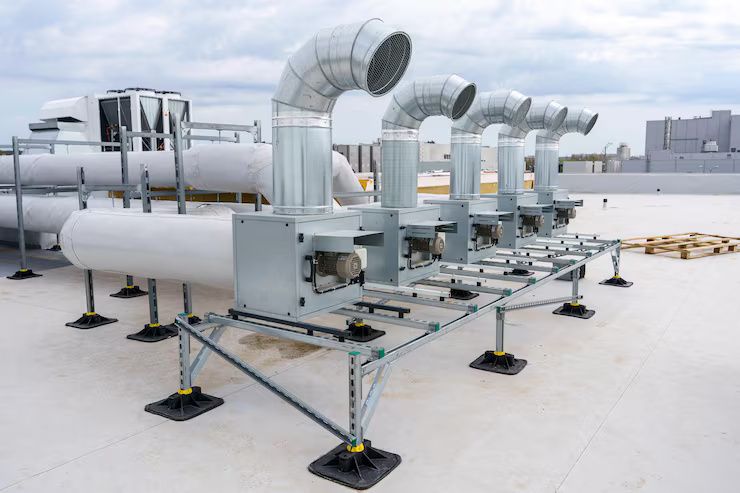
Understanding how an industrial refrigeration plant works helps businesses and technical teams evaluate cooling requirements, equipment functions, energy use, safety considerations, and maintenance needs. Modern plants combine refrigeration equipment, heat-transfer components, controls, monitoring systems, and carefully designed piping networks to maintain stable temperatures under changing operating conditions.
What Is an Industrial Refrigeration Plant?
An industrial refrigeration plant is a centralized system that produces and distributes cooling for industrial processes or temperature-controlled spaces. It typically uses a refrigeration cycle to extract heat from a process, product, storage room, or other area and transfer that heat to the surrounding environment.
The plant may serve a single large facility or multiple cooling zones. Depending on the application, it can provide low-temperature refrigeration, chilled water, glycol cooling, air cooling, or direct refrigeration to process equipment.
A typical industrial refrigeration system includes:
- Compressors
- Condensers
- Evaporators
- Expansion devices
- Refrigerant piping
- Pumps and circulation equipment
- Control and monitoring systems
- Cooling towers or other heat-rejection equipment where required
- Safety and protection devices
The size and configuration of the plant depend on cooling capacity, operating temperatures, production schedules, environmental conditions, and the characteristics of the industrial process.
How Does an Industrial Refrigeration System Work?
Most industrial refrigeration plants operate according to the basic vapor-compression refrigeration cycle. The process continuously moves refrigerant through several stages to absorb heat from a controlled environment and release it elsewhere.
1. Compression
The refrigeration cycle begins when low-pressure refrigerant vapor enters the compressor. The compressor increases the refrigerant's pressure, which also raises its temperature.
Industrial compressors are designed for continuous operation and may use different technologies depending on the required capacity and operating conditions. Multiple compressors can also be arranged in parallel so that cooling output can respond to changing demand.
2. Condensation
The high-pressure, high-temperature refrigerant then moves to the condenser. Here, heat is transferred from the refrigerant to another medium, such as air or water.
As heat is rejected, the refrigerant changes from a vapor into a high-pressure liquid. Condensers therefore play an important role in maintaining efficient heat rejection and stable system operation.
3. Expansion
The high-pressure liquid passes through an expansion device. This reduces the refrigerant pressure and temperature.
The resulting low-pressure refrigerant mixture is then ready to enter the evaporator and absorb heat again.
4. Evaporation
Inside the evaporator, the refrigerant absorbs heat from the process or space being cooled. As it absorbs thermal energy, the refrigerant evaporates into a vapor.
The vapor returns to the compressor, and the cycle repeats.
This continuous process allows the refrigeration plant to remove heat over extended operating periods while maintaining the required temperature range.
Major Components of an Industrial Refrigeration Plant
Each component has a specific role, but the plant must be considered as an integrated system.
Compressors
Compressors provide the pressure difference needed to circulate refrigerant through the system. Industrial facilities may use reciprocating, screw, centrifugal, or other compressor technologies depending on capacity and application.
Large plants may use multiple compressors to improve capacity control and operational flexibility.
Condensers
Condensers reject the heat collected from the refrigerated environment and the heat generated during compression. Their design influences system performance, especially in facilities operating under varying outdoor temperatures.
Evaporators
Evaporators absorb heat from the area or process being cooled. Their design varies according to whether the application involves cold rooms, process cooling, liquid chilling, freezing, or other industrial requirements.
Expansion Devices
Expansion valves or related devices regulate refrigerant flow into the evaporator while creating the pressure reduction required for evaporation.
Piping and Pumps
Refrigerant piping connects the main components, while pumps may circulate secondary cooling fluids such as chilled water or glycol. Proper piping design is important for maintaining reliable flow, pressure, and temperature conditions.
Types of Industrial Refrigeration Applications
Industrial refrigeration plants support a wide range of temperature-control requirements.
Cold storage: Large warehouses use refrigeration systems to preserve food, agricultural products, pharmaceuticals, and other temperature-sensitive materials.
Food processing: Refrigeration may be integrated into freezing, cooling, preparation, packaging, and storage processes.
Beverage production: Breweries, dairies, and beverage plants often require controlled cooling for ingredients, processing equipment, and finished products.
Pharmaceutical manufacturing: Temperature-controlled environments and process cooling can help maintain specified manufacturing conditions.
Chemical processing: Some chemical processes require controlled temperatures to manage reactions, material properties, or production conditions.
Manufacturing: Industrial refrigeration can support machinery cooling, process-temperature control, and production environments.
Refrigerants and Heat-Transfer Methods
Refrigerants are central to refrigeration system performance. Modern industrial plants may use different refrigerant technologies based on application requirements, system design, environmental considerations, and applicable regulations.
Some systems use a refrigerant directly at the cooling point, while others use a secondary fluid. In a secondary-loop system, refrigeration equipment cools a fluid such as water or glycol, which is then circulated to different parts of the facility.
The choice between direct and secondary cooling depends on factors such as temperature requirements, system layout, safety considerations, equipment configuration, and operating conditions.
Automation and Control in Modern Refrigeration Plants
Modern industrial refrigeration plants increasingly use automated controls to monitor operating conditions and adjust system performance.
Sensors can measure parameters such as:
- Temperature
- Pressure
- Refrigerant conditions
- Fluid flow
- Compressor operation
- Energy consumption
- Equipment status
A centralized control system can use this information to coordinate compressors, fans, pumps, valves, and other equipment.
Capacity control is particularly important because cooling demand is rarely constant. Automated systems can adjust refrigeration output as production loads, storage conditions, and ambient temperatures change.
Remote monitoring can also help operators identify abnormal operating conditions and maintenance requirements before they develop into larger operational problems.
Energy Efficiency Considerations
Refrigeration can represent a significant portion of energy use in facilities that operate continuously. Improving efficiency therefore involves more than selecting efficient individual components.
Important considerations include appropriate system sizing, effective heat transfer, insulation, compressor capacity control, condenser performance, evaporator operation, and regular maintenance.
Reducing unnecessary heat gain is also important. Well-maintained insulation, properly sealed cold rooms, efficient doors, and suitable airflow management can reduce the refrigeration load.
Energy monitoring provides another useful tool by allowing operators to compare refrigeration performance against production activity and identify unusual changes.
Safety and Maintenance Requirements
Industrial refrigeration plants require structured maintenance because they operate with pressurized equipment, rotating machinery, electrical systems, and refrigerants.
Routine maintenance may include inspecting compressors, checking oil conditions, cleaning heat-transfer surfaces, examining valves and piping, verifying sensors, testing controls, and checking safety devices.
Operators should also follow established procedures for refrigerant management, equipment isolation, emergency response, and confined or restricted work areas.
Preventive maintenance is generally more effective than waiting for equipment failure because refrigeration problems can affect production, product quality, storage conditions, and overall facility operation.
How to Plan an Industrial Refrigeration Plant
Planning should begin with the actual cooling requirement rather than simply selecting equipment. Engineers typically consider required temperatures, heat loads, operating hours, production patterns, ambient conditions, expansion requirements, available utilities, and facility layout.
The system should provide sufficient capacity for normal operation while allowing practical control during periods of lower demand. Equipment accessibility, maintenance space, piping routes, ventilation, safety systems, and future operational changes should also be considered during design.
Frequently Asked Questions
What is the main purpose of an industrial refrigeration plant?
Its main purpose is to remove and control heat for industrial processes, storage areas, products, machinery, or temperature-sensitive materials.
How is industrial refrigeration different from commercial refrigeration?
Industrial refrigeration systems generally operate at larger capacities and are designed for demanding continuous-duty applications, complex processes, multiple temperature zones, or large storage environments.
What are the main parts of a refrigeration plant?
The primary components include compressors, condensers, evaporators, expansion devices, piping, controls, and supporting equipment such as pumps and heat-rejection systems.
Why is automation important?
Automation helps monitor operating conditions, regulate cooling capacity, improve temperature control, identify abnormal conditions, and coordinate equipment operation.
What affects refrigeration plant efficiency?
System design, equipment selection, heat-transfer performance, insulation, operating temperatures, load variation, maintenance, controls, and heat rejection can all influence efficiency.
Conclusion
Industrial refrigeration plants are sophisticated cooling systems built around a simple principle: continuously remove unwanted heat and transfer it away from the area or process that needs cooling. Compressors, condensers, expansion devices, and evaporators work together as part of the refrigeration cycle, while controls and monitoring systems help manage changing loads.
For modern industrial facilities, effective refrigeration planning involves more than cooling capacity. Reliability, temperature stability, energy performance, maintenance access, operational safety, and long-term system flexibility are equally important. Understanding these fundamentals provides a useful foundation for evaluating how industrial refrigeration plants work and how they support modern manufacturing, processing, and temperature-controlled operations.