
Industrial robotics refers to the use of programmable mechanical machines to perform manufacturing, material handling, assembly, inspection, and other industrial activities. These robots combine mechanical structures, motors, sensors, controllers, and software to complete tasks with controlled movements and repeatable operations.
The development of industrial robotics is closely connected to the growth of modern manufacturing and automation. Early industrial robots were primarily designed for repetitive operations in automotive factories. Over time, improvements in computer technology, electronic controls, machine vision, and artificial intelligence expanded their capabilities across different industries.
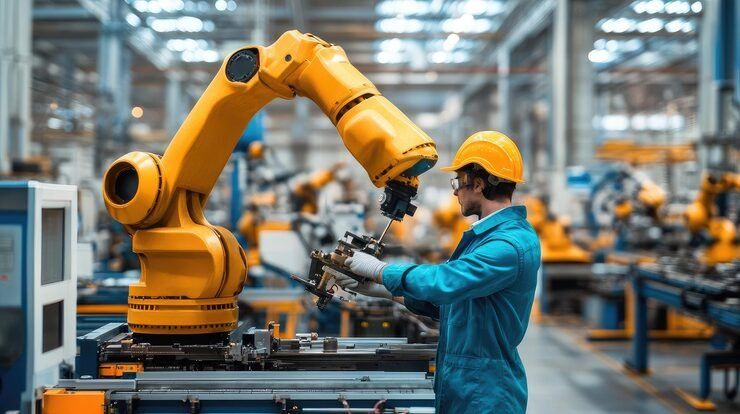
Today, industrial robotics applications include welding, painting, packaging, palletizing, machine tending, electronic assembly, and quality inspection. Modern robotic systems can also communicate with production equipment, manufacturing software, and connected factory networks.
Why Industrial Robotics Matters in Modern Manufacturing
Industrial robotics plays an important role in manufacturing because many production activities require repetitive movements, controlled positioning, consistent handling, and precise operations. Robots can perform programmed tasks in environments involving high temperatures, heavy materials, hazardous substances, or continuous production cycles.
Manufacturers use industrial automation systems to address production challenges such as inconsistent product quality, material handling difficulties, workplace hazards, and equipment utilization.
Industrial robotics affects several groups:
Manufacturers: Use robots to automate repetitive production operations.
Factory Operators: Work with robotic equipment and automated production systems.
Maintenance Engineers: Monitor robot performance and maintain mechanical and electrical components.
Production Managers: Coordinate robotic operations with manufacturing schedules.
System Integrators: Connect robots with conveyors, sensors, controllers, and factory software.
Industrial Designers: Develop robotic work cells and production layouts.
According to the International Federation of Robotics (IFR), the main reasons for industrial robot adoption include production flexibility, product quality, productivity, and workplace safety.
Major Types of Industrial Robots Used in Manufacturing
Different industrial robot types are designed for specific movements, payload capacities, working areas, and production requirements.
Articulated Robots
Articulated robots use multiple rotating joints to provide flexible movement. They commonly have four to six or more axes, depending on their design.
These robots are widely used for automotive welding, painting, material handling, machine tending, and assembly operations.
Cartesian Robots
Cartesian robots operate along linear axes, generally using X, Y, and Z movements. Their structured movement makes them suitable for applications requiring controlled positioning.
Common applications include machine loading, packaging, pick-and-place operations, and automated inspection.
SCARA Robots
Selective Compliance Assembly Robot Arms (SCARA) are designed for fast horizontal movements and precise assembly operations. They are frequently used in electronics manufacturing, component insertion, packaging, and small-part handling.
Delta Robots
Delta robots use interconnected arms arranged around a fixed structure. Their lightweight design supports rapid picking, sorting, and packaging activities.
They are commonly found in food processing, pharmaceutical packaging, and consumer goods production.
Collaborative Robots
Collaborative robots, commonly called cobots, are designed for applications involving interaction with human workers. Depending on the risk assessment and safety configuration, they can assist with assembly, machine tending, inspection, and material handling.
Cobots generally emphasize flexible deployment and accessible programming, although their payload and speed capabilities vary by model.
Robot Type | Main Movement | Common Application |
|---|---|---|
Articulated | Multiple rotating joints | Welding and painting |
Cartesian | Linear axis movement | Pick-and-place |
SCARA | Horizontal articulated movement | Precision assembly |
Delta | Parallel arm movement | High-speed packaging |
Collaborative | Application-dependent movement | Human-robot collaboration |
Industrial Robotics Technologies and Automation Systems
Modern industrial robots combine several technologies to perform complex manufacturing activities.
Artificial Intelligence and Machine Vision
Artificial intelligence allows robotic systems to analyze information and respond to selected operating conditions. Machine vision uses cameras and image-processing software to identify objects, inspect components, and guide robotic movements.
These technologies are used in automated quality inspection, component sorting, defect detection, and intelligent picking systems.
Robotic Sensors and Motion Control
Industrial robots use sensors to monitor position, force, speed, temperature, and surrounding conditions. Motion controllers coordinate motor movements and help maintain programmed operating sequences.
Force and torque sensors are particularly useful in assembly applications where controlled contact with components is required.
Automated Guided Vehicles and Mobile Robots
Automated guided vehicles (AGVs) and autonomous mobile robots (AMRs) move materials between production stations, warehouses, and storage areas.
AGVs generally follow defined routes or guidance systems, while AMRs use navigation technologies to move through changing environments.
Digital Twin and Simulation Technology
Digital twin technology creates a digital representation of a physical robot or production system. Engineers use simulation software to evaluate robotic movements, workspace layouts, collision risks, and production sequences before implementing changes.
Industrial Communication Systems
Industrial robots communicate with PLCs, sensors, production equipment, and manufacturing execution systems (MES). Industrial Ethernet and other communication protocols help coordinate activities across connected production environments.
Industrial Robot Manufacturing and Integration Processes
Industrial robot deployment involves more than installing a robotic arm. It requires equipment selection, application planning, system integration, programming, and safety evaluation.
Application Planning and Robot Selection
The process begins by identifying the manufacturing task, required payload, operating speed, working area, and movement requirements.
Engineers select a suitable robot based on the product dimensions, production environment, tooling requirements, and intended operating cycle.
Robotic Work Cell Design
A robotic work cell is a designated area containing the robot, workpieces, fixtures, tools, sensors, and safety equipment.
Its design considers robot reach, movement paths, operator access, material flow, and surrounding machinery.
Programming and System Integration
Robots are programmed using dedicated software, teach pendants, simulation tools, or application-specific interfaces.
System integrators connect robotic equipment with conveyors, industrial controllers, machine vision systems, and other production machinery.
Testing and Commissioning
Before regular operation, the robotic system undergoes testing to verify movement accuracy, task execution, equipment communication, and safety functions.
Commissioning also involves operator training, maintenance planning, and documentation.
Global Industrial Robot Manufacturers and Technology Providers
The industrial robotics market includes robot manufacturers, automation equipment developers, software providers, and system integration companies.
Some internationally recognized industrial robot manufacturers include:
ABB: Develops industrial robots, collaborative robots, and automation technologies for manufacturing.
FANUC: Manufactures industrial robots, CNC systems, and factory automation equipment.
KUKA: Provides robotic systems for automotive, electronics, logistics, and general manufacturing.
Yaskawa Motoman: Develops industrial robots for welding, handling, assembly, and packaging.
Kawasaki Robotics: Manufactures industrial robots for material handling, welding, and manufacturing applications.
Universal Robots: Specializes in collaborative robotic systems for industrial applications.
Mitsubishi Electric: Provides industrial automation equipment, controllers, and robotic systems.
Stäubli: Develops industrial robots for precision manufacturing, electronics, and pharmaceutical applications.
Other participants include machine vision companies, robotic gripper manufacturers, sensor developers, industrial software providers, and automation system integrators.
The selection of a manufacturer depends on application requirements, technical compatibility, regional support arrangements, safety features, and equipment specifications.
Industrial Applications of Robotics Across Different Sectors
Industrial robots are used in various industries to automate manufacturing and material handling operations.
Industry | Robotic Application | Main Purpose |
|---|---|---|
Automotive | Welding and painting | Vehicle assembly |
Electronics | Precision assembly | Component manufacturing |
Food Processing | Sorting and packaging | Product handling |
Pharmaceuticals | Packaging and inspection | Controlled production |
Aerospace | Drilling and component handling | Aircraft manufacturing |
Metalworking | Cutting and welding | Metal fabrication |
Logistics | Palletizing and transportation | Warehouse automation |
Plastics | Machine tending | Plastic product manufacturing |
In automotive factories, articulated robots perform welding, painting, and component installation. Electronics manufacturers use SCARA robots for precision assembly, while food manufacturers use delta robots for sorting and packaging.
Pharmaceutical facilities use robotic systems for selected packaging, inspection, and material handling activities. In warehouses, mobile robots coordinate the movement of materials between storage and production areas.
Industrial Robotics Regulations and Safety Standards in India
Industrial robotics is influenced by machinery safety requirements, workplace regulations, electrical standards, and applicable industry-specific rules.
In India, the Ministry of Labour and Employment oversees relevant occupational safety frameworks. The Occupational Safety, Health and Working Conditions Code, 2020, forms part of the country's broader workplace safety legislation.
The Bureau of Indian Standards (BIS) develops relevant industrial and machinery standards. Internationally, ISO 10218 addresses industrial robot safety, while ISO/TS 15066 provides additional guidance for collaborative robot applications.
Important safety considerations include:
Emergency stop systems and protective devices.
Robot operating zones and restricted access.
Collision prevention and risk assessment.
Electrical and mechanical equipment safety.
Operator training and maintenance procedures.
Safe integration of robots with surrounding machinery.
Safety requirements depend on the robot type, application, operating environment, and applicable regulations.
Recent Developments in Industrial Robotics, 2024–2026
Industrial robotics is evolving through artificial intelligence, improved sensing, connected manufacturing systems, and more flexible automation technologies.
AI-Powered Robotics: AI is expanding the ability of robots to recognize objects, interpret visual information, and adapt selected movements to changing conditions.
Collaborative Robotics: Cobots are being adopted for applications involving flexible production, machine tending, assembly, and material handling. IFR reported that collaborative robots represented 10.5% of industrial robots installed worldwide in 2023.
Humanoid Robotics: Manufacturers and technology developers are investigating humanoid robots for industrial environments, although reliability, safety, payload, and operating performance remain important evaluation factors.
Digital Twin Integration: Virtual robot models are increasingly used for production simulation, movement planning, and system-level analysis.
AI-Based Automation: The integration of AI, machine vision, and industrial control systems is expanding the range of manufacturing tasks that robots can perform.
Tools and Software Used in Industrial Robotics
Industrial robotics depends on specialized software and engineering tools for robot programming, simulation, monitoring, and system integration.
Some commonly used platforms include:
ABB RobotStudio: Used for robot programming, simulation, and virtual commissioning.
FANUC ROBOGUIDE: Supports robotic cell simulation and offline programming.
KUKA.Sim: Used for robot simulation and production layout planning.
Siemens TIA Portal: Supports industrial automation programming and controller configuration.
MATLAB and Simulink: Used for robotics modeling, control system development, and simulation.
ROS (Robot Operating System): Provides software libraries and development tools for robotics applications.
Visual Components: Supports 3D factory simulation and robotic production planning.
These platforms help engineers evaluate robot movements, production layouts, equipment communication, and manufacturing workflows.
Frequently Asked Questions About Industrial Robotics
1. What are the main applications of industrial robotics?
Industrial robotics is used for welding, painting, assembly, packaging, palletizing, machine tending, material handling, and automated quality inspection.
2. What are the five main types of industrial robots?
The five common categories are articulated robots, Cartesian robots, SCARA robots, delta robots, and collaborative robots. Each has different movement capabilities and industrial applications.
3. How does AI improve industrial robot automation?
AI helps robots recognize objects, analyze visual information, identify production patterns, and adapt selected operations to changing conditions.
4. Who are the major global industrial robot manufacturers?
Major manufacturers include ABB, FANUC, KUKA, Yaskawa Motoman, Kawasaki Robotics, Universal Robots, Mitsubishi Electric, and Stäubli.
5. What is the difference between industrial robots and collaborative robots?
Traditional industrial robots commonly operate in designated work cells with protective barriers or other safety systems. Collaborative robots are designed for applications involving interaction with people, subject to appropriate risk assessments and safety measures.
Conclusion
Industrial robotics is an important part of modern manufacturing, combining mechanical engineering, automation, sensors, and intelligent software. Different robot types support specialized activities such as welding, assembly, packaging, inspection, and material handling. AI, machine vision, digital twins, and collaborative robotics are expanding industrial automation capabilities. Equipment selection, system integration, workplace safety, and regulatory compliance remain essential aspects of industrial robot applications.