The Internet of Things (IoT) refers to a network of physical objects that can collect, exchange, and sometimes act on data through internet-connected technologies.
These objects can include household appliances, industrial machines, vehicles, agricultural equipment, medical devices, environmental sensors, and smart infrastructure.
An IoT device generally contains sensors, software, communication capabilities, or a combination of these elements. Sensors gather information such as temperature, movement, pressure, location, humidity, or energy consumption. The device then sends the information to another device, an IoT platform, an edge computing system, or a cloud-based environment for processing.
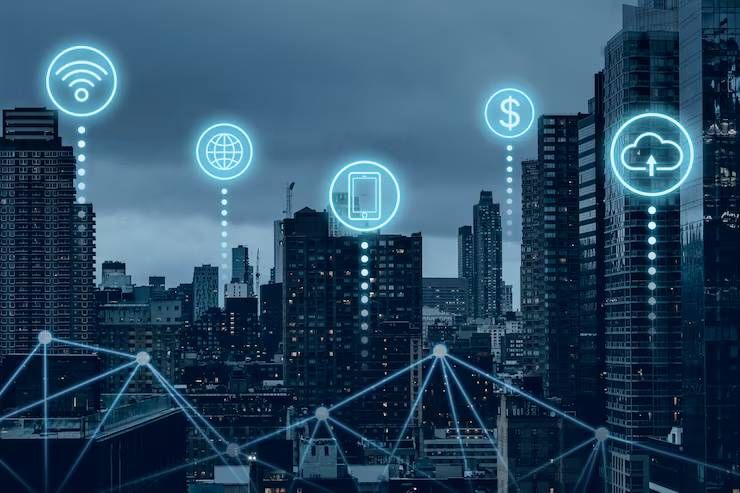
The basic IoT process can be understood as:
Device → Sensor → Network → Data Processing → Application → Action
For example, a temperature sensor in a manufacturing facility can monitor equipment conditions continuously. If the temperature rises beyond a defined level, the system can notify an operator or trigger an automated response.
IoT therefore connects the physical and digital worlds. It allows information from physical environments to become available for analysis, monitoring, automation, and decision-making.
| IoT Component | Main Function |
|---|---|
| Sensors | Collect information from the physical environment |
| Connected devices | Process or transmit collected information |
| Network | Transfers data between devices and systems |
| Edge computing | Processes selected information close to the device |
| Cloud or data systems | Store and analyze larger volumes of information |
| Applications | Present information and support actions |
Why the Internet of Things Matters
IoT has become important because organizations and individuals increasingly depend on connected systems. Instead of collecting information manually at occasional intervals, connected devices can gather data continuously or at scheduled intervals.
For households, IoT can support smart lighting, connected appliances, security systems, energy monitoring, and environmental controls. In healthcare, connected medical devices can collect selected measurements and help healthcare professionals monitor information remotely.
Industrial IoT is particularly important in manufacturing, energy, transportation, logistics, and infrastructure. Sensors can monitor machines and operating conditions, while data analytics can help identify unusual patterns.
IoT can address several practical challenges:
- Continuous monitoring of equipment and environments
- Faster access to operational information
- Automation of repetitive activities
- Remote monitoring of geographically distributed assets
- Detection of unusual conditions
- Better use of collected operational data
- Support for predictive maintenance programs
- Improved visibility across complex systems
IoT also affects consumers. Smart watches, connected vehicles, home assistants, security cameras, and fitness devices demonstrate how everyday products can become part of connected networks.
However, greater connectivity also introduces challenges. Devices may collect sensitive information, communicate across several networks, and depend on software that requires regular maintenance. This makes IoT security an important part of IoT architecture.
Recent Developments in IoT
IoT development has increasingly moved toward the combination of connected devices, artificial intelligence, edge computing, 5G, and advanced data analytics.
In India, the Ministry of Electronics and Information Technology's 2025–26 annual report highlighted the growing importance of intelligent IoT sensors. It noted applications across healthcare, agriculture, manufacturing, energy management, smart cities, transportation, and other sectors. The report also described the Centre of Excellence in Intelligent Internet of Things Sensors, established with support from the Government of Kerala.
Another notable development was India Mobile Congress 2025, held from October 8–11, 2025. STPI highlighted startups and technology initiatives covering IoT alongside artificial intelligence, blockchain, cybersecurity, FinTech, AgriTech, and data analytics. This reflects the growing convergence between IoT and other digital technologies.
India's telecommunications infrastructure is also relevant to IoT growth. In January 2026, the government reported that 5G services were available in 99.9% of districts in the country. Wider connectivity can support applications that depend on reliable mobile communication, although actual IoT performance still depends on device design, network conditions, and application requirements.
The direction of IoT development can be summarized as follows:
| Development | Relevance to IoT |
|---|---|
| AI and machine learning | Helps interpret large volumes of sensor data |
| Edge computing | Processes information closer to connected devices |
| 5G connectivity | Supports connected applications requiring mobile networks |
| Intelligent sensors | Enables more detailed monitoring |
| Industrial IoT | Connects machines, production systems, and operational data |
| Cybersecurity | Protects devices, networks, and information |
These developments show that modern IoT is increasingly becoming part of a wider technology ecosystem rather than functioning as an isolated category.
Laws, Policies, and Regulations in India
IoT systems in India can be affected by rules concerning telecommunications, cybersecurity, personal data, electronic systems, and sector-specific requirements.
The Digital Personal Data Protection Act, 2023 is relevant when IoT systems process personal data. For example, a connected device may collect information that can be associated with an identifiable individual. The Act establishes a framework for processing digital personal data and protecting individuals' rights.
On November 14, 2025, MeitY notified the Digital Personal Data Protection Rules, 2025. The rules introduced a phased implementation timeline, with different provisions becoming applicable at different times. IoT systems that process personal data therefore need to consider applicable requirements for notice, consent, security safeguards, and data handling as relevant provisions take effect.
Telecommunications regulation is another important area. India's Telecommunications (Telecom Cyber Security) Rules, 2024 were notified on November 21, 2024. The rules establish cybersecurity obligations for telecommunications entities and include provisions concerning telecommunications equipment and identifiers.
An October 2025 amendment to the Telecom Cyber Security Rules and an August 2026 circular concerning use of the ICDR portal demonstrate that the regulatory framework continued to develop during the past year.
The practical effect of these policies depends on the IoT device, the type of information collected, the network involved, and the organization operating the system. Organizations should therefore assess applicable requirements rather than treating every IoT deployment as subject to exactly the same rules.
Tools and Resources for Learning IoT
Several established tools and reference resources can help people understand or experiment with IoT concepts.
- Arduino IDE: Useful for programming compatible microcontroller boards and experimenting with sensors.
- Node-RED: A visual programming environment commonly used for connecting devices, data sources, APIs, and applications.
- ThingsBoard: An IoT platform that can be used for learning about device data, dashboards, telemetry, and IoT architecture.
- MQTT: A lightweight messaging protocol widely associated with connected-device communication.
- OWASP Internet of Things Project: Provides security guidance and information about common IoT security risks.
- NIST IoT resources: Provides technical guidance and publications covering IoT cybersecurity and trustworthy connected-device practices.
For beginners, a simple learning path is to understand sensors first, followed by microcontrollers, networking, MQTT, data storage, dashboards, and cybersecurity.
Frequently Asked Questions
What is the Internet of Things in simple terms?
The Internet of Things is a system in which physical objects use sensors, software, and communication technologies to collect and exchange data. Examples include smart watches, connected vehicles, industrial sensors, and smart home equipment.
How does an IoT device work?
An IoT device generally collects information through sensors, processes some of that information, and sends relevant data through a network. Software can then analyze the information and present it to a person or use it to trigger an automated action.
What is IoT security?
IoT security involves protecting connected devices, networks, software, and data from unauthorized access, misuse, manipulation, and other cybersecurity threats. Strong authentication, software updates, encryption, access controls, and secure device configuration are common security considerations.
What is industrial IoT?
Industrial IoT, or IIoT, applies connected sensors and digital technologies to industrial environments. It can be used to monitor machinery, production systems, energy use, environmental conditions, and other operational processes.
What is the role of AI in IoT?
AI can analyze information generated by connected devices and identify patterns that may be difficult to detect manually. When combined with IoT data, AI can support anomaly detection, forecasting, classification, automation, and other analytical tasks.
Conclusion
The Internet of Things connects physical objects with digital networks so that information can be collected, communicated, analyzed, and used for appropriate actions. Its applications range from smart homes and wearable devices to industrial automation, agriculture, healthcare, transportation, and smart infrastructure.
The next stage of IoT is increasingly connected with artificial intelligence, edge computing, advanced sensors, and faster communication networks. At the same time, privacy and cybersecurity remain essential because connected devices can generate significant amounts of information.
In India, developments in intelligent IoT sensors, 5G connectivity, data protection, and telecommunications cybersecurity are shaping the environment in which connected technologies operate. Understanding both the technical foundations and the regulatory context is therefore important for anyone studying or working with IoT.