Offset printing machines are mechanical and computer-controlled systems used to reproduce text, images, graphics, packaging materials, books, brochures, newspapers, labels, and many other printed products.
The technology is based on the principle that ink and water do not mix. In traditional offset printing, an image is transferred from a printing plate to a rubber blanket and then from the blanket onto paper or another suitable substrate.
The word "offset" refers to this indirect transfer process. Unlike direct printing methods, the plate does not normally press the image directly onto the final material.
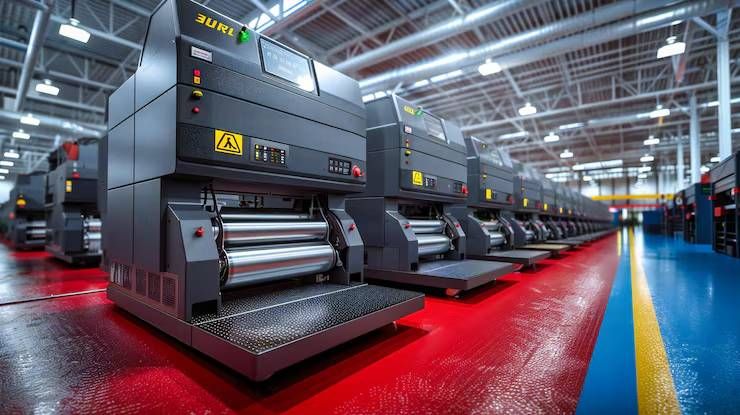
Modern offset printing machines can contain several printing units arranged in sequence. A four-colour press commonly uses cyan, magenta, yellow, and black, known as CMYK. Additional units may be used for special colours, coatings, or other finishing processes.
Offset printing is generally divided into two major machine formats:
- Sheetfed offset presses: Individual sheets of paper or board are fed into the machine.
- Web offset presses: Paper is supplied from a continuous roll and moves through the press at high speed.
A typical production workflow includes digital artwork preparation, prepress processing, plate imaging, plate mounting, ink and dampening preparation, printing, inspection, and finishing.
The basic process can be represented as:
| Stage | Main Activity |
|---|---|
| Prepress | Artwork preparation and colour separation |
| Plate production | Image transferred to printing plates |
| Plate cylinder | Plate carries the printable image |
| Blanket cylinder | Transfers the image from plate to substrate |
| Impression cylinder | Applies pressure for image transfer |
| Drying/finishing | Printed material is dried, coated, folded, or cut |
The technology continues to develop through automation, computer-to-plate systems, digital workflow integration, improved colour control, and energy-management features.
Why Offset Printing Machines Remain Important
Offset printing remains an important part of the commercial printing and publishing ecosystem because it combines established mechanical principles with increasingly sophisticated digital controls.
The technology is used across several areas, including:
- Books and educational publications
- Newspapers and magazines
- Corporate brochures and catalogues
- Product packaging and folding cartons
- Stationery and business documents
- Marketing and informational materials
- Labels and specialised printed products
- Large-volume publishing applications
One important advantage is consistency. Once the press has been correctly prepared and calibrated, the same image can be reproduced across a large production run with relatively stable colour and registration.
Offset printing also supports a broad range of paper weights, sizes, coatings, and substrates, depending on the machine configuration.
The technology is particularly relevant to businesses and organisations that require predictable colour reproduction and repeatable production processes. However, machine selection and workflow design depend on factors such as substrate, format, production volume, colour requirements, finishing requirements, and available automation.
Colour management is another major consideration. The ISO 12647 family provides process-control principles for offset lithographic printing. ISO is currently developing a new edition of ISO 12647-2, which covers process control for offset lithographic processes and is intended to replace the 2013 edition.
Recent Technology Developments
Offset printing technology has continued to evolve during 2025 and 2026, particularly around automation, workflow integration, colour control, energy efficiency, and reduced material waste.
In April 2026, HEIDELBERG India reported the installation of a new four-colour sheetfed offset press with a coating unit at Bhabani Offset in Guwahati. In August 2026, the company also announced an integrated sheetfed offset printing, workflow, and training competence centre in partnership with Printech Park Cluster.
These developments illustrate a broader movement toward combining mechanical printing equipment with digital workflow systems and technical training.
Automation is also becoming more significant. Modern presses can incorporate automated plate changing, colour measurement, registration control, presetting, washing systems, inspection systems, and production monitoring. These features can reduce manual intervention and help maintain consistent production conditions.
Sustainability has become another important technology consideration. Current industry discussions increasingly focus on lower material waste, energy-efficient equipment, reduced chemical use, recyclable substrates, and improved ink and coating technologies.
A 2026 industry report on sheetfed offset technology highlighted automation, digital integration, energy optimisation, and waste reduction as important areas of development.
Digital printing is also influencing offset printing technology. Digital systems can be advantageous for highly variable or short-run applications, while offset remains relevant for many repeatable, high-volume requirements. As a result, some modern production environments use both technologies rather than treating them as direct replacements.
Comparison of Common Offset Press Types
| Machine type | Typical format | Main characteristic | Common applications |
|---|---|---|---|
| Sheetfed offset | Individual sheets | Flexible substrate and format handling | Books, brochures, packaging |
| Web offset | Continuous paper roll | High-speed continuous production | Newspapers, magazines |
| Heatset web offset | Continuous roll with drying | Suitable for coated substrates and fast production | Magazines and commercial publications |
| Coldset web offset | Continuous roll without heat drying | Often used with absorbent newsprint | Newspapers |
| Four-colour offset | Four printing units | CMYK colour reproduction | General commercial printing |
| Multi-colour offset | Multiple printing units | Supports additional colours and coatings | Packaging and specialised applications |
Indian Laws, Standards, and Policies
Offset printing machines in India can be affected by several areas of regulation, including taxation, workplace safety, environmental management, waste handling, and state-level pollution-control requirements.
The Central Board of Indirect Taxes and Customs lists printing machinery under tariff heading 8443 in its GST rate information. The applicable tax treatment can depend on the exact classification and transaction, so organisations should verify the current classification before making compliance decisions.
Environmental requirements can also be relevant. Printing operations may involve inks, solvents, cleaning materials, paper waste, used containers, and other process-related materials. Depending on the operation and its environmental impact, permissions or compliance requirements may arise under applicable central and state pollution-control frameworks.
The Central Pollution Control Board maintains environmental rules and regulatory information, including material relating to industrial pollution and noise control. The Noise Pollution (Regulation and Control) Rules, 2000 regulate ambient noise and include industrial activity among the sources considered under the framework.
Electronic components associated with printing equipment may also raise end-of-life waste considerations. India's E-Waste (Management) Rules, 2022 establish an extended producer responsibility framework for covered electrical and electronic equipment and provide roles for the CPCB and State Pollution Control Boards.
Workplace safety is another consideration. The Occupational Safety, Health and Working Conditions Code, 2020 provides a national framework covering occupational safety and working conditions, including provisions relevant to industrial establishments.
Actual requirements can vary according to the type of press, installation, chemicals used, scale of operation, location, and applicable state regulations. Regulatory information should therefore be checked with the relevant authority before implementation.
Useful Tools and Resources
Several technical resources can help people understand and manage offset printing workflows.
PDF/X standards: PDF/X is an ISO-standardised family designed for reliable exchange of digital files intended for print reproduction. The PDF Association maintains current information about PDF/X standards, including PDF/X-4 and PDF/X-6.
ISO 12647: This standard family provides technical principles for process control and colour reproduction in printing. The current ISO development work on ISO/CD 12647-2 is particularly relevant to offset lithographic printing.
Fogra resources: Fogra provides information about ProcessStandard Offset and ISO 12647-based colour and process control. Its resources cover printing inks, consumables, colour measurement, and process standardisation.
CIP4 and JDF: The CIP4 organisation develops Job Definition Format (JDF) specifications for exchanging production information between systems. JDF can support workflow integration among prepress, management information, press-control, and finishing systems.
Colour-management software: Prepress departments commonly use colour-management applications, spectrophotometers, proofing systems, and calibration tools to maintain consistent colour reproduction.
Production calculators: Paper-weight, sheet-size, imposition, ink-coverage, production-time, and substrate calculators can assist with planning and technical evaluation.
Frequently Asked Questions
What is an offset printing machine?
An offset printing machine transfers an inked image from a plate to a rubber blanket and then onto the printing substrate. The indirect transfer principle gives the technology its name and helps produce consistent images across a production run.
What is the difference between sheetfed and web offset printing?
Sheetfed machines print on individual sheets, while web offset machines use a continuous roll of paper. Sheetfed systems are widely used for books, brochures, packaging, and commercial materials, while web presses are commonly associated with continuous high-volume publishing.
Why is colour management important in offset printing?
Colour management helps maintain predictable colour reproduction between digital artwork, proofing, plates, and the final printed result. Standards such as ISO 12647 provide process-control principles for offset printing.
What is computer-to-plate technology?
Computer-to-plate, or CTP, is a prepress technology that transfers digital page information directly onto printing plates without the traditional film-based intermediate stage. It can simplify the prepress workflow and support accurate plate production.
Are offset printing machines becoming more automated?
Yes. Modern offset presses increasingly incorporate automated setup, colour and registration control, digital workflow integration, production monitoring, and other control systems. Recent industry developments in India and elsewhere show continued investment in integrated printing and workflow technologies.
Conclusion
Offset printing machines remain an important technology for publishing, packaging, commercial printing, and other applications requiring repeatable and controlled print reproduction. Although digital printing has expanded significantly, offset technology continues to evolve rather than simply disappearing.
Modern offset presses increasingly combine mechanical printing principles with computerised controls, colour-management systems, automated setup, digital workflows, and sustainability-focused technologies.
In India, understanding the technology also requires awareness of applicable tax classification, environmental requirements, workplace safety provisions, waste-management rules, and relevant technical standards.