
Offshore and mooring components are essential parts of marine infrastructure used to secure vessels, floating platforms, offshore production units, and other structures in position. These components help manage forces caused by wind, waves, currents, tides, and vessel movement. They are used in offshore oil and gas operations, floating wind energy projects, ports, ship terminals, and marine construction.
Mooring systems connect a floating structure to anchors, piles, or other seabed foundations through chains, wire ropes, synthetic ropes, connectors, and related equipment. The arrangement depends on water depth, seabed conditions, environmental loads, the size of the floating structure, and the intended operating life.
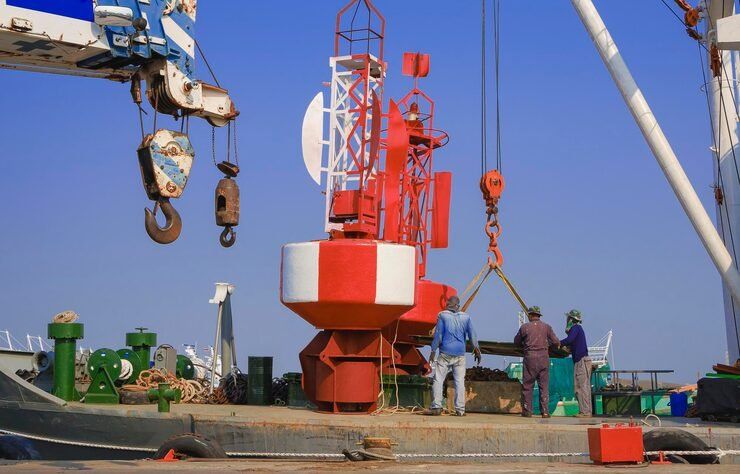
Offshore engineering has developed alongside commercial shipping, offshore energy production, and deepwater exploration. As offshore activities have expanded into deeper waters and more demanding environments, equipment designs have evolved to accommodate higher loads, corrosion exposure, fatigue, and complex installation requirements.
Main types of offshore and mooring components
Offshore mooring arrangements contain several interconnected components, each with a specific function.
Mooring chains: Heavy-duty chain assemblies that connect floating structures to anchors or other mooring equipment.
Wire ropes: Steel wire assemblies used where particular strength, flexibility, and handling characteristics are required.
Synthetic mooring ropes: Ropes made from engineered fibers that can reduce system weight and provide specific elasticity characteristics.
Anchors: Devices designed to resist movement by transferring mooring loads into the seabed.
Shackles and connectors: Mechanical fittings that connect chains, ropes, anchors, and structural attachment points.
Fairleads and chain stoppers: Equipment that guides mooring lines and secures chains or other load-bearing elements.
Buoys and floats: Floating devices used for navigation, marker functions, subsea support, or particular mooring arrangements.
Tensioning equipment: Hydraulic or mechanical systems used to adjust or maintain tension where the design requires it.
These components must be selected as part of an engineered system. A component's nominal strength alone does not establish whether it is appropriate for a particular offshore application.
How offshore mooring systems work
A mooring system resists the movement of a floating structure by transferring environmental and operational forces through connected lines and seabed attachments. The mooring lines may be arranged in different patterns according to the required station-keeping performance.
In a catenary mooring arrangement, the suspended shape and weight of the mooring line contribute to the system's response. In taut-leg systems, lines are installed with greater tension, and their geometry and elasticity influence how loads are transferred to the seabed.
Some floating facilities use spread mooring, in which lines extend in several directions around the structure. Others use turret mooring systems that allow a vessel to rotate relative to the environmental conditions while remaining connected to its mooring arrangement.
The appropriate configuration depends on the structure, water depth, environmental loads, seabed characteristics, and operational requirements.
Importance of Offshore and Mooring Components
Offshore mooring components are important because floating structures must remain within defined operating limits despite changing marine conditions. Excessive movement can affect operational safety, connected pipelines or cables, loading operations, and the integrity of nearby equipment.
Mooring failures can result from several interacting factors, including corrosion, fatigue, abrasion, overloading, manufacturing defects, incorrect installation, and unexpected environmental conditions. Reliable engineering and maintenance practices help identify and manage these risks.
Offshore applications across industries
Oil and gas production: Floating production, storage, and offloading vessels, offshore platforms, and floating storage units may use mooring systems to maintain position during operations.
Floating wind energy: Floating wind turbines require mooring lines and anchors to limit movement while accommodating the loads transmitted through the floating platform.
Ports and shipping: Mooring equipment secures ships at terminals, docks, and offshore loading facilities. The equipment arrangement depends on vessel size, berth design, and local environmental conditions.
Marine construction: Barges, floating cranes, construction platforms, and temporary work structures use mooring systems to maintain position during installation and maintenance activities.
Subsea infrastructure: Some mooring arrangements operate alongside subsea cables, pipelines, risers, and monitoring equipment. Their design must account for interaction between these systems.
Factors affecting component performance
Offshore equipment operates in environments that can be more demanding than many land-based applications. Engineers consider a range of conditions when specifying components.
Corrosion: Seawater and marine exposure can deteriorate metallic components over time.
Fatigue: Repeated loading from waves, wind, currents, and vessel motion can initiate or extend cracks.
Abrasion: Contact between ropes, chains, fairleads, and other surfaces can gradually damage materials.
Extreme loading: Storms and unusual environmental conditions can impose loads beyond ordinary operating levels.
Seabed conditions: Soil type, rock, sediment depth, and seabed slope influence anchor selection and holding performance.
Inspection access: Deepwater and submerged components may require remotely operated vehicles, specialized inspection tools, or recovery procedures.
The performance of the complete system depends on the compatibility of its components, their installation, and their condition throughout the operating life.
Equipment Types and Marine Technologies
Offshore mooring technology includes conventional mechanical components as well as engineered systems for positioning, monitoring, and controlling floating structures. The design must account for the forces transmitted through the entire mooring arrangement rather than treating each item as an isolated component.
Mooring chains, wire ropes, and synthetic lines
Mooring chains are commonly manufactured from high-strength steel and are designed for specified tensile loads, dimensions, and operating conditions. Stud-link and studless chains are used in different marine applications, depending on the system design and applicable requirements.
Steel wire ropes consist of multiple wires arranged into strands. Their flexibility and load-bearing characteristics make them suitable for selected mooring and marine lifting applications. They require inspection for broken wires, corrosion, deformation, and other signs of deterioration.
Synthetic mooring ropes may use high-performance fibers such as polyester or other engineered materials. Their relatively low weight can be useful in deepwater applications, although creep, abrasion, ultraviolet exposure, temperature, and handling requirements must be evaluated according to the material.
Anchors and seabed attachment systems
Anchors transfer mooring loads into the seabed. Different anchor types are designed for different soil conditions and loading directions.
Drag-embedment anchors penetrate the seabed as the mooring line applies horizontal force.
Suction piles use a hollow steel structure installed through controlled pressure differences to penetrate suitable seabed soils.
Driven piles are installed into the seabed using specialized piling equipment.
Gravity anchors rely substantially on their weight and interaction with the seabed to resist movement.
Plate anchors are designed to develop resistance through an embedded plate, with performance depending on installation and soil conditions.
Anchor selection requires geotechnical information, load analysis, installation planning, and assessment of potential seabed movement. A design suitable for soft sediment may not perform appropriately in rocky or highly variable seabed conditions.
Connectors, fairleads, and chain stoppers
Connectors provide load-bearing links between mooring system elements. Shackles, specialized links, and other fittings must be compatible with the connected chain or rope and designed for the expected load directions.
Fairleads guide mooring lines through designated paths while managing contact and alignment. Chain stoppers secure chains at specified locations and transfer loads to the supporting structure. Their design must account for local structural stresses, movement, and inspection requirements.
Dynamic positioning and monitoring systems
Dynamic positioning systems use thrusters, sensors, control computers, and positioning references to maintain a vessel's position. They differ from conventional anchor-based mooring because thrust and control systems actively counter environmental forces.
Some offshore operations use dynamic positioning alongside conventional mooring equipment, while others rely primarily on one approach. The choice depends on the vessel, operational profile, water depth, environmental conditions, and required reliability.
Monitoring systems may measure line tension, platform movement, environmental conditions, and equipment status. Data from these systems can help operators identify unusual behavior and plan inspections, but monitoring does not replace physical examination or engineering assessment.
Manufacturing Processes and Quality Control
Offshore and mooring components require controlled manufacturing because defects can affect the integrity of a complete marine structure. Production methods vary by component type, material, size, and design specification.
How offshore components are manufactured
Material selection and preparation: Manufacturers select steel grades, alloys, or synthetic fibers according to mechanical properties, environmental exposure, and applicable specifications. Materials may undergo incoming inspection and testing before production begins.
Forging and forming: Chain links, shackles, connectors, and other metallic components may be produced through forging, casting, machining, or specialized forming processes. The method depends on the component geometry and required material properties.
Welding and fabrication: Structural components, anchor bodies, piles, and support assemblies may require controlled welding procedures. Weld inspection and appropriate non-destructive testing help identify defects that may not be visible on the surface.
Heat treatment: Selected steel components undergo controlled heating and cooling to obtain specified mechanical properties. Process control is important because unsuitable treatment can affect strength, toughness, and dimensional stability.
Surface protection: Metallic components may receive coatings, protective treatments, or corrosion-management systems. The appropriate approach depends on immersion conditions, coating compatibility, abrasion exposure, and maintenance arrangements.
Rope manufacturing: Synthetic ropes are produced by arranging fibers into yarns, strands, or braided structures. Construction, finishing, and testing influence their strength, elongation, handling behavior, and durability.
Testing and inspection
Manufacturers and operators use several methods to assess equipment quality.
Tensile testing measures how a specimen responds to an applied pulling force.
Dimensional inspection checks component geometry against specified tolerances.
Non-destructive testing examines materials or welds for particular defects without necessarily damaging the component.
Proof-load testing applies a defined load under an approved procedure to assess specified performance characteristics.
Corrosion and material examinations evaluate degradation, surface condition, and relevant material properties.
Testing requirements depend on the component, design code, classification requirements, and project specifications. A successful test does not eliminate the need for correct installation, suitable operation, and continuing inspection.
Recent Developments in Offshore Mooring Technology
Developments from 2024 through 2026 reflect the expansion of floating offshore wind, deepwater energy projects, digital monitoring, and efforts to improve marine equipment reliability. Project designs continue to evolve as operators address different water depths, environmental conditions, installation constraints, and operating periods.
Floating offshore wind and deepwater systems
Floating wind projects use platforms connected to the seabed through engineered mooring arrangements. These systems must accommodate wind loads, wave motion, turbine operation, and repeated movement over extended periods.
Deepwater developments have also encouraged the use of lighter mooring lines, specialized synthetic ropes, optimized anchor arrangements, and installation methods adapted to remote offshore locations. Each design must account for the interactions between the floating platform, mooring lines, anchors, and subsea infrastructure.
Digital monitoring and inspection
Sensors and data analysis are increasingly used to monitor selected mooring system parameters. Measurements may include line tension, platform movement, corrosion indicators, and environmental conditions.
Digital monitoring can help identify changes that require investigation and support maintenance planning. However, sensor reliability, data quality, and the interpretation of recorded measurements remain important limitations.
Remotely operated vehicles and other subsea inspection technologies also help examine submerged components. These tools can support visual inspection and selected measurements without requiring divers to access every location.
Materials and environmental considerations
Material development focuses on the combination of strength, fatigue resistance, corrosion behavior, weight, and durability. Protective coatings, improved rope construction, and corrosion-management techniques can help address specific environmental challenges.
Environmental assessment is also relevant when selecting anchor systems and installation methods. Seabed disturbance, marine habitats, installation noise, and eventual equipment removal may need to be considered during project planning.
Laws, Standards, and Regulatory Requirements
Offshore and mooring equipment is subject to technical requirements intended to protect personnel, vessels, offshore structures, and the marine environment. Applicable rules depend on the project location, vessel classification, equipment type, and whether the system supports oil and gas production, shipping, or renewable energy.
International standards and industry guidance
Several organizations publish standards and technical guidance relevant to offshore mooring systems.
International Maritime Organization (IMO): Develops international maritime safety and environmental instruments applicable to ships and relevant offshore activities.
International Organization for Standardization (ISO): Publishes standards addressing offshore structures, engineering practices, and related technical requirements.
American Petroleum Institute (API): Publishes engineering standards and recommended practices relevant to offshore petroleum operations.
International Association of Classification Societies (IACS): Provides unified requirements and technical guidance used by participating classification societies.
DNV: Develops technical standards and recommended practices covering offshore structures, mooring systems, materials, and verification.
The applicable document depends on the project specification and regulatory framework. Classification requirements, flag-state obligations, coastal-state regulations, and contractual provisions may apply together.
Regulatory considerations in India
Offshore projects in India may need to comply with applicable maritime legislation, offshore petroleum regulations, environmental approvals, and port or coastal requirements. Depending on the activity, relevant authorities may include the Directorate General of Shipping, the Directorate General of Hydrocarbons, port authorities, and environmental regulators.
Projects must determine which requirements apply to their location and operations. Equipment certification, installation approval, inspection records, and environmental permissions may form part of the compliance process. Not every offshore mooring component is subject to the same approval requirements.
Tools and Resources for Offshore Mooring Systems
Engineers, manufacturers, inspectors, and offshore operators use technical tools to design mooring arrangements, evaluate equipment, and document operating conditions.
Common engineering tools
Mooring analysis software: Models environmental loading, line tension, platform movement, and system response under defined conditions.
Structural analysis tools: Evaluate stresses, deformations, fatigue, and load transfer through components and supporting structures.
Geotechnical analysis tools: Help engineers assess seabed conditions and the suitability of anchor systems.
Inspection and asset management systems: Organize inspection schedules, equipment histories, defect records, and maintenance activities.
Underwater inspection equipment: Includes remotely operated vehicles, cameras, and selected measurement instruments for examining submerged mooring components.
Information needed for equipment selection
Before selecting offshore mooring equipment, engineering teams typically evaluate:
Water depth and seabed characteristics.
Expected wave, wind, and current conditions.
Vessel or platform dimensions and displacement.
Required operating life and inspection arrangements.
Material strength, fatigue resistance, and corrosion exposure.
Compatibility between chains, ropes, connectors, anchors, and structural attachment points.
Installation limitations and applicable technical standards.
These factors help determine whether a proposed mooring arrangement is suitable for its intended operating environment.
Frequently Asked Questions
What are offshore and mooring components?
They are mechanical and structural elements used to secure vessels and floating offshore structures. Examples include chains, wire ropes, synthetic ropes, anchors, shackles, fairleads, and chain stoppers.
What is the difference between mooring chains and synthetic mooring ropes?
Mooring chains are metallic components with substantial weight and specific wear and strength characteristics. Synthetic ropes are generally lighter and may provide different elasticity and handling properties. Selection depends on the system design and operating conditions.
Which anchors are used in offshore mooring systems?
Common options include drag-embedment anchors, suction piles, driven piles, gravity anchors, and plate anchors. The appropriate type depends on seabed conditions, load direction, water depth, and installation requirements.
How are offshore mooring components tested?
Testing can include tensile testing, dimensional inspection, material examination, non-destructive testing, and approved proof-load procedures. The required tests depend on the component specifications and applicable standards.
How are offshore mooring systems monitored?
Selected systems use tension sensors, position measurements, environmental monitoring, and subsea inspections. These methods help identify unusual conditions and support maintenance planning, but they do not eliminate the need for physical inspection.
Conclusion
Offshore and mooring components help maintain the position and stability of vessels and floating structures in demanding marine environments. Chains, ropes, anchors, connectors, and monitoring technologies must function together within an engineered system. Manufacturing quality, material selection, installation procedures, corrosion management, and regular inspections all influence long-term reliability. Developments in floating wind energy, deepwater engineering, and digital monitoring continue to shape offshore mooring technology.