Snack frying machines are food-processing systems designed to cook snack products in heated edible oil under controlled conditions.
They are used for products such as potato chips, namkeen, sev, boondi, extruded snacks, coated nuts, pellets, and other fried foods.
Traditional frying can involve manually controlling oil temperature, product loading, cooking time, and removal. A modern industrial snack frying machine brings several of these activities into a controlled mechanical process. Depending on the design, a system may include a frying tank, conveyor, temperature-control unit, oil circulation system, filtration equipment, and product discharge mechanism.
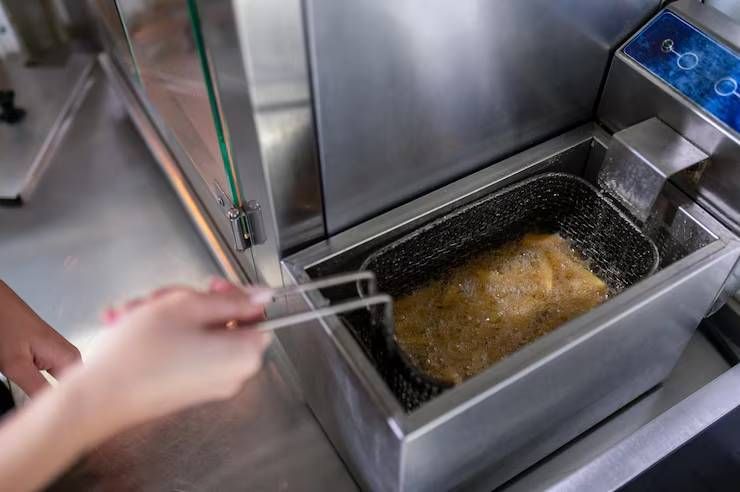
The basic frying process is relatively simple. Prepared food enters heated oil, moisture inside the food turns into steam, and heat moves through the product. The frying conditions influence texture, colour, moisture content, oil absorption, and overall product characteristics.
Different snack products require different frying conditions. Thin potato slices, for example, behave differently from batter-based products such as boondi or sev. Therefore, equipment configuration and process settings need to match the particular food being produced.
Common machine categories include:
- Batch frying machines
- Continuous frying machines
- Conveyor-based frying systems
- Automatic snack frying machines
- Vacuum frying systems
- Forming and frying machines
- Specialized frying lines for chips, namkeen and coated snacks
The Central Food Technological Research Institute has also developed technology for forming and frying food products, including snacks such as sev, boondi, namkeen and nuggets, demonstrating how forming and frying operations can be integrated.
Why Snack Frying Equipment Matters
The importance of snack processing equipment has increased as food manufacturers seek greater consistency, process control and hygiene. Manual frying can produce variations because temperature, cooking time and product loading may change from one batch to another.
Mechanized frying can help address some of these issues by providing controlled operating conditions.
Important areas include:
- Temperature control: Maintaining an appropriate oil temperature helps produce more consistent frying results.
- Residence time: Conveyor speed or batch duration can influence how long food remains in the oil.
- Oil circulation: Controlled circulation can distribute heat more evenly.
- Filtration: Removing crumbs and food particles can help maintain oil quality.
- Product consistency: Controlled feeding can produce more uniform cooking.
- Hygiene: Food-contact components can be designed for easier cleaning and inspection.
- Process monitoring: Sensors and control systems can help operators monitor important operating parameters.
Modern systems can also reduce the need for continuous manual intervention. However, automation does not eliminate the need for trained operators, cleaning procedures, preventive maintenance and food-safety controls.
The main relationship between process variables can be summarized as follows:
| Process factor | Main influence |
|---|---|
| Oil temperature | Frying rate and product colour |
| Frying duration | Moisture removal and texture |
| Product thickness | Heat penetration |
| Oil circulation | Heat distribution |
| Product loading | Temperature recovery |
| Filtration | Removal of crumbs and particles |
| Oil condition | Flavour and food-safety considerations |
Main Types of Snack Frying Machines
Batch frying machines process a defined quantity of food at a time. They can be suitable when different products need different frying conditions or when production is organized into separate batches.
Continuous frying machines move food through heated oil using conveyors or related mechanisms. They are commonly associated with larger, continuous production environments where consistent processing is required.
Automatic snack frying machines can combine feeding, frying, conveying and discharge functions. Depending on the system, temperature and conveyor controls may also be integrated.
Vacuum frying systems operate at reduced pressure, allowing frying at lower temperatures than conventional atmospheric frying. This technology is being studied and applied for products where colour, flavour, nutrient retention and oil absorption are important considerations.
Forming and frying machines combine shaping and frying. This approach can be useful for products that require controlled forming before entering the frying stage.
The appropriate configuration depends on the product, desired throughput, raw material characteristics, frying method, available space, energy requirements and food-safety procedures.
Recent Developments in Snack Frying Technology
Recent developments have focused on greater process control, healthier product development, automation and resource efficiency.
In 2025, industry discussions highlighted technologies such as low-temperature finish frying, continuous vacuum frying and pulsed electric field pre-treatment as approaches being explored to improve snack processing and help manage acrylamide formation.
Another development is the increasing use of automation. Modern frying lines can connect temperature sensors, conveyors, filtration systems and control panels so that operators can observe and adjust important process parameters.
Health-oriented snack development is also influencing processing technology. A 2025 report on food-processing innovation in India described equipment development around snacks made from millets and other grains, reflecting broader interest in alternatives to conventional fried snack formats.
FSSAI's current standards-development information also shows continuing technical review of oils and fats, including revisions and additions relating to vegetable-oil standards and composition parameters.
A simplified view of current technology priorities is:
| Technology direction | Processing objective |
|---|---|
| Automated temperature control | More stable frying conditions |
| Continuous filtration | Better management of food particles |
| Vacuum frying | Controlled lower-temperature frying |
| Sensor-based monitoring | Improved process visibility |
| Integrated forming and frying | Combined processing stages |
| Energy-efficient systems | Reduced resource use |
| Data recording | Better process documentation |
Indian Laws and Food-Safety Requirements
In India, snack frying operations are affected by the Food Safety and Standards Act, 2006 and regulations administered by the Food Safety and Standards Authority of India (FSSAI). The Act establishes the framework for science-based food standards and regulates areas including food manufacture, storage, distribution and import.
One particularly important requirement for frying operations concerns the condition of edible oil.
FSSAI states that repeated frying causes Total Polar Compounds (TPC) to form in oil. The authority has established a 25% TPC limit, beyond which the vegetable oil should not be used for frying. FSSAI also requires food businesses to monitor oil quality during frying.
Food businesses using significant quantities of frying oil also have record-keeping and disposal responsibilities. FSSAI's guidance states that food businesses consuming 50 litres or more of edible oil for frying per day are required to maintain records of oil use and disposal and dispose of used cooking oil through appropriate channels.
The RUCO (Repurpose Used Cooking Oil) initiative addresses the responsible handling of used cooking oil and aims to prevent unsuitable oil from re-entering the food chain.
FSSAI continues to publish and update food-law notifications. For example, its 2026 notification records include amendments and regulatory notices covering areas such as licensing and registration, packaging, food categories and other food-safety matters.
For operators, compliance therefore involves more than selecting machinery. It also includes appropriate oil monitoring, sanitation, documentation, food handling, employee practices and adherence to applicable FSSAI requirements.
Useful Tools and Resources
Several official and technical resources can help people understand snack frying operations:
- FSSAI Food Laws and Notifications: Useful for checking current food-safety regulations and amendments.
- FSSAI RUCO resources: Helpful for understanding used cooking oil management and TPC requirements.
- FSSAI Food Standards: Provides access to food-product, additive, oil and fat-related standards.
- India Code: Provides the text of the Food Safety and Standards Act, 2006.
- CSIR-CFTRI technology resources: Useful for learning about food-processing technologies, including forming and frying systems.
- Temperature and process-recording tools: Digital thermometers, data loggers and production records can help document frying conditions.
- Oil-quality testing instruments: TPC meters and laboratory testing can support oil-quality monitoring where appropriate.
- Preventive-maintenance checklists: Useful for tracking cleaning, inspection, lubrication and component checks.
For regulatory decisions, the latest official FSSAI notification or applicable legal document should take priority over older summaries or third-party explanations.
Frequently Asked Questions
What are snack frying machines used for?
They are used to fry food products such as potato chips, namkeen, sev, boondi, coated nuts, extruded snacks and other fried foods under controlled processing conditions.
What is the difference between batch and continuous frying?
Batch frying processes a defined quantity of product at one time, while continuous frying generally moves food through the frying system using a conveyor or similar mechanism. The choice depends on product characteristics and production requirements.
Why is frying temperature important?
Temperature affects cooking speed, moisture removal, colour, texture and oil absorption. Excessively high or unstable temperatures can contribute to undesirable product changes and oil degradation.
How does FSSAI regulate frying oil in India?
FSSAI has established a 25% limit for Total Polar Compounds in used vegetable oil. Oil exceeding this level should not be used for frying. Food businesses must also follow applicable monitoring and used-oil management requirements.
Can frying machines be integrated with other processing equipment?
Yes. Depending on the production line, frying can be integrated with forming, feeding, conveying, filtration, seasoning and other food-processing stages. The exact configuration depends on the snack product and process requirements.
Conclusion
Snack frying machines have developed from relatively simple heated-oil systems into increasingly controlled food-processing equipment. Temperature management, conveyor control, oil filtration, monitoring and automation can contribute to more consistent frying conditions.
Current developments are also moving toward vacuum frying, improved process monitoring, resource efficiency and alternative snack formulations. At the same time, food businesses in India must consider FSSAI requirements concerning food safety, frying-oil quality and used cooking oil.
For anyone evaluating industrial snack frying machines or broader commercial snack frying equipment, the key considerations are the product being processed, required frying conditions, process control, hygiene, oil management, energy use and regulatory compliance. The equipment should ultimately support a controlled food process rather than being considered as an isolated machine.