Wide belt sanders are industrial machines designed to remove material from the surface of wood, panels, composites, plastics, and selected other materials using a continuous abrasive belt. They are commonly used for thickness calibration, surface leveling, smoothing, and preparation before coating or further finishing.
Unlike handheld sanding equipment, wide belt sanding machines are designed to process larger workpieces through a controlled feed system. The abrasive belt moves continuously while rollers transport the material through the sanding area, allowing manufacturers to process boards, panels, doors, furniture components, and other products with consistent surface contact.
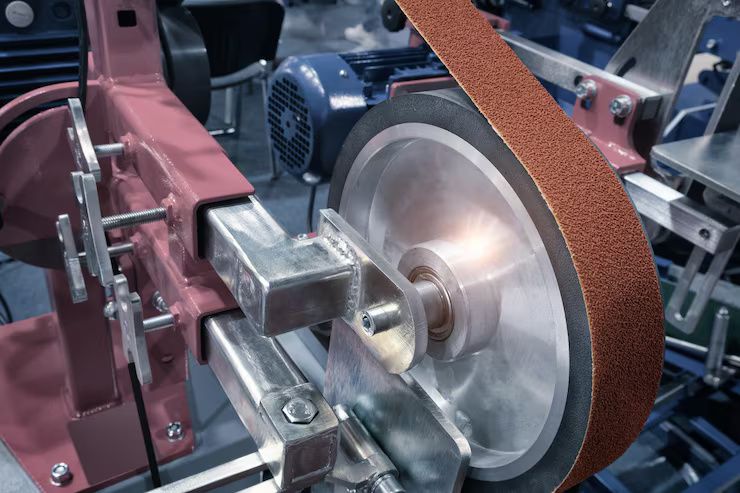
Modern surface finishing systems increasingly combine wide belt sanding with automated feeding, electronic thickness control, abrasive-belt monitoring, dust extraction, sensors, and digital production controls. These technologies make wide belt sanders an important part of automated woodworking and panel-processing environments.
Context
Understanding Wide Belt Sanders
A wide belt sander uses a broad continuous abrasive belt that rotates around drums or rollers. The workpiece passes through the machine while the abrasive surface removes a controlled amount of material.
The machine can be configured with one or more sanding heads. Single-head machines may perform basic calibration or finishing, while multi-head systems can use different abrasive grades or sanding configurations during the same production cycle.
Commonly processed materials include:
- Solid wood
- Wood panels
- MDF
- Particleboard
- Plywood
- Veneer
- Certain composite materials
- Selected plastics
The machine configuration must be matched to the material and required surface characteristics.
How Wide Belt Sanding Works
The sanding process begins when a workpiece enters the machine through an automated feed mechanism. Feed rollers maintain the movement of the material while the sanding belt contacts its surface.
A typical process includes:
- The workpiece is positioned at the machine entrance.
- The feed system transports the material at a controlled speed.
- The sanding belt contacts the surface.
- Abrasive particles remove a controlled amount of material.
- The workpiece passes through additional sanding heads when present.
- Dust and sanding particles are collected through an extraction system.
- The finished surface is checked for thickness and quality.
The exact sequence depends on machine design, material type, abrasive selection, and production requirements.
Main Components of Wide Belt Sanders
| Component | Function |
|---|---|
| Abrasive belt | Removes material from the workpiece |
| Contact roller | Controls abrasive contact with the material |
| Sanding head | Holds and operates the abrasive system |
| Feed rollers | Move the workpiece through the machine |
| Pressure shoes | Help control sanding contact |
| Conveyor | Supports material movement |
| Thickness control | Maintains the intended material dimension |
| Dust extraction system | Removes sanding dust |
| Control panel | Manages operating parameters |
Types of Wide Belt Sanders
Wide belt sanders can be categorized according to sanding configuration and application.
| Type | General Application |
| Single-head sander | Basic calibration and surface sanding |
| Two-head sander | Sequential coarse and fine sanding |
| Multi-head sander | Multiple finishing stages |
| Calibrating sander | Controlled material removal and thickness adjustment |
| Finishing sander | Surface smoothing and preparation |
| Automatic wide belt sander | Continuous production environments |
| CNC-integrated sanding system | Digitally controlled production processes |
Abrasive Belt Selection
Abrasive belts are available in different materials and grit sizes. Coarser abrasives generally remove more material, while finer abrasives are used for smoother surface preparation.
Selection can depend on:
- Material hardness
- Required material removal
- Desired surface roughness
- Feed speed
- Sanding pressure
- Machine configuration
Using an inappropriate abrasive can affect surface quality, belt life, and production performance.
Wide Belt Sanders Compared With Other Sanders
Handheld belt sanders are designed for localized work and operator-controlled movement. Drum sanders use a rotating abrasive drum, while wide belt sanders use a continuous abrasive belt supported by a larger industrial machine.
Wide belt systems are particularly suited to larger workpieces and repeatable production because the feed mechanism controls the movement of the material through the sanding area.
Importance
Role in Industrial Sanding Technologies
Industrial sanding technologies are used when surfaces require controlled material removal, dimensional adjustment, or preparation for subsequent processing.
Wide belt sanding can help manufacturers perform operations such as:
- Thickness calibration
- Surface leveling
- Scratch reduction
- Preparation for coating
- Preparation for polishing
- Veneer preparation
The final result depends on machine setup, abrasive condition, material properties, and operating parameters.
Surface Finishing Systems
Surface finishing systems are often part of a broader production line. A wide belt sander may be positioned after cutting or pressing and before coating, painting, laminating, or assembly.
A production line can therefore include:
- Material preparation
- Cutting or forming
- Calibration
- Wide belt sanding
- Surface inspection
- Coating or finishing
- Assembly
Integrating these stages can reduce unnecessary material handling.
Applications in Furniture Manufacturing
Furniture production is a major application area for wide belt sanding. Panels, doors, tabletops, cabinet components, and other wooden parts may require controlled surface preparation.
Sanding can help establish consistent dimensions and provide a suitable surface for later finishing operations.
Applications in Panel Manufacturing
MDF, particleboard, plywood, and other panel products may pass through wide belt sanding systems for calibration or surface preparation.
Industrial panel sanding requires control over:
- Material thickness
- Feed speed
- Abrasive grade
- Sanding pressure
- Surface consistency
Applications Beyond Woodworking
Although widely associated with woodworking, wide belt sanding concepts can also be applied to selected composite and synthetic materials.
The abrasive, machine configuration, dust-control approach, and operating conditions must be appropriate for the specific material.
Importance of Thickness Control
For many manufactured panels and components, maintaining a defined thickness is an important part of quality control.
Electronic thickness-control systems can monitor and adjust machine settings to maintain the desired dimension during production. Actual dimensional accuracy depends on machine calibration, material variation, measurement systems, and operating conditions.
Automation in Surface Finishing
Automated sanding systems can coordinate material feeding, abrasive operation, thickness adjustment, dust collection, and production monitoring.
This reduces the amount of repetitive manual handling required in some production environments while allowing operators to focus on machine setup, monitoring, maintenance, and quality inspection.
Recent Updates
Increased Automation
From 2024 through 2026, industrial sanding equipment continued moving toward greater automation and digital control.
Modern systems can incorporate:
- Automatic setup
- Electronic thickness adjustment
- Automated feed control
- Machine monitoring
- Abrasive management
- Digital production records
These features connect sanding machines with broader manufacturing automation systems.
Digital Thickness Monitoring
Electronic measurement systems can monitor workpiece thickness during production. Some systems can use measured information to adjust machine settings or identify deviations.
This is particularly relevant when manufacturers process large quantities of material with defined dimensional requirements.
Multi-Stage Sanding
Multi-head wide belt sanders allow different sanding operations to occur in sequence. A coarse abrasive may remove material during an initial stage, followed by finer abrasives for surface preparation.
This approach can reduce the need to move workpieces between separate sanding machines.
Improved Dust Extraction
Dust management remains an important part of modern sanding equipment. Wide belt sanders can generate substantial quantities of fine particulate material, particularly when processing wood.
Machine designs increasingly integrate extraction connections and enclosed sanding areas to help capture airborne material at its source. OSHA specifically identifies fine wood dust as a concern associated with sanding operations and recommends appropriate ventilation and dust-control measures.
Sensor-Based Machine Monitoring
Sensors can provide information about machine operation, including belt condition, feed movement, motor activity, and other process variables.
Collected information can support maintenance planning and production monitoring.
Integration With Digital Manufacturing
Wide belt sanders can be connected with manufacturing software that records production information and machine conditions.
Digital integration can provide information about:
- Machine status
- Production cycles
- Material throughput
- Maintenance events
- Operating parameters
This creates a connection between surface finishing and wider smart manufacturing systems.
Laws or Policies
Machine Guarding Requirements
Wide belt sanders contain abrasive belts, rotating rollers, moving feed systems, and other mechanical hazards. In the United States, OSHA's woodworking machinery requirements include specific provisions for sanding machines.
OSHA requires feed rolls on self-feed sanding machines to have appropriate guards that prevent workers' hands from contacting in-running rolls. OSHA also specifies guarding requirements for belt sanding machines at nip points and for unused belt runs.
Point-of-Operation Safety
The point of operation is the area where the machine performs work on the material. OSHA's general machine-guarding requirements call for protection from hazards such as points of operation, in-running nip points, and rotating parts.
Machine guards should be appropriate for the equipment design and operating conditions.
Wood Dust Management
Sanding can generate fine wood dust that may affect workplace air quality. OSHA's woodworking guidance identifies dust as an important hazard associated with sanding equipment and emphasizes appropriate ventilation and control measures.
Dust-control requirements can depend on the workplace, material, equipment, and applicable regulations.
Maintenance and Inspection
Abrasive belts and machine components require regular inspection. Worn, damaged, improperly installed, or poorly maintained components can create mechanical and process hazards.
OSHA's woodworking machinery standard includes requirements concerning maintenance, machine condition, controls, guards, and related safety considerations.
Fire and Explosion Considerations
Fine combustible dust can create additional workplace hazards under certain conditions. Facilities processing significant quantities of combustible materials may therefore need appropriate dust collection, housekeeping, electrical, and fire-prevention measures.
Specific requirements depend on the facility and materials being processed.
Tools and Resources
Abrasive Grit Selection Guides
Abrasive manufacturers provide technical information about grit sizes and abrasive materials.
Selection references can help compare abrasives according to:
- Material type
- Material removal requirements
- Surface finish
- Feed speed
- Sanding stage
Thickness Measurement Tools
Digital thickness gauges and industrial measurement systems can be used to verify finished workpieces.
Measurements may include:
- Overall thickness
- Thickness variation
- Flatness
- Dimensional consistency
Dust Collection Systems
Industrial dust collectors and extraction systems are commonly integrated with sanding equipment.
A suitable system can be designed around:
- Airflow requirements
- Duct configuration
- Particle characteristics
- Filter type
- Machine enclosure
Machine Monitoring Systems
Industrial monitoring platforms can collect information from sanding machines and other production equipment.
They may track:
- Machine status
- Production cycles
- Operating conditions
- Maintenance events
- Selected process measurements
Surface Measurement Equipment
Surface-measurement instruments can help evaluate characteristics such as roughness and consistency.
These tools are useful when a specific surface condition is required before coating, laminating, polishing, or assembly.
Manufacturer Technical Manuals
Machine manuals provide important information about setup, abrasive installation, maintenance, operating limits, guarding, and machine-specific procedures.
Technical documentation should be used alongside applicable workplace regulations and safety procedures.
FAQs
What are wide belt sanders?
Wide belt sanders are industrial sanding machines that use a continuous abrasive belt to remove material, calibrate thickness, and prepare surfaces on wood, panels, composites, and selected other materials.
How do industrial sanding technologies work?
Industrial sanding technologies use controlled abrasive contact to remove material from a workpiece. Feed systems, sanding heads, abrasive belts, pressure controls, and dust extraction work together to manage the process.
What are wide belt sanders used for?
Wide belt sanders are commonly used for thickness calibration, surface leveling, smoothing, and preparation of wood panels, furniture components, doors, veneer, and other manufactured materials.
What is the difference between a wide belt sander and a drum sander?
A wide belt sander uses a continuous abrasive belt that runs around rollers, while a drum sander uses an abrasive-covered rotating drum. Wide belt systems are commonly configured for continuous industrial feeding and controlled surface processing.
What safety concerns apply to wide belt sanders?
Important concerns include contact with abrasive surfaces, in-running nip points, moving feed rollers, wood dust, flying particles, and maintenance hazards. OSHA identifies guarding and dust-control measures as important considerations for sanding machinery.
Conclusion
Wide belt sanders are important industrial sanding machines used for controlled material removal, thickness calibration, surface leveling, and finishing preparation. They are widely applied in woodworking, furniture, panel manufacturing, and selected composite-processing environments. Recent developments include electronic thickness control, automated feeding, multi-stage sanding, sensor monitoring, improved dust extraction, and digital manufacturing integration. Because sanding involves moving machinery and airborne particulate generation, appropriate guarding, dust management, maintenance, and workplace safety procedures remain essential.