Wind turbine blades are aerodynamic structures that capture energy from moving air and convert it into rotational motion for electricity generation. Modern wind turbine blades combine composite materials, aerodynamic engineering, structural design and manufacturing technologies to support efficient operation across onshore and offshore wind installations.
Blade dimensions, materials, airfoil profiles, structural reinforcement and manufacturing methods vary according to turbine capacity, wind conditions and installation requirements.
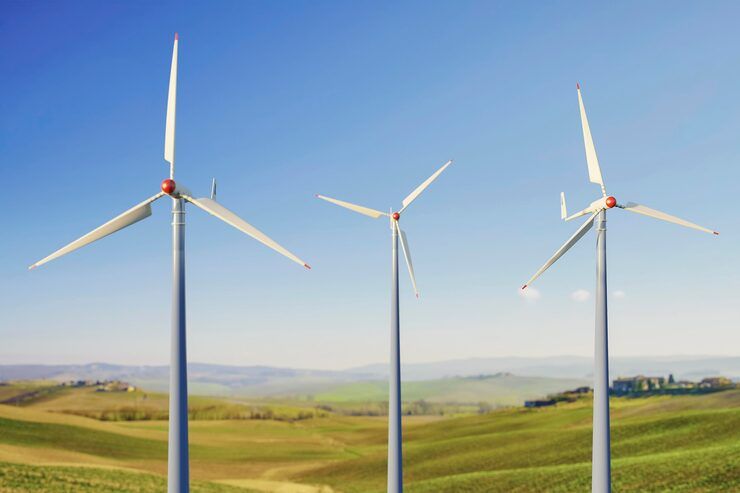
Why Wind Turbine Blades Matter
Blades are among the most important components of a wind turbine because their aerodynamic shape determines how effectively wind energy is converted into mechanical rotation.
Key design considerations include:
Blade length and rotor diameter
Airfoil geometry
Weight and structural stiffness
Wind-load resistance
Fatigue performance
Surface condition
Environmental durability
Manufacturing precision
Larger turbines generally require longer blades capable of handling substantial aerodynamic and gravitational loads while maintaining controlled deformation during operation.
Types of Wind Turbine Blades
Onshore Wind Turbine Blades
Onshore blades are designed for turbines installed on land. Their dimensions and structural characteristics depend on turbine capacity, terrain, wind conditions and transportation limitations.
Offshore Wind Turbine Blades
Offshore turbines can use significantly larger blades because wind resources over open water can support large-scale installations. These blades require careful structural engineering to withstand demanding environmental conditions.
Fixed-Pitch and Variable-Pitch Blades
Fixed-pitch configurations maintain a relatively constant blade angle, while variable-pitch systems adjust blade orientation according to operating conditions.
Variable-pitch technology allows turbine control systems to regulate aerodynamic forces and rotor performance.
Utility-Scale Blades
Utility-scale wind turbines use large composite blades designed for high-capacity electricity generation. Their production involves advanced molds, composite layup, bonding, curing and quality inspection processes.
Wind Turbine Blade Materials
Modern blades commonly use fiber-reinforced polymer composites because they provide a useful combination of strength, stiffness and relatively low weight.
Fiberglass Composites
Glass fiber reinforced polymers are widely used in blade structures. They provide mechanical strength while supporting large-scale composite manufacturing.
Carbon Fiber
Carbon fiber can provide high stiffness with relatively low mass. It may be incorporated into selected structural areas where weight and stiffness requirements are particularly demanding.
Epoxy and Polymer Resins
Resin systems bind reinforcing fibers into a composite structure. Resin selection affects mechanical properties, curing behavior and manufacturing requirements.
Core Materials
Foam and other lightweight structural core materials can be incorporated into sandwich structures. These materials increase structural thickness and stiffness without adding excessive mass.
Wind Turbine Blade Manufacturing Technologies
Wind turbine blade manufacturing combines composite processing, precision tooling and structural bonding.
A simplified manufacturing sequence includes:
Mold preparation — Blade molds are cleaned and prepared for composite production.
Material placement — Reinforcing fibers and core materials are positioned according to the engineering design.
Resin infusion or molding — Resin is introduced into the reinforcement structure.
Curing — Heat or controlled environmental conditions allow the composite material to achieve its required properties.
Component assembly — Major blade sections and structural components are joined.
Bonding — Adhesive systems connect structural sections and internal components.
Finishing — Surfaces are trimmed, finished and prepared for inspection.
Quality inspection — Dimensional, structural and surface inspections verify manufacturing consistency.
Aerodynamics of Wind Turbine Blades
Blade aerodynamics determine how efficiently a turbine extracts energy from moving air.
The blade profile is designed to generate aerodynamic lift as air flows across its surface. As the blade rotates, this aerodynamic force produces torque around the rotor hub.
Important aerodynamic factors include:
Airfoil shape
Angle of attack
Wind velocity
Blade twist
Chord distribution
Tip geometry
Rotor speed
Surface roughness
Blade Twist
Wind velocity relative to different sections of a rotating blade varies with distance from the hub. Blade twist helps maintain suitable aerodynamic conditions along the blade length.
Blade Pitch
Pitch systems change the blade angle relative to incoming airflow. Pitch control can regulate rotor loading and help maintain appropriate operating conditions across different wind speeds.
Manufacturing Quality and Structural Testing
Large blades require dimensional accuracy and structural consistency because manufacturing defects can affect performance and durability.
Quality-control processes may include:
Visual inspection
Dimensional measurement
Ultrasonic inspection
Thermographic inspection
Surface inspection
Adhesive-bond inspection
Structural testing
Non-destructive testing can help identify internal voids, delamination, bonding irregularities and other composite-related defects without destroying the component.
Wind Turbine Blade Comparison
| Blade Category | Typical Application | Key Considerations |
|---|---|---|
| Onshore blades | Land-based wind farms | Transport, terrain, wind conditions |
| Offshore blades | Offshore wind farms | Large scale, environmental loading |
| Fiberglass blades | Broad turbine applications | Strength and manufacturing efficiency |
| Carbon-fiber reinforced blades | Weight-sensitive designs | High stiffness and reduced mass |
| Utility-scale blades | Large wind farms | Structural loads and aerodynamic efficiency |
| Variable-pitch blades | Modern turbine systems | Rotor control and aerodynamic regulation |
Automation in Wind Turbine Blade Manufacturing
Automation is increasingly incorporated into large composite manufacturing operations.
Automated technologies can support:
Fiber placement
Material cutting
Resin processing
Robotic trimming
Adhesive application
Surface finishing
Dimensional inspection
Defect detection
Digital production systems can also record manufacturing parameters and inspection information for quality management and traceability.
Wind Turbine Blade Cost Factors
The overall cost of a blade depends on numerous technical and manufacturing factors rather than a single specification.
Important factors include:
Blade length
Turbine capacity
Composite materials
Carbon-fiber content
Mold requirements
Manufacturing technology
Structural reinforcement
Quality-control requirements
Transportation requirements
Installation conditions
Custom engineering
Larger offshore blades generally involve more complex engineering, manufacturing, transportation and installation requirements than smaller land-based blades.
Wind Energy Applications
Wind turbine blades are used across several wind-energy environments.
Onshore Wind Farms
Land-based turbines are widely deployed in areas with suitable wind resources and available infrastructure.
Offshore Wind Farms
Offshore turbines use large rotor systems to capture wind energy over marine environments. Blade design must account for large structural loads and environmental exposure.
Distributed Wind Systems
Smaller turbines can support localized electricity generation for facilities, farms, remote installations and other applications where site conditions are suitable.
Hybrid Renewable Energy Systems
Wind generation can be integrated with solar, battery storage and other energy technologies to create coordinated renewable-energy systems.
How to Select Wind Turbine Blades
Blade selection depends on the turbine platform, site conditions and engineering requirements.
Consider:
Turbine compatibility — Confirm compatibility with the rotor, hub and control system.
Blade dimensions — Evaluate length, chord and rotor diameter requirements.
Material structure — Compare fiberglass, carbon-reinforced and hybrid composite designs.
Wind conditions — Consider average wind speed, turbulence and extreme wind conditions.
Environmental exposure — Evaluate moisture, temperature, erosion and other site factors.
Transportation — Large blades require specialized logistics planning.
Inspection requirements — Establish appropriate quality and maintenance procedures.
Manufacturers and Suppliers
The wind turbine blade supply chain includes composite-material producers, blade manufacturers, engineering companies, equipment manufacturers, inspection technology providers and logistics companies.
Commercial procurement may involve requirements for:
Blade specifications
Material certifications
Production capacity
Quality-control procedures
Testing documentation
Delivery schedules
Transportation planning
Maintenance support
Replacement components
For large wind projects, procurement teams typically evaluate technical compatibility, manufacturing capabilities, logistics requirements and lifecycle considerations together.
Frequently Asked Questions
What are wind turbine blades made from?
Wind turbine blades are commonly manufactured from fiber-reinforced polymer composites, including fiberglass and, in selected structural areas, carbon-fiber reinforcement. Lightweight core materials and resin systems may also form part of the composite structure.
How are wind turbine blades manufactured?
Manufacturing commonly involves mold preparation, fiber and core placement, resin infusion or molding, curing, component assembly, structural bonding, finishing and quality inspection.
Why are wind turbine blades twisted?
Blade twist helps maintain suitable aerodynamic conditions along the blade because the relative airflow changes from the hub toward the blade tip.
What affects wind turbine blade performance?
Blade geometry, airfoil design, length, pitch angle, surface condition, structural stiffness, wind conditions and rotor operating parameters can all affect performance.
How long can wind turbine blades be?
Blade dimensions vary significantly according to turbine design and capacity. Utility-scale and offshore turbines generally use substantially longer blades than small distributed wind systems.
Conclusion
Wind turbine blades combine aerodynamic engineering, composite materials, structural design and advanced manufacturing technologies. Blade type, length, airfoil geometry, material structure and manufacturing quality all influence how a turbine interacts with available wind resources.
As wind turbines continue to evolve toward larger capacities, blade manufacturing is increasingly focused on lightweight composite structures, automated production, advanced inspection and aerodynamic optimization. These developments support applications across onshore, offshore and distributed wind-energy systems.