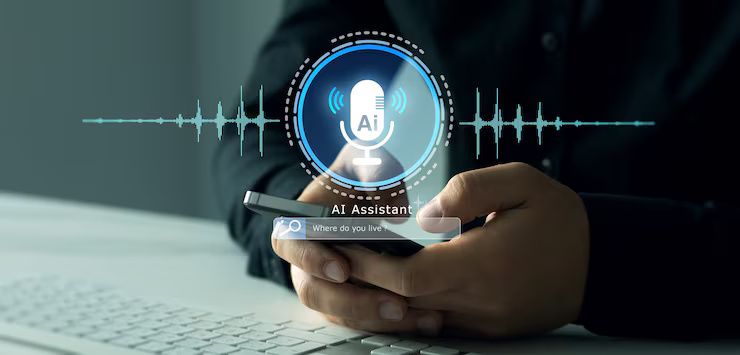
AI voice assistants are software systems that use artificial intelligence, speech recognition, natural language processing, and machine learning to understand spoken requests and respond through voice or other digital interfaces. They can answer questions, perform commands, retrieve information, control connected devices, and support business workflows.
Modern AI voice assistants are becoming more capable through advances in large language models, speech synthesis, conversational AI, and multimodal computing. Their applications range from smartphones and smart homes to healthcare, automobiles, customer communication, education, enterprise software, and industrial environments.
Context
What Are AI Voice Assistants?
An AI voice assistant is a digital system that receives spoken language, interprets the request, determines an appropriate response or action, and communicates the result using synthesized or recorded speech.
Traditional voice-command systems often depended on predefined commands. Modern AI voice assistants can use machine-learning models to interpret natural language, recognize context, and handle more conversational interactions.
How AI Voice Assistants Work
A typical voice interaction involves several stages:
- Voice capture — A microphone receives the user's speech.
- Speech recognition — Audio is converted into text or another machine-readable representation.
- Language understanding — The system identifies the user's intent and relevant information.
- Reasoning or retrieval — An AI model, database, application, or connected system processes the request.
- Action execution — The assistant may perform an authorized digital action.
- Speech generation — A text-to-speech system creates the spoken response.
- Audio playback — The response is delivered through a speaker or other audio interface.
The architecture can vary significantly depending on the device, application, and level of cloud connectivity.
Major Technologies
AI voice assistants combine several technologies.
| Technology | Primary Function | Typical Application |
|---|---|---|
| Speech Recognition | Converts speech into machine-readable input | Voice commands |
| Natural Language Processing | Interprets language | Intent understanding |
| Large Language Models | Generates and processes responses | Conversational interaction |
| Text-to-Speech | Produces synthetic speech | Spoken responses |
| Machine Learning | Identifies patterns | Personalization and recognition |
| Wake-Word Detection | Identifies activation phrases | Hands-free activation |
| Speaker Recognition | Differentiates speakers | User identification |
| Knowledge Retrieval | Accesses relevant information | Question answering |
| APIs | Connects external systems | Digital actions |
| Edge Computing | Processes data locally | Lower-latency interaction |
Conversational AI
Conversational AI enables systems to maintain context across multiple exchanges. Instead of requiring users to provide a complete command each time, an assistant can use earlier parts of a conversation to interpret subsequent requests.
This capability depends on the underlying model, application architecture, session design, and privacy controls.
Speech Recognition
Speech recognition systems convert spoken language into digital representations that software can process. Modern systems can recognize different accents, speaking patterns, background conditions, and languages, although performance varies according to the acoustic environment and language model.
Noise reduction and microphone-array technologies can improve recognition in environments where several sounds are present.
Importance
Why AI Voice Assistants Matter
Voice interfaces provide an alternative to typing, clicking, and traditional graphical interfaces. They can be particularly useful when users need hands-free interaction or when information needs to be accessed quickly.
Voice interaction can also make certain digital systems more accessible to people who have difficulty using conventional input methods.
Consumer Applications
AI voice assistants can be incorporated into:
- Smartphones
- Smart speakers
- Televisions
- Wearable devices
- Vehicles
- Home automation systems
- Headphones
- Personal computers
Common functions include setting reminders, retrieving information, controlling compatible devices, managing calendars, playing media, and navigating applications.
Business Applications
Businesses can use voice AI for a variety of workflows.
Customer communication: Voice systems can handle routine questions and direct users to appropriate information.
Employee assistance: Internal assistants can help staff locate information, summarize documents, or interact with approved enterprise systems.
Appointment management: Voice interfaces can support scheduling and confirmation workflows.
Information retrieval: Employees can ask spoken questions about authorized internal knowledge sources.
Workflow automation: Voice commands can initiate predefined digital processes when appropriate permissions are available.
Healthcare Applications
Voice technology can support healthcare-related workflows such as documentation, scheduling, accessibility, and information retrieval.
However, healthcare implementations require careful attention to privacy, security, accuracy, authorization, and applicable regulatory requirements. Voice systems should not be treated as substitutes for qualified clinical judgment.
Automotive Applications
Voice assistants are increasingly incorporated into connected vehicles and infotainment systems.
Drivers can potentially use voice commands for navigation, communication, media control, climate settings, and other supported functions without interacting directly with a touchscreen.
The available capabilities depend on the vehicle architecture and the connected software platform.
Smart Home Applications
Smart-home voice interfaces can connect compatible devices such as:
- Lighting systems
- Thermostats
- Security devices
- Appliances
- Entertainment equipment
- Smart locks
- Sensors
Users can issue spoken commands through compatible microphones or smart speakers.
Recent Updates
Generative AI Voice Assistants
Generative AI has expanded the capabilities of voice assistants beyond fixed command structures. Large language models can generate more flexible responses and handle broader conversational contexts.
This allows users to interact with some systems using natural conversational language rather than memorizing specific commands.
More Natural Speech Generation
Modern text-to-speech technologies can generate speech with improved pronunciation, rhythm, pauses, and conversational characteristics.
The quality of synthetic speech varies according to the model, language, voice configuration, and application.
Multimodal Assistants
Voice is increasingly combined with text, images, documents, and other information types.
A multimodal assistant may receive a spoken question about an image, summarize a document aloud, or combine voice interaction with a visual application interface.
On-Device AI
Some voice-processing functions can run directly on smartphones, computers, vehicles, and other devices.
On-device processing can reduce dependence on network connectivity for certain functions and may help limit transmission of some types of audio data. However, the privacy characteristics depend on the specific implementation.
Enterprise Voice AI
Organizations are exploring voice AI for internal knowledge systems, contact centers, workflow automation, meeting documentation, and employee productivity.
Enterprise deployments generally require identity management, access controls, data governance, monitoring, and integration with existing business systems.
Laws or Policies
Privacy and Voice Data
Voice recordings and associated information can potentially contain personal or sensitive data. Organizations should determine what information is collected, why it is processed, where it is stored, and how long it is retained.
Applicable privacy requirements vary by jurisdiction and application.
Consent and Recording Requirements
Some voice applications record or analyze conversations. Depending on the jurisdiction and context, users may need to be informed about recording or processing.
Organizations should establish appropriate disclosure and consent procedures where required.
Data Security
Voice assistants connected to business systems should use suitable authentication and authorization controls.
Sensitive actions should not be performed solely because a voice command was detected. Additional verification may be appropriate for activities involving financial information, personal records, security systems, or other restricted resources.
AI Governance
Organizations deploying AI voice assistants should consider accuracy, transparency, data protection, access management, human oversight, and incident management.
The appropriate governance framework depends on the application and regulatory environment.
Tools and Resources
Speech Recognition Platforms
Speech-to-text technologies provide the foundation for many voice interfaces. Developers can integrate speech recognition into applications using software development kits, APIs, or device-native capabilities.
Large Language Models
Large language models can provide conversational reasoning and response generation. When integrated with voice systems, they can transform spoken questions into contextual interactions.
Text-to-Speech Platforms
Text-to-speech technologies convert generated responses into spoken audio. Developers can configure factors such as language, voice characteristics, pronunciation, and speaking style depending on platform capabilities.
Voice Development Frameworks
Voice applications can be created using combinations of:
- Speech recognition APIs
- Conversational AI frameworks
- Large language model APIs
- Text-to-speech engines
- Mobile development frameworks
- Web technologies
- Enterprise APIs
- IoT platforms
Analytics and Monitoring
Voice applications can use analytics to measure interaction frequency, recognition errors, response latency, user journeys, and system performance.
Monitoring should be designed with appropriate privacy and data-retention controls.
FAQs
What are AI voice assistants?
AI voice assistants are software systems that understand spoken requests and provide information or perform authorized actions using technologies such as speech recognition, natural language processing, machine learning, and speech synthesis.
How do AI voice assistants understand speech?
A microphone captures speech, a recognition system processes the audio, and language models interpret the resulting information. The system then determines an appropriate response or action.
What is the difference between traditional voice assistants and generative AI assistants?
Traditional assistants often depend heavily on predefined commands and workflows. Generative AI assistants can use large language models to interpret more flexible language and generate context-aware responses.
Where are AI voice assistants used?
Applications include smartphones, vehicles, smart homes, customer communication, enterprise software, healthcare workflows, education, accessibility tools, and industrial environments.
Can AI voice assistants work without the internet?
Some functions can operate locally through on-device processing, while other capabilities require cloud-based models or external services. The exact functionality depends on the system architecture.
Conclusion
AI voice assistants combine speech recognition, natural language processing, machine learning, large language models, and speech synthesis to create conversational interfaces between people and digital systems.
Their applications extend from everyday device control to enterprise workflows, automotive systems, healthcare administration, customer communication, and connected environments. Recent developments in generative AI, multimodal interaction, natural speech generation, and on-device processing are expanding the range of possible applications.
Successful implementation requires more than conversational capability. Privacy, authentication, data security, accuracy, accessibility, system integration, and appropriate human oversight are important considerations when deploying AI voice assistants.