
Artificial intelligence (AI) in manufacturing refers to the use of intelligent computer systems, machine learning algorithms, robotics, and data analysis technologies to improve industrial production processes. These technologies help manufacturers monitor machinery, identify production problems, inspect product quality, manage inventory, and analyze operational information.
The use of AI in industrial environments developed from earlier computer-controlled manufacturing and industrial automation systems. Traditional factories relied heavily on manual inspection, programmed machinery, and fixed production instructions. As computing power, sensors, and industrial connectivity improved, manufacturers began introducing machine learning and advanced analytical systems into their production environments.
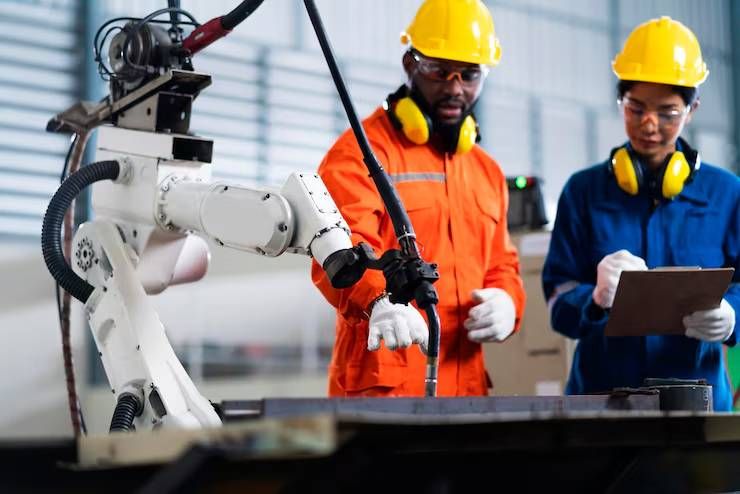
Today, AI manufacturing technologies are becoming part of smart factory systems, where machines, production equipment, software, and industrial networks exchange information. These systems support data-driven decisions across different manufacturing activities.
Why Artificial Intelligence Matters in Modern Manufacturing
Manufacturing companies operate in environments where production accuracy, equipment reliability, product quality, and supply chain coordination are important. Traditional monitoring methods may not identify every equipment problem or production irregularity immediately.
AI systems analyze large amounts of operational data to identify patterns, recognize unusual conditions, and support production planning. Their applications affect automotive manufacturers, electronics companies, pharmaceutical facilities, food processing plants, and heavy engineering industries.
Important applications include:
Predictive Maintenance: Analyzes machine data to identify conditions associated with possible equipment failures.
Quality Inspection: Uses computer vision to identify surface defects, dimensional variations, and manufacturing irregularities.
Production Optimization: Analyzes production information to support scheduling and process adjustments.
Inventory Management: Helps estimate material requirements and monitor inventory levels.
Energy Management: Examines energy consumption patterns and identifies opportunities for improved resource utilization.
Workplace Safety: Uses sensors and visual recognition systems to identify certain operational hazards.
These applications can support industrial decision-making, although their effectiveness depends on data quality, system integration, and appropriate human supervision.
Major AI Technologies Used in Manufacturing
Different AI technologies perform different functions within industrial production systems. Manufacturers select technologies according to their operational requirements and available infrastructure.
Machine Learning
Machine learning allows computer systems to identify patterns in historical and real-time data. In manufacturing, it can analyze equipment performance, production measurements, and operational records.
For example, a machine learning model can examine vibration and temperature readings to identify unusual equipment behaviour that may require inspection.
Computer Vision
Computer vision enables machines to interpret visual information through cameras and image-processing software. It is commonly used for automated quality inspection, component identification, packaging verification, and production monitoring.
Deep Learning
Deep learning uses multilayer neural networks to analyze complex information. Manufacturing applications include defect classification, image recognition, production forecasting, and analysis of machine operating conditions.
Natural Language Processing
Natural language processing allows computer systems to interpret and generate human language. Industrial applications include technical document analysis, maintenance information retrieval, production reporting, and communication with digital assistants.
Generative AI
Generative AI can produce text, summaries, technical explanations, and other digital content based on supplied information. In manufacturing environments, it can help engineers examine equipment documentation, summarize maintenance records, and retrieve information from technical databases.
Smart Factory Systems and AI-Based Industrial Automation
A smart factory combines connected machinery, industrial sensors, software platforms, robotics, and data analysis systems. AI adds analytical capabilities that help these technologies interpret operational information.
Industrial Internet of Things (IIoT)
IIoT connects industrial equipment through sensors and communication networks. These devices collect information about temperature, pressure, vibration, speed, and other operating conditions.
AI systems can analyze this information to identify patterns and support production monitoring.
AI-Powered Robotics
Industrial robots perform activities such as welding, painting, assembly, packaging, and material handling. AI-based vision and perception systems can help robots recognize objects and respond to changing conditions.
Collaborative robots, commonly called cobots, are designed to work alongside human operators in appropriately configured environments.
Digital Twin Technology
A digital twin is a virtual representation of a physical machine, production line, or manufacturing process. It uses operational data to reflect the condition and behaviour of the corresponding physical system.
AI can analyze digital twin data to support simulations, maintenance planning, and production analysis.
Automated Production Control
Programmable logic controllers (PLCs), supervisory control and data acquisition (SCADA) systems, and manufacturing execution systems (MES) coordinate different production activities.
AI can complement these systems by identifying unusual operating conditions and generating recommendations for process adjustments.
AI Manufacturing Processes and Industrial Applications
AI technologies are used throughout different stages of manufacturing, from product development to final inspection.
Predictive Maintenance: AI models examine equipment information to identify possible signs of component deterioration. This helps maintenance teams plan inspections based on observed machine conditions.
Automated Quality Control: Camera-based inspection systems analyze manufactured components and identify visible defects. These systems are commonly used in electronics, automotive production, and packaging.
Production Scheduling: AI-based planning systems analyze production capacity, material availability, and operational requirements to support manufacturing schedules.
Supply Chain Management: Machine learning models analyze demand patterns, inventory information, and transportation data to support supply chain planning.
Industrial Energy Management: AI systems examine electricity consumption and operating patterns to identify areas where energy use may be adjusted.
Warehouse Automation: AI-powered robots and automated material handling systems support product identification, movement, storage, and inventory tracking.
| AI Technology | Manufacturing Application | Main Function |
|---|---|---|
| Machine learning | Predictive maintenance | Identifies operational patterns |
| Computer vision | Quality inspection | Detects visual defects |
| Deep learning | Image analysis | Processes complex data |
| Generative AI | Technical documentation | Summarizes industrial information |
| Digital twins | Production simulation | Represents physical systems |
| Robotics AI | Automated assembly | Supports adaptive machine operations |
Global AI Manufacturing Providers and Technology Companies
The industrial AI ecosystem includes technology companies, automation manufacturers, software developers, robotics companies, and cloud computing providers.
Some internationally recognized organizations include:
Siemens: Develops industrial automation, digital manufacturing, industrial software, and AI-related technologies.
ABB: Provides industrial robotics, electrification, motion control, and automation systems.
NVIDIA: Develops computing platforms, AI software, and simulation technologies used in industrial applications.
Microsoft: Provides cloud computing, AI platforms, and industrial data integration technologies.
IBM: Develops enterprise AI, data analytics, and industrial AI solutions.
Rockwell Automation: Focuses on industrial automation, control systems, and manufacturing software.
Schneider Electric: Provides industrial automation, energy management, and digital industrial technologies.
Bosch: Develops industrial technology, connected manufacturing systems, sensors, and automation solutions.
These organizations operate in different parts of the industrial technology ecosystem. Their products and capabilities vary according to the application, production environment, and integration requirements.
Regulations and Government Initiatives in India
AI adoption in Indian manufacturing is influenced by industrial regulations, data governance requirements, workplace safety frameworks, and national technology initiatives.
The Ministry of Electronics and Information Technology (MeitY) supports India's digital technology development and the IndiaAI Mission, approved in 2024. The mission focuses on expanding computing infrastructure, developing AI capabilities, supporting research, and encouraging responsible AI adoption.
India's AI Governance Guidelines provide a principle-based framework for safe and trusted AI development and deployment. These guidelines are relevant to organizations considering AI applications in industrial environments.
Manufacturing facilities must also consider applicable requirements under:
The Digital Personal Data Protection Act, 2023, where personal data is processed.
Applicable factory and occupational safety regulations.
Environmental protection requirements.
Relevant Bureau of Indian Standards (BIS) standards.
Industrial cybersecurity and information security requirements.
Companies should assess the regulations applicable to their specific manufacturing activities, equipment, and data processing operations.
Recent Developments in AI Manufacturing, 2024–2026
AI in manufacturing continues to develop through improvements in industrial computing, robotics, data analytics, and connected production systems.
Generative AI Adoption: Manufacturers are exploring AI assistants for technical documentation, engineering knowledge retrieval, and production information analysis.
Physical AI and Robotics: Intelligent robotic systems are gaining attention for object recognition, movement planning, and interaction with physical industrial environments.
Digital Twin Integration: AI-supported digital twins are being developed for equipment monitoring, manufacturing simulations, and process analysis.
Industrial AI Governance: Research organizations and governments are emphasizing reliability, explainability, data quality, and human oversight in industrial AI systems.
AI for Manufacturing Engineering: India's 2026 AI for Manufacturing Engineering Technology initiative has highlighted responsible AI adoption, industrial skills, and collaboration between technology providers and manufacturing organizations.
These developments reflect a gradual movement from isolated AI experiments toward integrated industrial applications. However, adoption varies across industries and company sizes.
Frequently Asked Questions About AI in Manufacturing
1. What is artificial intelligence in manufacturing?
AI in manufacturing uses machine learning, computer vision, robotics, and data analytics to support production monitoring, equipment maintenance, quality inspection, and industrial planning.
2. How does AI improve smart factory systems?
AI analyzes information from connected machines and production systems to identify unusual conditions, support operational decisions, and improve process monitoring.
3. What are the main AI applications in industrial automation?
Common applications include predictive maintenance, robotic assembly, automated quality inspection, production scheduling, warehouse automation, and energy monitoring.
4. Who are the major AI manufacturing technology providers?
Recognized providers include Siemens, ABB, NVIDIA, Microsoft, IBM, Rockwell Automation, Schneider Electric, and Bosch.
5. What is the difference between AI and traditional industrial automation?
Traditional automation generally follows predefined instructions and control rules. AI can analyze data, recognize patterns, and generate predictions or recommendations that support more adaptive industrial operations.
Conclusion
Artificial intelligence is becoming an important technology within modern manufacturing, supporting equipment monitoring, quality inspection, production planning, and industrial automation. Machine learning, computer vision, robotics, digital twins, and generative AI each have different applications across manufacturing environments. Global technology providers and government initiatives are contributing to the development of smart factory systems. Successful industrial AI implementation depends on reliable data, suitable infrastructure, regulatory awareness, and appropriate human supervision.