A bib necklace is a broad necklace designed to cover part of the upper chest or neckline.
Unlike a simple chain or pendant, it usually has a wider front section made from multiple strands, linked elements, beads, gemstones, metalwork, or decorative motifs.
The name comes from its visual resemblance to a bib. The design can range from relatively simple layered chains to elaborate pieces extending across much of the neckline.
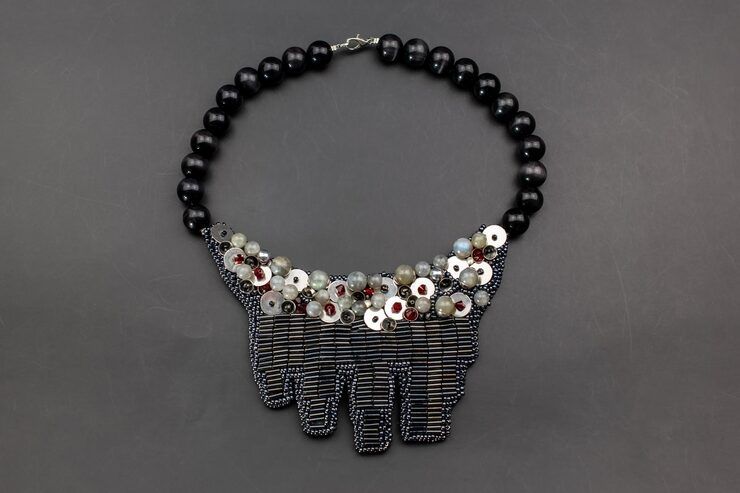
Bib necklaces have appeared in different forms throughout jewellery history. Wide collars were used in ancient cultures, while elaborate statement necklaces became particularly visible in European and American fashion during the 20th century. Indian jewellery traditions also include broad necklaces, layered ornaments, chokers, and elaborate bridal pieces that share some characteristics with modern bib designs.
A bib necklace can be made from many materials, including:
- Gold and silver
- Platinum and other jewellery metals
- Pearls
- Diamonds and coloured gemstones
- Glass, crystal, ceramic, or enamel
- Beads and textile elements
- Mixed-metal components
The overall structure is usually more important than a particular material. A bib necklace is primarily defined by its broad visual coverage and concentrated decorative area around the neckline.
Main Types of Bib Necklaces
Bib necklaces are not one uniform style. Their construction and appearance can vary considerably.
| Type | Common Characteristics | Typical Visual Effect |
|---|---|---|
| Layered bib | Several chains or strands | Fluid and dimensional |
| Collar bib | Broad, close-fitting structure | Strong and defined |
| Gemstone bib | Coloured stones or crystals | Decorative and colourful |
| Pearl bib | Multiple pearl strands | Classic and formal |
| Metal bib | Sculpted or linked metalwork | Modern and architectural |
| Bridal bib | Detailed motifs and traditional elements | Ornate and ceremonial |
The choice between these forms often depends on neckline, occasion, clothing structure, and personal preference.
Why Bib Necklaces Remain Relevant
Bib necklaces are important because they provide a way to make the neckline the visual focus of an outfit. This makes them useful in fashion styling, ceremonial dress, bridal jewellery, and formalwear.
They can also solve a practical styling problem: a simple outfit may need a strong focal element without requiring several different accessories. A broad necklace can create that focal area through its shape, texture, and colour.
For jewellery designers, bib structures provide more surface area for creative work. Designers can experiment with repeated motifs, graduated gemstones, articulated sections, enamel, filigree, and mixed materials.
The style also has relevance for different groups:
- Fashion audiences may use bib necklaces as statement accessories.
- Bridal wearers may choose elaborate versions for traditional ceremonies.
- Jewellery designers can use the broad format to explore detailed craftsmanship.
- Collectors may be interested in unusual materials, historical designs, or distinctive construction.
- Stylists can use them to create visual balance around different necklines.
Materials, Construction, and Design Considerations
The appearance of a bib necklace depends on how its components are arranged. Some designs use individually articulated sections so that the necklace follows the movement of the body. Others use a relatively rigid front plate.
Weight distribution is an important design consideration. A wide necklace does not necessarily need to be extremely heavy. Hollow metalwork, lightweight components, textile backing, and carefully spaced elements can create visual volume without adding unnecessary mass.
Gemstone bib necklaces can use diamonds, emeralds, rubies, sapphires, pearls, or other decorative stones. The arrangement may be symmetrical, graduated, floral, geometric, or abstract.
Indian jewellery provides particularly strong examples of elaborate bib-like forms. At the India International Jewellery Show in March 2025, showcased designs included bridal bib necklaces using kundan-set polkis, floral motifs, ruby accents, and traditional craftsmanship.
Recent Developments and Trends
Statement necklaces have become more visible in contemporary fashion during 2026. Fashion coverage has highlighted a broader movement toward noticeable neckwear, including oversized pendants, sculptural necklaces, layered pieces, and other designs that place greater attention on the neckline.
This trend is relevant to bib necklaces because the style naturally occupies more visual space than a conventional pendant. Modern versions are increasingly being interpreted through lighter construction, mixed materials, geometric shapes, fringe, and sculptural details rather than only through heavily ornamented designs.
In February 2026, fashion coverage also highlighted the return of statement necklaces to red-carpet and runway styling, with designers using large pendants and distinctive necklace structures as central elements of outfits.
Another notable direction has been the renewed interest in fringe and mesh jewellery. Vogue Arabia identified metallic mesh fringe bib necklaces as part of the Autumn/Winter 2025–26 accessory direction, connecting the style with broader interest in textured jewellery and medieval-inspired fashion.
In India, traditional and contemporary approaches are also overlapping. Bridal bib designs can combine traditional techniques such as kundan and polki with updated proportions and styling, allowing historical jewellery concepts to appear in modern wardrobes.
These developments suggest that the bib necklace is not limited to one fashion period. Its basic wide-neckline structure can be adapted to changing materials, silhouettes, and styling preferences.
Laws and Policies in India
Bib necklaces made from precious metals may be affected by India's jewellery hallmarking framework. The Bureau of Indian Standards (BIS) administers the hallmarking system for gold and silver jewellery and artefacts under the applicable standards and regulations.
For hallmarked gold jewellery, the hallmark includes the BIS Standard Mark, the purity or fineness marking, and a six-digit Hallmark Unique Identification (HUID) number. Consumers can use the BIS CARE application to verify HUID information for applicable gold jewellery.
The regulatory framework has continued to develop. BIS's mandatory hallmarking page records amendments issued on 31 July 2025, 2 March 2026, 28 April 2026, and 3 August 2026, showing that the coverage and implementation framework can change over time.
Silver jewellery also received an important update in 2025. BIS introduced the revised IS 2112:2025, with HUID-based hallmarking for silver jewellery and articles available on a voluntary basis from 1 September 2025. The revised standard includes purity grades and an identification system that can be checked through BIS resources.
For anyone researching precious-metal bib necklaces in India, the relevant BIS requirements should therefore be checked against the latest official guidance rather than relying only on older jewellery information.
Helpful Tools and Resources
Several official and practical resources can help people understand bib necklaces and related jewellery information.
- BIS CARE App: Useful for checking HUID information on applicable hallmarked jewellery.
- BIS Hallmarking Portal: Provides information about hallmarking procedures, registered jewellers, standards, and regulatory updates.
- BIS Hallmarking FAQs: Explains gold and silver purity grades, HUID, hallmark components, and consumer protections.
- Jewellery measurement tools: Necklace length guides can help compare collar, princess, matinee, and longer necklace proportions.
- Jewellery design software: CAD-based jewellery design programs can be used to create and examine complex bib necklace structures before production.
- Gemstone identification references: Gemmological resources can help explain differences between natural, synthetic, treated, and imitation stones.
The BIS website is particularly useful when the necklace contains precious metals because hallmarking requirements can depend on the material and applicable regulations. BIS also provides consumer information about testing and complaint procedures.
Frequently Asked Questions
What is a bib necklace?
A bib necklace is a broad necklace with a concentrated decorative section covering part of the upper chest or neckline. It may contain chains, beads, gemstones, metalwork, pearls, or mixed materials.
How is a bib necklace different from a regular necklace?
The main difference is coverage. A regular necklace may consist primarily of a chain and pendant, while a bib necklace generally has a wider front structure that covers more of the neckline.
Are bib necklaces suitable for bridal jewellery?
Yes. Bib-shaped jewellery can work well with bridal clothing because its broad structure provides space for traditional motifs, gemstones, pearls, kundan, polki, and other decorative elements. Indian jewellery traditions include several broad and layered necklace forms.
What materials are commonly used in bib necklaces?
Common materials include gold, silver, platinum, gemstones, pearls, glass, crystals, beads, enamel, and mixed materials. The choice affects the necklace's appearance, weight, durability, and maintenance requirements.
What should be checked on a gold bib necklace in India?
For applicable hallmarked gold jewellery, consumers should look for the BIS Standard Mark, purity or fineness information, and the six-digit HUID. The HUID can be checked through the BIS CARE App.
Conclusion
Bib necklaces are a distinctive category of statement jewellery defined mainly by their broad structure and concentration of decorative elements around the neckline. Their designs can range from simple layered constructions to elaborate gemstone, pearl, metal, or traditional Indian jewellery forms.
Their relevance continues as fashion moves between minimalist and expressive styles. During 2025 and 2026, renewed interest in statement necklaces, sculptural jewellery, fringe details, and expressive neckwear has created new ways to interpret the bib silhouette.
For jewellery containing precious metals in India, design considerations should be accompanied by awareness of BIS hallmarking standards and the latest regulatory requirements. Understanding construction, materials, styling, and identification marks provides a more informed foundation for evaluating bib necklaces as both fashion accessories and pieces of jewellery craftsmanship.