Dust collection systems are engineered systems used to capture, transport, filter, and manage airborne dust and particulate matter generated during industrial processes. They are widely used in manufacturing plants, woodworking facilities, metalworking operations, mining, cement production, pharmaceuticals, food processing, and other industrial environments.
A typical system combines collection hoods, ductwork, fans, filters, dust collectors, control equipment, and dust discharge mechanisms. System configuration depends on particle characteristics, airflow requirements, process conditions, filtration efficiency, and facility layout.
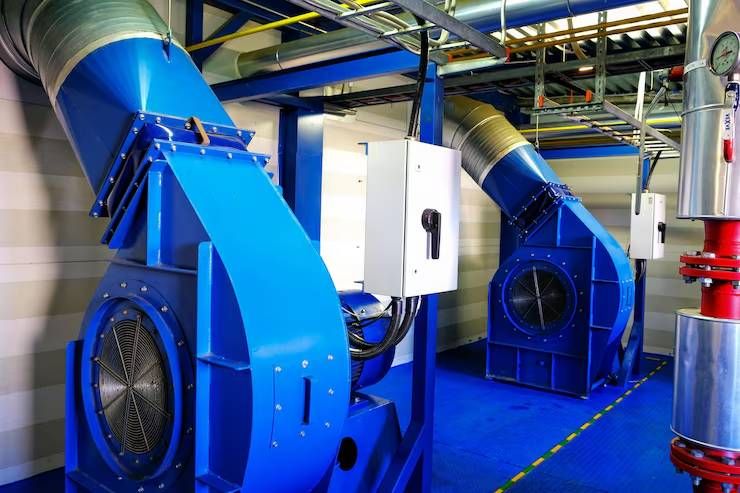
Why Dust Collection Systems Matter
Industrial processes can generate fine particles, fibers, fumes, and other airborne contaminants. Without appropriate collection equipment, these particles can accumulate around machinery and work areas and interfere with production environments.
A properly engineered industrial dust collection system captures contaminants close to their source and transports them through ductwork to a filtration unit. The filtered air can then be exhausted or managed according to the facility's operating requirements.
System performance depends heavily on maintaining appropriate airflow and pressure throughout the network.
Types of Dust Collection Equipment
Different equipment types are designed for different particle sizes, concentrations, and industrial processes.
Cartridge Dust Collectors
Cartridge collectors use pleated filter cartridges to provide substantial filtration area within a relatively compact housing. They are frequently used for fine particulate applications and manufacturing processes where space efficiency is important.
Baghouse Dust Collectors
Baghouse systems use fabric filter bags to separate particulate matter from an air stream. They are commonly used for large-volume industrial applications, including cement, minerals, metal processing, and other heavy industries.
Cyclone Dust Collectors
Cyclone collectors use centrifugal forces to separate larger particles from an air stream. They are often used as pre-separation equipment before finer filtration stages.
Wet Dust Collectors
Wet collectors use liquid to capture and remove particulate matter from contaminated air. They can be useful for selected applications involving dust characteristics that require wet collection methods.
Portable Dust Collectors
Portable systems can be moved between production areas or connected directly to individual machines. They are commonly used where centralized duct networks are impractical.
Dust Collection Technologies
Modern dust collection systems use several technologies depending on application requirements.
Source Capture
Source capture collects dust as close as possible to where it is generated. Collection hoods, machine enclosures, extraction arms, and pickup points can reduce the quantity of contaminants entering the surrounding environment.
Mechanical Separation
Cyclones and other mechanical separators remove larger particles using changes in airflow direction, velocity, and centrifugal forces.
Fabric Filtration
Fabric filters capture particulate matter as contaminated air passes through filter media. Accumulated dust is periodically removed through cleaning mechanisms.
Cartridge Filtration
Pleated cartridges provide a large filtration surface area. Automated cleaning systems can remove accumulated dust and help maintain airflow.
Pulse-Jet Cleaning
Pulse-jet systems use short bursts of compressed air to dislodge accumulated dust from filter media. The technology is commonly incorporated into industrial baghouse and cartridge dust collectors.
Filtration and Airflow
Airflow is a fundamental design parameter in a dust collection system. The required airflow depends on the number of collection points, hood configuration, duct dimensions, particle characteristics, and process conditions.
Important design parameters include:
Air volume
Air velocity
Static pressure
Duct diameter
Filter area
Filter media
Pressure drop
Fan capacity
Collection efficiency
Insufficient airflow can reduce source capture, while excessive airflow can increase energy consumption and place unnecessary loads on equipment.
Dust Collection System Manufacturing Process
Manufacturing an industrial dust collection system involves engineering, fabrication, assembly, and quality-control stages.
First, engineers determine the required airflow, filtration technology, dust characteristics, operating conditions, and equipment configuration. Components such as collector housings, hoppers, ductwork, filter assemblies, fans, and control panels are then manufactured or sourced.
The system is assembled and inspected for dimensional accuracy, structural integrity, sealing, filtration configuration, and equipment compatibility. Larger projects may also involve customized ductwork, automated controls, monitoring equipment, and integrated dust discharge systems.
Automation and Control Technologies
Modern dust collection equipment can incorporate automated controls for monitoring and operation.
Common technologies include:
Variable frequency drives
Differential pressure sensors
Automated filter cleaning
PLC-based controls
Remote monitoring
Airflow sensors
Filter condition monitoring
Automatic dust discharge
Differential pressure monitoring can help indicate changes in filter loading, while variable-speed fan control can adjust airflow according to operating conditions.
Industrial Applications
Dust collection systems are used across numerous industries.
| Industry | Typical Dust Collection Application |
|---|---|
| Woodworking | Sawdust and wood particles |
| Metalworking | Grinding and machining particles |
| Cement | Cement and mineral dust |
| Mining | Mineral and material dust |
| Food processing | Powder and ingredient particles |
| Pharmaceuticals | Fine powder collection |
| Plastics | Polymer and processing dust |
| Construction | Concrete and silica-containing dust |
| Chemical processing | Process particulate collection |
| Recycling | Material separation and dust control |
The equipment configuration varies according to the physical and chemical characteristics of the collected material.
Dust Collection System Cost Factors
The cost of an industrial dust collection system depends on system capacity, collector type, filtration technology, fan size, ductwork, controls, installation requirements, materials, and customization.
A small cartridge collector connected to one machine has substantially different requirements from a centralized system serving an entire manufacturing facility. Systems handling abrasive, corrosive, combustible, or high-temperature materials may require specialized components and engineering.
How to Select a Dust Collection System
Before selecting equipment, industrial facilities should evaluate:
Type and characteristics of the dust
Particle size and concentration
Required airflow
Number of collection points
Required filtration technology
Ductwork configuration
Filter media requirements
Fan and motor capacity
Dust discharge method
Monitoring and automation requirements
Proper system sizing is important because equipment that is undersized may not provide adequate collection, while an unnecessarily large system can increase energy and capital requirements.
Frequently Asked Questions
What is a dust collection system?
A dust collection system captures airborne particulate matter, transports it through ductwork, separates it using filtration or mechanical collection equipment, and manages the collected material.
What are the main types of dust collectors?
Common types include cartridge collectors, baghouse collectors, cyclone collectors, wet collectors, and portable dust collection units.
Why is airflow important in dust collection?
Airflow determines whether contaminants can be effectively captured and transported through the system. It is influenced by collection points, ductwork, fan capacity, and process conditions.
What industries use industrial dust collectors?
Mining, cement, woodworking, metalworking, pharmaceuticals, plastics, food processing, construction, chemical processing, and recycling facilities commonly use dust collection equipment.
What factors affect dust collection system cost?
Collector type, airflow capacity, filtration media, fan configuration, ductwork, controls, materials, installation requirements, and customization can all influence overall system cost.
Conclusion
Dust collection systems combine source capture, airflow management, filtration, mechanical separation, fans, ductwork, and control technologies to manage industrial particulate matter. Cartridge collectors, baghouses, cyclones, wet collectors, and automated filtration systems can be configured according to specific process requirements.
As industrial facilities adopt more automated production equipment, dust collection systems are increasingly integrated with sensors, variable-speed drives, automated filter cleaning, and digital monitoring. Careful engineering and appropriate equipment selection remain important for achieving consistent airflow, filtration performance, and reliable industrial operation.