
Pipeline inspection robots are specialized robotic systems designed to examine the internal and external conditions of pipelines, identify structural defects, and collect information about pipeline integrity. These machines are used in water distribution networks, oil and gas pipelines, wastewater systems, chemical processing facilities, and industrial manufacturing plants.
Traditional pipeline inspection methods often require manual examination, excavation, or the removal of pipelines from operation. Robotic inspection technologies provide alternative approaches by allowing cameras, sensors, and measurement equipment to enter pipeline networks and examine areas that may be difficult for human inspectors to reach.
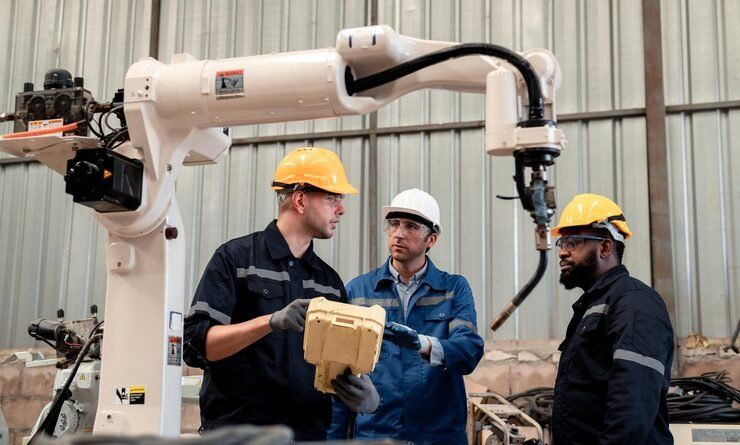
The development of pipeline inspection robots is closely connected to advances in industrial robotics, remote sensing, machine vision, and non-destructive testing. Modern systems can travel through different pipeline configurations while transmitting inspection information to operators.
Today, pipeline inspection robots include crawler robots, in-pipe inspection systems, magnetic robots, swimming robots, and autonomous robotic platforms. Their designs depend on pipeline diameter, material, operating environment, and inspection requirements.
Why Pipeline Inspection Robots Matter in Modern Industries
Pipelines transport water, petroleum, natural gas, chemicals, wastewater, and other industrial materials. Over time, these structures may experience corrosion, cracks, deposits, deformation, joint damage, and material deterioration.
Pipeline inspection robots help operators examine these conditions and collect information for maintenance planning and infrastructure management.
Major industrial applications include:
Oil and Gas Pipelines: Inspection of corrosion, wall thickness, weld conditions, and structural irregularities.
Water Distribution Networks: Examination of leaks, internal deposits, cracks, and pipe deterioration.
Wastewater Infrastructure: Inspection of drainage networks, sewer pipes, blockages, and structural defects.
Chemical Processing Plants: Examination of industrial pipelines carrying process fluids and chemicals.
Power Generation Facilities: Inspection of cooling water systems, steam-related infrastructure, and industrial pipe networks.
Manufacturing Facilities: Monitoring internal pipeline conditions within production plants and industrial processing systems.
These robotic technologies can reduce the need for certain manual inspection activities and provide digital information about pipeline conditions. However, their suitability depends on pipeline geometry, access conditions, and the inspection method.
Major Types of Pipeline Inspection Robots
Pipeline inspection robots are classified according to their movement mechanisms, operating environments, and inspection capabilities.
Crawler-Based Pipeline Inspection Robots
Crawler robots use wheels, tracks, or articulated mechanical systems to move inside pipelines. They generally carry cameras, lighting equipment, sensors, and communication systems.
These robots are commonly used in wastewater networks, industrial pipelines, and large-diameter water infrastructure.
Some crawler systems include adjustable wheel mechanisms that allow them to operate in pipelines with different internal dimensions.
In-Pipe Inspection Robots
In-pipe robots are designed to travel through the internal passage of a pipeline while collecting inspection information.
Their movement mechanisms may include wheels, magnetic attachments, flexible bodies, or propulsion systems.
These robots can carry inspection cameras, ultrasonic sensors, laser measurement devices, and other non-destructive testing equipment.
Magnetic Pipeline Inspection Robots
Magnetic robots use permanent magnets or electromagnetic systems to attach themselves to suitable ferromagnetic pipeline surfaces.
They are particularly relevant for inspecting steel pipelines, including certain vertical and curved sections.
Magnetic adhesion helps maintain contact with the pipe surface during inspection, although the system must account for wall thickness, coatings, surface conditions, and pipeline geometry.
Swimming and Underwater Pipeline Robots
Swimming robots use propellers or other propulsion mechanisms to move through water-filled pipelines and submerged infrastructure.
They are used in selected water distribution, reservoir, and underwater pipeline inspection applications.
These systems may carry underwater cameras, sonar equipment, lighting systems, and navigation sensors.
Autonomous Pipeline Inspection Robots
Autonomous pipeline robots use onboard sensors, control systems, and navigation software to perform selected inspection activities with limited operator intervention.
Depending on their design, they may identify obstacles, record inspection data, estimate their position, and follow predefined inspection routes.
Some systems combine autonomous navigation with remote operator control.
Pipeline Inspection Technologies and Sensor Systems
Pipeline inspection robots use different sensing technologies to identify structural problems and measure pipeline conditions.
CCTV and Machine Vision Inspection
Closed-circuit television (CCTV) systems use cameras and lighting equipment to capture images and videos of internal pipeline surfaces.
Machine vision software can analyze these images to identify visible defects, deposits, cracks, deformation, and other irregularities.
Ultrasonic Testing Technology
Ultrasonic testing uses high-frequency sound waves to examine material characteristics and identify certain internal defects.
Specialized ultrasonic sensors can measure pipeline wall thickness and detect areas of material loss, depending on surface conditions and sensor configuration.
Magnetic Flux Leakage Inspection
Magnetic Flux Leakage (MFL) technology magnetizes suitable steel pipeline materials and measures changes in magnetic fields caused by material loss or defects.
It is widely associated with specialized pipeline inspection tools used in oil, gas, and industrial infrastructure.
Laser Profiling and LiDAR
Laser profiling systems measure internal pipeline geometry using laser-based sensing.
These systems can help identify deformation, changes in internal diameter, deposits, and dimensional irregularities.
LiDAR-based technologies are also used in selected robotic inspection and mapping applications.
Non-Destructive Testing Sensors
Non-Destructive Testing (NDT) methods examine material conditions without requiring destructive removal of the inspected component.
Depending on the application, robotic inspection systems may incorporate:
Ultrasonic testing.
Magnetic flux leakage.
Eddy current testing.
Laser measurement.
Visual inspection.
Sonar-based measurement.
The appropriate technology depends on the pipe material, defect type, wall thickness, and inspection objectives.
Pipeline Inspection Robot Manufacturing Processes
Manufacturing pipeline inspection robots involves mechanical engineering, electronic components, sensor integration, software development, and system testing. The manufacturing approach depends on the robot's movement mechanism, pipeline environment, inspection requirements, and operating conditions.
Mechanical Design and Robot Fabrication
The manufacturing process begins with designing a robotic structure suitable for the intended pipeline diameter and internal conditions.
Engineers use computer-aided design (CAD) software to develop the chassis, wheel assemblies, articulated joints, protective housings, and sensor mounting arrangements.
Common manufacturing operations include:
CNC machining of mechanical components.
Metal cutting and precision fabrication.
Welding and structural assembly.
Polymer molding for protective components.
Manufacturing of wheels, tracks, and magnetic attachments.
Materials such as stainless steel, aluminum alloys, and engineering polymers may be selected according to environmental and mechanical requirements.
Electronic Systems and Sensor Integration
Electronic components control robot movement, communication, navigation, and inspection operations.
Manufacturers integrate cameras, ultrasonic sensors, motor controllers, lighting systems, batteries, communication modules, and embedded computing hardware.
Sensor placement is important because the robot must collect useful inspection information while moving through restricted pipeline spaces.
Software Development and Robotic Control
Robotic control software manages movement, navigation, sensor readings, and inspection data collection.
Software development may include:
Motor control programming.
Remote operation interfaces.
Obstacle detection algorithms.
Camera image processing.
Sensor data acquisition.
Automated defect classification.
Artificial intelligence and machine learning technologies are increasingly being explored for interpreting inspection data and identifying potential pipeline abnormalities.
Assembly and Quality Testing
After mechanical and electronic integration, the robot undergoes functional and environmental testing.
Typical testing activities include movement testing, obstacle navigation, sensor calibration, battery evaluation, communication testing, and water or dust resistance assessment where applicable.
Manufacturers may also conduct controlled pipeline trials to evaluate robot performance in bends, joints, different diameters, and challenging internal conditions.
Global Pipeline Inspection Robot Manufacturers and Suppliers
The global pipeline inspection equipment industry includes specialized robotic manufacturers, inspection technology developers, and companies producing pipeline monitoring systems.
Some internationally recognized companies include:
Eddyfi Technologies: Develops inspection technologies, robotic platforms, and NDT equipment.
Deep Trekker: Develops remotely operated underwater robots used for infrastructure and industrial inspection.
Envirosight: Develops robotic CCTV inspection systems and equipment for sewer infrastructure.
IBAK: Develops camera systems, crawler robots, and inspection technologies for underground pipelines.
CUES: Develops sewer inspection cameras, robotic crawlers, and pipeline assessment equipment.
Mini-Cam: Develops camera systems and robotic inspection equipment for drainage and pipeline networks.
RedZone Robotics: Develops robotic inspection technologies for water and wastewater infrastructure.
Not all these companies manufacture the same type of robot. Their equipment portfolios cover different pipeline diameters, inspection environments, and robotic technologies.
Industrial Pipeline Inspection Robot Developments, 2024–2026
Pipeline inspection robotics continues to develop through improvements in autonomous navigation, sensor integration, and automated inspection analysis.
Recent developments include:
Multi-Sensor Inspection: Modern research increasingly combines visual cameras, ultrasonic sensors, and other inspection technologies within modular robotic platforms.
AI-Based Defect Detection: Machine learning systems are being explored to classify corrosion, cracks, deformation, and other pipeline abnormalities.
Autonomous Navigation: Robotic platforms are incorporating improved localization, obstacle detection, and adaptive movement mechanisms.
Digital Pipeline Monitoring: Inspection information can be integrated with digital asset records and pipeline integrity management systems.
Inspection of Difficult Pipelines: Compact and flexible robotic designs are being developed for pipelines that are difficult to inspect using conventional in-line inspection equipment.
Pipeline Inspection Robot Regulations and Industrial Standards
Pipeline inspection activities are influenced by industrial safety regulations, pipeline integrity requirements, and non-destructive testing standards. Requirements vary according to the pipeline material, operating conditions, industry, and country.
In India, the Petroleum and Natural Gas Regulatory Board (PNGRB) establishes technical and safety regulations relevant to petroleum and natural gas pipeline infrastructure. The Bureau of Indian Standards (BIS) develops applicable technical standards for industrial equipment and engineering practices.
Internationally, organizations such as the International Organization for Standardization (ISO) and the American Petroleum Institute (API) publish standards relevant to pipeline inspection and integrity management.
Important compliance areas include:
Pipeline inspection and integrity assessment.
Robotic equipment electrical and mechanical safety.
Non-destructive testing procedures.
Inspection data recording and documentation.
Hazardous-area equipment requirements.
Operator training and risk assessment.
Equipment calibration and performance verification.
ISO 19345 and API 1163 are among the standards relevant to pipeline integrity and in-line inspection activities.
Frequently Asked Questions About Pipeline Inspection Robots
1. What are pipeline inspection robots used for?
Pipeline inspection robots examine internal or external pipeline conditions. They help identify corrosion, cracks, blockages, deformation, and other structural abnormalities.
2. What are the main types of pipeline inspection robots?
Major types include crawler robots, magnetic inspection robots, swimming robots, autonomous in-pipe robots, and remotely operated inspection systems.
3. Which technologies are used in robotic pipeline inspection?
Common technologies include CCTV cameras, ultrasonic testing, magnetic flux leakage, laser profiling, LiDAR, eddy current testing, and machine vision.
4. Who are the major pipeline inspection robot manufacturers?
International companies include Eddyfi Technologies, Deep Trekker, Envirosight, IBAK, CUES, Mini-Cam, and RedZone Robotics. Their equipment covers different inspection applications.
5. How are pipeline inspection robots manufactured?
Manufacturing involves mechanical design, precision fabrication, electronic integration, sensor installation, software development, robotic assembly, and functional testing.
Conclusion
Pipeline inspection robots are important technologies for examining industrial pipelines, water networks, wastewater systems, and oil and gas infrastructure. Different robotic designs use cameras, ultrasonic sensors, magnetic inspection systems, and autonomous navigation technologies to collect pipeline condition information. Manufacturing involves mechanical engineering, electronic integration, software development, and quality testing. Advances in artificial intelligence, multi-sensor inspection, and robotic automation continue to influence the development of pipeline inspection technologies.