Environmental monitoring systems are integrated technologies used to measure, record, analyze, and manage environmental conditions. These systems can monitor air quality, water parameters, emissions, temperature, humidity, particulate matter, noise, radiation, soil conditions, and other environmental indicators.
Modern environmental monitoring combines sensors, analytical instruments, data acquisition equipment, software platforms, communication networks, and reporting tools. Industries use these systems to understand environmental conditions, support regulatory programs, identify changes, and maintain documented monitoring records.
Context
What Are Environmental Monitoring Systems?
An environmental monitoring system is a combination of hardware and software designed to collect environmental measurements over time. Depending on the application, the system may operate continuously, at scheduled intervals, or through periodic sampling.
A basic system can include sensors connected to a data logger, while a larger industrial installation may use multiple measurement stations, communication networks, centralized software, automated alarms, and analytical platforms.
Major Environmental Monitoring Technologies
Environmental monitoring covers a wide range of technologies.
| Monitoring Technology | Main Measurement | Typical Applications |
|---|---|---|
| Air Quality Sensors | Gases and particulates | Industrial sites, cities |
| Water Quality Sensors | pH, conductivity, dissolved oxygen | Treatment facilities, waterways |
| Emission Monitoring | Stack gases and particles | Industrial plants |
| Weather Stations | Wind, temperature, humidity | Environmental studies |
| Noise Monitoring | Sound levels | Industrial and urban areas |
| Soil Sensors | Moisture and chemical parameters | Agriculture, land studies |
| Radiation Monitoring | Radiation levels | Nuclear and research facilities |
| Dust Monitoring | Particulate concentrations | Mining, construction |
| VOC Monitoring | Volatile organic compounds | Chemical facilities |
| Data Loggers | Environmental measurements | Remote monitoring |
The selection of equipment depends on the substances being measured, required measurement range, environmental conditions, sampling frequency, and applicable regulatory requirements.
Environmental Monitoring Equipment
Environmental monitoring equipment can range from portable instruments to permanent monitoring stations.
Common equipment includes:
- Gas analyzers
- Particulate monitors
- Water-quality analyzers
- Weather stations
- Noise meters
- Radiation detectors
- Data acquisition units
- Environmental data loggers
- Calibration equipment
- Remote telemetry devices
Portable instruments are useful for field measurements, inspections, and verification, while fixed systems are commonly used when continuous or repeated measurements are required.
Environmental Sensors
Sensors are central components of environmental monitoring systems. They convert physical or chemical conditions into measurable signals that can be processed by monitoring equipment.
Examples include temperature sensors, humidity sensors, electrochemical gas sensors, optical particle sensors, pressure sensors, conductivity probes, dissolved oxygen sensors, and pH electrodes.
Sensor selection requires consideration of sensitivity, accuracy, measurement range, environmental exposure, maintenance requirements, calibration, and expected operating conditions.
Importance
Why Environmental Monitoring Matters
Environmental conditions can change due to industrial activity, weather, transportation, construction, agriculture, and natural processes. Monitoring systems provide measurement data that can help organizations understand these changes.
In industrial environments, monitoring may support environmental management programs, emissions control, workplace assessments, process optimization, and regulatory reporting.
Air Quality Monitoring
Air quality monitoring systems measure pollutants and particulate matter in ambient or industrial environments.
Depending on the application, systems may monitor substances such as:
- Particulate matter
- Nitrogen oxides
- Sulfur dioxide
- Carbon monoxide
- Ozone
- Volatile organic compounds
- Carbon dioxide
Industrial facilities may also monitor emissions from specific process points using dedicated analytical equipment.
Water Quality Monitoring
Water monitoring systems measure physical and chemical characteristics of water.
Typical parameters include pH, temperature, conductivity, turbidity, dissolved oxygen, oxidation-reduction potential, and selected chemical compounds.
Continuous monitoring can help identify changes in water conditions, while laboratory analysis may be used for parameters requiring more specialized testing.
Industrial Emissions Monitoring
Industrial facilities may use emissions monitoring equipment to measure pollutants released through stacks or other emission points.
Continuous emissions monitoring systems can combine sampling equipment, gas analyzers, particulate measurement technologies, data processing, and reporting systems.
The exact parameters depend on the industrial process and applicable environmental requirements.
Environmental Monitoring Manufacturers and Suppliers
Manufacturers and suppliers contribute different components to environmental monitoring systems. Some specialize in sensors, while others produce analytical instruments, data acquisition equipment, monitoring stations, or integrated software.
When evaluating equipment, organizations can examine:
- Measurement range
- Accuracy specifications
- Calibration requirements
- Environmental protection rating
- Communication protocols
- Data storage
- Software compatibility
- Maintenance requirements
- Regulatory certifications
- Installation conditions
The appropriate equipment depends on the monitoring objective rather than simply the number of available features.
Industrial Applications
Environmental monitoring systems are used across many sectors.
Manufacturing: Facilities can monitor emissions, air quality, wastewater parameters, temperature, humidity, and other environmental indicators.
Chemical processing: Monitoring may focus on gases, volatile compounds, wastewater, emissions, and process-related environmental conditions.
Mining: Dust, particulate matter, water quality, noise, vibration, and meteorological conditions can be monitored around mining operations.
Power generation: Facilities may monitor stack emissions, ambient air conditions, wastewater, and other environmental parameters.
Oil and gas: Environmental monitoring can include air emissions, water conditions, soil, leaks, and meteorological measurements.
Pharmaceutical manufacturing: Controlled environments may require monitoring of temperature, humidity, airborne particles, and other parameters relevant to manufacturing conditions.
Agriculture: Soil moisture, weather conditions, water quality, and nutrient-related measurements can support environmental and agricultural management.
Recent Updates
IoT-Based Environmental Monitoring
Internet of Things technologies have expanded the ability to connect distributed environmental sensors. Connected devices can transmit measurements to centralized platforms through wired or wireless networks.
This allows organizations to collect information from locations that may be difficult to monitor manually.
Remote Monitoring
Remote environmental monitoring is increasingly used for geographically distributed sites. Sensors can transmit data through cellular, satellite, Wi-Fi, LoRaWAN, or other communication technologies, depending on the operating environment.
Remote access can allow authorized personnel to review measurements without physically visiting every monitoring location.
Real-Time Data Platforms
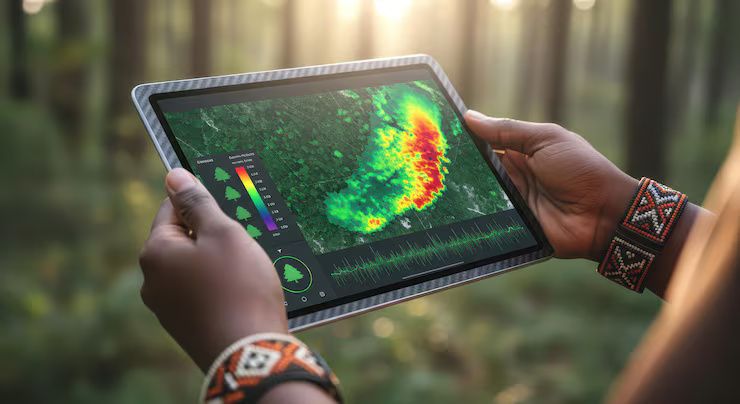
Modern monitoring platforms can display measurements through dashboards and automated reporting systems. Depending on system design, users may receive notifications when measurements cross predefined thresholds.
Real-time visualization can help teams identify changes more quickly than periodic manual data collection.
Artificial Intelligence and Analytics
Advanced analytics can be applied to large environmental datasets. Machine learning techniques may help identify patterns, detect unusual measurements, classify events, or support forecasting.
However, analytical results depend on data quality, sensor calibration, environmental variability, and appropriate model design. Automated analysis should therefore be interpreted alongside measurement and operational context.
Low-Power Sensor Networks
Advances in low-power electronics have expanded the use of distributed environmental sensors. Battery-powered devices can operate for extended periods when measurement frequency and communication requirements are carefully configured.
These systems are particularly useful for remote environmental monitoring applications.
Laws or Policies
Environmental Regulations
Environmental monitoring requirements vary significantly according to country, industry, pollutant, facility type, and environmental medium.
Regulations may establish limits or monitoring requirements for air emissions, wastewater discharges, hazardous substances, waste management, noise, and other environmental factors.
Organizations should identify the requirements applicable to their specific facility rather than relying on generalized environmental monitoring guidelines.
Measurement Quality
Regulatory monitoring may require defined measurement methods, calibration procedures, sampling intervals, detection limits, and data-quality criteria.
Monitoring equipment should therefore be selected according to the measurement methodology and regulatory requirements associated with the intended application.
Calibration and Maintenance
Environmental sensors and analytical instruments can experience measurement drift over time. Regular calibration, maintenance, inspection, and verification can help maintain data quality.
Calibration schedules should be determined according to equipment specifications, operating conditions, measurement requirements, and applicable procedures.
Data Records
Environmental monitoring programs commonly require records of measurements, calibration activities, equipment maintenance, sampling activities, and reporting.
Digital systems can maintain timestamped records and audit trails, making it easier to organize large datasets and retrieve historical information.
Tools and Resources
Environmental Data Loggers
Data loggers collect measurements from connected sensors and store them for later analysis or transmission.
They are commonly used for temperature, humidity, pressure, water quality, weather, and other environmental measurements.
Monitoring Dashboards
Environmental dashboards can combine measurements from multiple monitoring points into a centralized interface.
Typical dashboard functions include:
- Real-time readings
- Historical trends
- Threshold notifications
- Equipment status
- Location-based monitoring
- Report generation
- Data export
Geographic Information Systems
GIS platforms can combine environmental measurements with geographic information. This can help visualize monitoring stations, pollutant patterns, environmental boundaries, and other spatial relationships.
Laboratory Analysis
Some environmental parameters require laboratory-based analytical methods. Field monitoring systems can therefore operate alongside laboratory testing rather than replacing it.
Calibration and Verification Tools
Calibration equipment helps compare instrument readings against known reference conditions. Regular verification can identify sensor drift or measurement problems before they affect larger datasets.
FAQs
What are environmental monitoring systems?
Environmental monitoring systems are technologies used to measure, record, analyze, and report environmental conditions such as air quality, water quality, emissions, temperature, humidity, noise, and particulate matter.
What sensors are used in environmental monitoring?
Common sensors include temperature, humidity, pressure, gas, particulate, pH, conductivity, dissolved oxygen, turbidity, and radiation sensors. The appropriate sensor depends on the environmental parameter being measured.
What industries use environmental monitoring equipment?
Manufacturing, chemical processing, mining, power generation, oil and gas, pharmaceuticals, agriculture, construction, utilities, and research organizations can use environmental monitoring equipment.
How does IoT support environmental monitoring?
IoT technology allows distributed sensors to communicate measurements through connected networks. Data can then be transferred to centralized platforms for visualization, analysis, alerts, and reporting.
What should organizations consider when selecting monitoring equipment?
Important considerations include measurement range, accuracy, calibration requirements, environmental conditions, communication methods, data storage, maintenance, regulatory requirements, and compatibility with existing systems.
Conclusion
Environmental monitoring systems combine sensors, analytical instruments, data acquisition technologies, communication networks, and software to provide structured information about environmental conditions. Their applications range from air and water monitoring to industrial emissions, soil conditions, noise, radiation, and meteorological measurements.
Advances in IoT connectivity, remote monitoring, real-time dashboards, low-power sensors, and data analytics are expanding how environmental information can be collected and analyzed. Effective implementation depends on appropriate equipment selection, reliable calibration, suitable measurement methods, data-quality controls, and alignment with applicable environmental requirements.