Brand24 is a media monitoring and social listening platform designed to help people understand how brands, organizations, products, and topics are discussed online.
It gathers public mentions from sources such as social media, news websites, blogs, forums, podcasts, and other online channels.
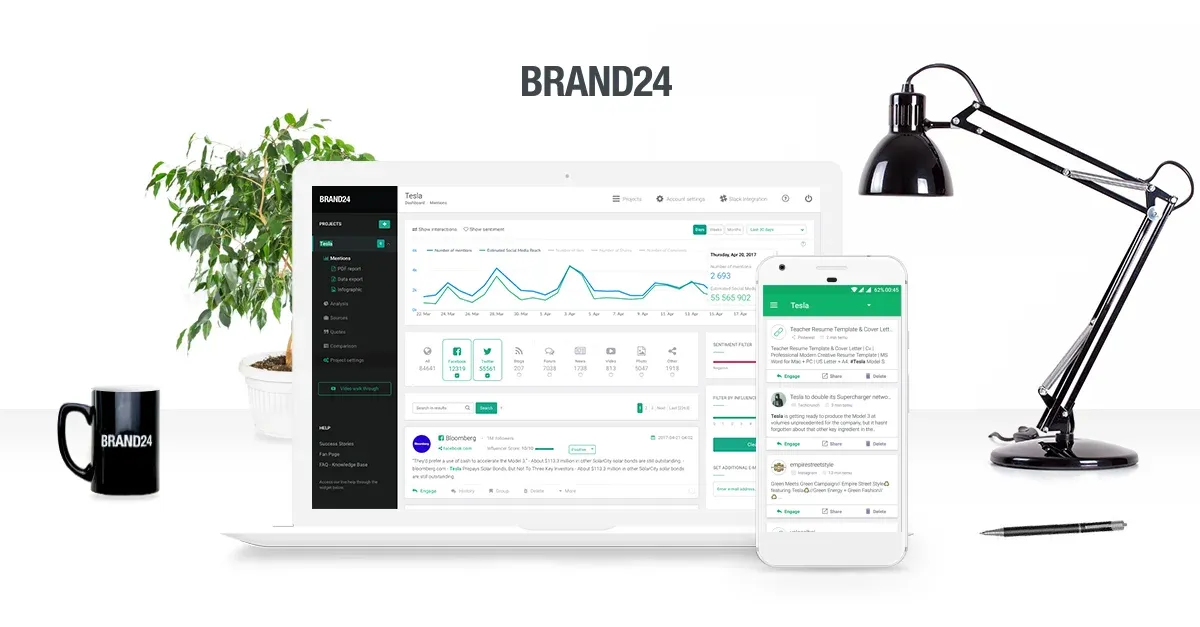
For beginners, Brand24 can be understood as a central place for observing online conversations. Instead of checking many platforms separately, users can examine mentions, sentiment, reach, discussion topics, and other measurements in one monitoring environment.
Context
Media monitoring has become increasingly important as online conversations move quickly between social networks, news websites, video platforms, discussion forums, and other digital channels. A single discussion can attract attention across several platforms within a short period.
Brand24 is designed around keyword-based monitoring. Users can create monitoring projects around a brand name, product name, campaign phrase, competitor, industry term, or another subject. The platform then gathers relevant public mentions and organizes them for analysis. Brand24 states that its monitoring covers more than 25 million online sources.
The main purpose is not simply to count mentions. The platform provides additional context, including reach, engagement, sentiment, influence, topics, and share of voice. These measurements can help users understand whether online attention is increasing, where conversations are happening, and what themes appear repeatedly.
For example, a communications team could monitor a company name and several related phrases. A researcher could track an industry topic. A marketing analyst could compare conversations around several competing brands. A public-relations team could examine changes in sentiment after an announcement.
Some commonly monitored areas include:
- Brand and organization names
- Products and campaigns
- Competitor names
- Industry keywords
- Hashtags
- News coverage
- Customer discussions
- Public online reviews
- Podcasts and video conversations
Brand24 also provides filtering and analysis features intended to reduce irrelevant mentions. Its current documentation describes advanced filters, sentiment analysis, topic analysis, demographic information, influence measurements, and context-based search.
Importance
Online reputation is influenced by many conversations that an organization may not directly control. Monitoring these discussions can help teams recognize recurring questions, changes in public sentiment, unusual increases in attention, and emerging subjects.
Brand24 can be relevant to several groups:
| User group | Possible monitoring purpose |
|---|---|
| Communications teams | Track public discussion and media coverage |
| Marketing teams | Study audience conversations and trends |
| Researchers | Examine discussions around selected subjects |
| Brand managers | Observe reputation and sentiment patterns |
| Analysts | Compare visibility and mention trends |
| Small organizations | Centralize public online monitoring |
One important measurement is sentiment. Automated sentiment analysis generally classifies mentions into categories such as positive, neutral, or negative. Brand24 also documents AI-based emotion analysis that can examine emotions such as joy, anger, and fear.
However, automated analysis should not be treated as perfect. Language can contain sarcasm, cultural references, slang, mixed opinions, or context that algorithms misunderstand. Human review remains useful when a mention could have an important reputational or communications impact.
Reach and mention volume provide another perspective. A large number of mentions does not automatically mean that public opinion is favorable. Similarly, a small number of mentions from highly visible accounts can attract substantial attention.
This distinction is important when interpreting Brand24 insights. Metrics should be examined together rather than treated as isolated indicators.
Recent Updates
Media monitoring is increasingly incorporating artificial intelligence to classify, summarize, and interpret large volumes of online discussion. Brand24's current feature set includes AI Insights, AI Brand Assistant, AI Topic Analysis, AI Anomaly Detection, sentiment analysis, emotion analysis, and intent analysis.
A notable 2026 development is the AI Brand Assistant. Brand24's documentation states that the feature can analyze project data through natural-language questions, provide conclusions, and create visualizations when appropriate. The company also states that improvements introduced in 2026 included higher precision, inline charts, and real-time web search integration.
Context-based searching is another recent direction. Rather than relying only on exact keyword matches, Brand24 describes Context Search as a way to filter mentions according to meaning and intended context. This can be useful when a keyword has multiple meanings or produces many unrelated results.
The platform's September 2026 changelog also describes expanded TikTok monitoring through video transcriptions. According to the update, keywords can be detected in spoken content inside TikTok videos even when those words do not appear in the video's written description.
These developments reflect a broader change in media monitoring: systems are moving from simple keyword collection toward contextual analysis, automated summaries, anomaly detection, and topic classification.
Laws or Policies
Media monitoring involves publicly available information, but public availability does not mean that every piece of information can be collected, stored, or reused without restrictions.
Privacy rules can apply when monitoring content that contains personal information. Organizations operating across different countries should consider applicable privacy laws, data-protection requirements, platform rules, retention practices, and the purpose for which collected information is processed.
The European Union's General Data Protection Regulation, commonly known as GDPR, is particularly relevant to organizations handling personal data connected with people in the European Economic Area. Depending on the circumstances, organizations may need a lawful basis for processing personal data and appropriate safeguards.
Platform terms also matter. Social networks and other websites can establish rules governing automated access, data collection, redistribution, and use of public content. A monitoring platform may therefore have access limitations even when information appears publicly visible.
Advertising and review rules can also become relevant when monitored information is later used in public communications. In the United States, the Federal Trade Commission states that endorsements should be truthful and that material relationships between endorsers and brands should be disclosed.
The FTC's updated Endorsement Guides also address practices involving consumer reviews, including misleading manipulation of reviews and relationships involving endorsers.
For this reason, Brand24 data should be treated as research information rather than automatically assuming that every mention can be republished or used in promotional communications.
Tools and Resources
A practical monitoring workflow usually begins with clearly defining what needs to be observed. Broad keywords can create large quantities of unrelated mentions, while extremely narrow keywords may miss useful conversations.
Useful resources include:
- Brand24 Mentions Feed for reviewing collected public discussions.
- Sentiment Analysis for identifying general positive, neutral, or negative patterns.
- Context Search for refining results based on meaning.
- AI Topic Analysis for grouping recurring discussion themes.
- AI Anomaly Detection for identifying unusual increases in mention activity.
- Comparison features for examining different brands or periods.
- Export functions for moving selected monitoring data into formats such as spreadsheets or presentations.
A simple monitoring process can follow these steps:
- Define the subject and research objective.
- Select relevant keywords and variations.
- Remove obvious unrelated terms.
- Monitor mentions over a consistent period.
- Review sentiment and discussion context.
- Identify unusual changes in volume or reach.
- Compare findings with previous periods.
- Manually inspect important or ambiguous mentions.
- Record conclusions with their supporting data.
It is also useful to establish a reporting schedule. Daily monitoring may be appropriate for rapidly changing subjects, while weekly or monthly reviews can be sufficient for longer-term research.
FAQs
What is Brand24 used for?
Brand24 is used to monitor and analyze public online mentions of selected brands, keywords, subjects, and competitors. Its features include mention tracking, sentiment analysis, reach measurements, topic analysis, and alerts.
How does Brand24 monitor online mentions?
Brand24 gathers public mentions associated with selected keywords from multiple online sources. Its documentation lists social media, news, blogs, forums, podcasts, video platforms, and other web sources among the monitored areas.
What is sentiment analysis in Brand24?
Sentiment analysis classifies the general tone of online mentions, commonly as positive, neutral, or negative. Results should still be reviewed because automated language analysis can misunderstand context, irony, or complicated statements.
Can Brand24 track competitors?
Yes. Brand24 documentation describes monitoring projects for brands, competitors, and specific keywords. Comparison features can be used to examine differences in visibility, mentions, sentiment, and other measurements.
What is Context Search?
Context Search is an AI-based filtering approach designed to identify mentions according to meaning rather than relying only on exact keyword matching. This can help reduce irrelevant results when a monitored phrase has multiple meanings.
Conclusion
Brand24 provides a structured way to examine public online conversations through media monitoring, mention tracking, sentiment analysis, and AI-supported insights. Its usefulness comes from combining different measurements and sources rather than relying on a single number.
As online discussions continue to expand across social media, news, video, podcasts, and forums, contextual analysis is becoming increasingly important. Responsible monitoring should also consider privacy rules, platform policies, data accuracy, and the need for human review when interpreting sensitive or ambiguous information.