Janmashtami, also known as Krishna Janmashtami, is a Hindu festival associated with the birth of Lord Krishna. It is observed on the Ashtami Tithi of Krishna Paksha in the month of Bhadrapada according to the Hindu lunar calendar.
Devotees commonly observe fasting, perform prayers, decorate spaces dedicated to Krishna, and participate in devotional activities.
For families celebrating at home, Janmashtami Puja can be organized in a simple and traditional manner. The exact customs may differ between regions, communities, and family traditions. Some families perform the main worship around midnight, traditionally associated with the time of Krishna's birth.
This guide explains how to do Janmashtami Puja at home, the commonly used Puja items, preparation steps, and related decoration and celebration ideas.
Why Do We Celebrate Janmashtami?
Janmashtami commemorates the birth of Lord Krishna, who is traditionally described as an incarnation of Lord Vishnu.
According to Hindu tradition, Krishna was born in Mathura to Devaki and Vasudeva. The story describes the rule of King Kansa, who feared a prophecy that Devaki's eighth child would become the cause of his downfall.
Because of this threat, Devaki and Vasudeva were imprisoned. Krishna was born there at midnight, and Vasudeva subsequently carried the newborn Krishna across the Yamuna River to Gokul, where he was raised in the household of Nanda and Yashoda.
The story of Krishna's birth and childhood forms an important part of Janmashtami traditions.
Story Behind Krishna Janmashtami
The traditional story begins with Kansa, the ruler of Mathura. A divine prophecy warned him that Devaki's eighth son would be responsible for his downfall.
Kansa imprisoned Devaki and Vasudeva and kept their children under close watch. Krishna was born as their eighth child.
According to the traditional account, divine circumstances helped Vasudeva take the newborn Krishna safely from Mathura to Gokul. Krishna was then raised by Nanda and Yashoda.
Krishna's childhood stories include his playful activities, friendship with other children, love of butter, and association with the residents of Gokul and Vrindavan.
These stories are remembered through devotional songs, performances, decorations, storytelling, and temple celebrations during Janmashtami.
When Is Janmashtami Celebrated?
The date of Janmashtami changes each year because it follows the Hindu lunar calendar.
The festival is associated with the eighth lunar day, or Ashtami Tithi, of Krishna Paksha. Many traditions observe the birth celebration around midnight.
Because the exact observance can vary by location and religious tradition, families should refer to a reliable local Panchang or their family tradition when determining the Puja timing.
Janmashtami Puja Samagri List
The exact Puja materials vary according to family customs. Common items may include:
| Puja Item | Common Purpose |
|---|---|
| Krishna idol or image | Main object of worship |
| Panchamrit ingredients | Ritual bathing |
| Water | Abhishek and purification |
| Flowers | Offering and decoration |
| Tulsi leaves | Traditional offering |
| Incense | Puja ritual |
| Diya | Lighting during worship |
| Fruits | Offering |
| Sweets | Bhog |
| Butter or makhan | Associated with Krishna |
| Mishri | Traditional food offering |
| Kumkum or sandalwood paste | Tilak and ritual use |
| New cloth | Dressing the Krishna idol |
| Flute decoration | Krishna-themed decoration |
| Peacock feather | Krishna-associated symbol |
Not every household needs all of these items. The Puja can be adapted according to family traditions and available materials.
How to Prepare for Janmashtami Puja at Home
Preparation can begin several hours before the main worship.
1. Clean the Puja Area
Clean the room or designated worship area. Wash the surface where the Krishna idol will be placed.
A clean environment is traditionally considered an important part of preparing for worship.
2. Prepare the Krishna Idol
Place a Krishna idol or image on a clean platform.
Families may use a small Bal Krishna idol, particularly when creating a child-Krishna-themed celebration.
3. Decorate the Puja Space
The area can be decorated using flowers, leaves, fabric, lights, and traditional decorative materials.
A small Jhanki can also be created to represent scenes associated with Krishna's birth or childhood.
4. Prepare the Offerings
Arrange fruits, sweets, butter, mishri, and other food offerings before the Puja begins.
If Panchamrit is being prepared, keep its ingredients ready in advance.
5. Prepare the Family
If the family is observing a fast, everyone should understand the household's chosen fasting practice. Different people and traditions follow different forms of fasting.
How to Do Janmashtami Puja at Home
The precise sequence can differ between traditions. A simple home observance may include the following steps.
Step 1: Begin With Prayer
Start the Puja by sitting calmly in front of the Krishna idol or image. Light a diya and incense if these are part of your family's practice.
Offer a prayer and focus on devotion and gratitude.
Step 2: Perform the Abhishek
Some traditions perform an Abhishek of the Krishna idol using water and Panchamrit.
If the idol is made from a material that should not be exposed to liquids, follow the care requirements for that particular idol.
After the Abhishek, gently clean and dry the idol.
Step 3: Dress the Krishna Idol
Dress the idol in clean or new clothing.
Traditional Krishna decorations may include a small crown, peacock feather, necklace, garland, or flute.
The decorations should be appropriate for the size and material of the idol.
Step 4: Apply Tilak
A traditional tilak may be applied according to the family's religious practice.
Families may also decorate the idol with sandalwood paste, flowers, and other customary items.
Step 5: Offer Flowers and Tulsi
Offer flowers and Tulsi leaves where appropriate.
Tulsi has a significant place in Vaishnav traditions and is commonly associated with offerings to Krishna.
Step 6: Offer Bhog
Place prepared food offerings before the Krishna idol.
Common offerings can include fruits, sweets, makhan, mishri, and other traditional foods.
Some families prepare special dishes specifically for Janmashtami.
Step 7: Perform Aarti
The family can perform Krishna Aarti together.
Devotional songs or traditional Janmashtami bhajans may be sung during the worship.
Step 8: Observe the Midnight Celebration
Many traditions associate the main celebration with midnight, representing the traditional time of Krishna's birth.
Families may perform special prayers, ring bells, sing devotional songs, and celebrate the birth of Krishna.
The exact ritual sequence should follow the family's tradition or guidance from a knowledgeable religious authority.
Janmashtami Decoration Ideas
Decoration is an important part of many home celebrations. It can range from a small Puja corner to a larger Krishna Jhanki.
Flower Decoration
Fresh flowers can be arranged around the Puja platform. Marigold and other commonly available flowers can be used to create garlands and borders.
Krishna Jhanki
A Jhanki can depict scenes from Krishna's birth or childhood. A simple backdrop, small figurines, fabric, flowers, and lights can be combined to create the display.
Matki Decoration
Matkis are closely associated with stories of Krishna's childhood and his playful relationship with butter and curd.
A clay pot can be decorated with flowers, fabric, ribbons, or traditional patterns.
Peacock Feather Theme
Peacock feathers are commonly associated with Krishna and can be incorporated into the decoration around the idol or Jhanki.
Lighting
Small decorative lights can be used around the Puja area. Battery-operated lights can be useful when electrical access is limited.
How to Create a Simple Janmashtami Jhanki
A Jhanki does not need to be complicated. A small table or platform can serve as the base.
Start by creating a backdrop using fabric or colored paper. Place the Krishna idol at the center and arrange decorative elements around it.
A small cradle can represent Bal Krishna. Flowers, lights, artificial grass, small trees, and traditional props can be used to build the surrounding scene.
The display should remain stable and should not obstruct normal movement through the room.
Janmashtami Dress for Baby Boy
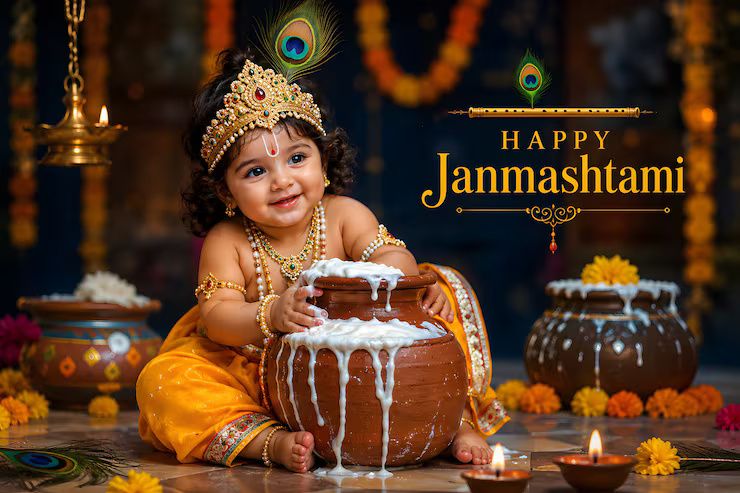
Baby Krishna-inspired clothing is another popular part of Janmashtami celebrations.
A traditional outfit for a baby boy may include:
- Dhoti-style clothing
- Small kurta
- Krishna-inspired crown
- Peacock feather
- Flute accessory
- Traditional jewelry
- Waist accessories
For babies, comfort and safety should take priority over elaborate styling.
Clothing should be breathable and appropriately sized. Small accessories that could become choking hazards should not be left within a baby's reach.
Janmashtami Food and Bhog Ideas
Food traditions differ across regions. Common Janmashtami offerings may include fruits, milk-based preparations, makhan, mishri, sweets, and other festive dishes.
Some families also prepare dishes using ingredients suitable for their fasting tradition.
Modern celebrations may include themed desserts such as Krishna-shaped sweets or a matki cake for Janmashtami. A cake decorated like a traditional clay pot can provide a contemporary addition to a family celebration.
When preparing food for a religious offering, households can follow their own dietary and religious practices.
Janmashtami Cake Order Online
The growing popularity of themed celebrations has introduced modern dessert formats into Janmashtami gatherings.
A Janmashtami cake may feature:
- Matki designs
- Krishna figurines
- Peacock feather decorations
- Flute motifs
- Blue and white decorative elements
- Butter-pot themes
People searching for a Janmashtami cake order online should check the cake's ingredients, size, delivery timing, storage requirements, and decoration details before placing an order.
Janmashtami Decoration Kits
For families looking for a more convenient preparation process, Janmashtami decoration kits can combine several decorative elements in one package.
A kit may contain items such as:
- Backdrop materials
- Artificial flowers
- Decorative hangings
- Peacock feather elements
- Krishna-themed props
- Small decorative lights
- Matki decorations
The contents can differ considerably between kits, so the product description should be checked carefully.
How to Make Janmashtami Celebration More Meaningful
Janmashtami can be observed through more than decoration and food. Families can read or listen to stories about Krishna, sing devotional songs, discuss the meaning of the festival, or watch traditional performances.
Children can participate by helping with simple decorations, learning devotional songs, making paper crafts, or listening to age-appropriate versions of Krishna's stories.
This can help connect the visual and festive elements of Janmashtami with its cultural and religious significance.
Frequently Asked Questions
Why do we celebrate Janmashtami?
Janmashtami commemorates the birth of Lord Krishna, who is traditionally regarded as an incarnation of Lord Vishnu. The festival is observed through prayer, fasting, devotional activities, and celebrations.
How can I do Janmashtami Puja at home?
Clean the worship area, prepare the Krishna idol, arrange the required Puja items and offerings, perform the family's traditional rituals, and participate in prayer and Aarti. The exact procedure varies between traditions.
What items are needed for Janmashtami Puja?
Common items include a Krishna idol, flowers, Tulsi leaves, water, Panchamrit ingredients, diya, incense, fruits, sweets, and clothing or decorations for the idol.
What are simple Janmashtami decoration ideas?
Simple options include flower arrangements, a decorated Matki, a Krishna Jhanki, fabric backdrops, peacock feather decorations, and small decorative lights.
What is a suitable Janmashtami dress for a baby boy?
A comfortable dhoti-style outfit with a small Krishna-inspired crown and other safe, age-appropriate elements can create a traditional look. Avoid loose or small accessories that could pose safety risks.
Conclusion
Janmashtami is a festival centered on the birth of Lord Krishna and is observed through a combination of religious rituals, fasting, devotional activities, storytelling, food, and decoration.
A home celebration can be simple or elaborate depending on family traditions. Preparing the Puja area, arranging the Krishna idol, offering food, performing Aarti, and observing the midnight celebration are common elements.
Modern additions such as Krishna-themed baby outfits, Janmashtami decoration kits, themed desserts, and creative Jhankis provide additional ways for families to participate. Whatever form the celebration takes, following one's family or community tradition can help preserve the cultural and religious meaning of Janmashtami.