Industrial robotics components are the mechanical, electrical, electronic, sensing, control, and software-related elements that allow industrial robots to move, detect objects, communicate with equipment, and perform automated production tasks. These components are used in robotic arms, autonomous material-handling systems, welding robots, assembly systems, packaging equipment, and automated inspection cells.
A modern robotic system combines precision mechanical components with servo drives, controllers, sensors, end effectors, cables, safety systems, and industrial communication technologies. Component selection depends on payload, reach, motion requirements, accuracy, operating environment, duty cycle, and application.
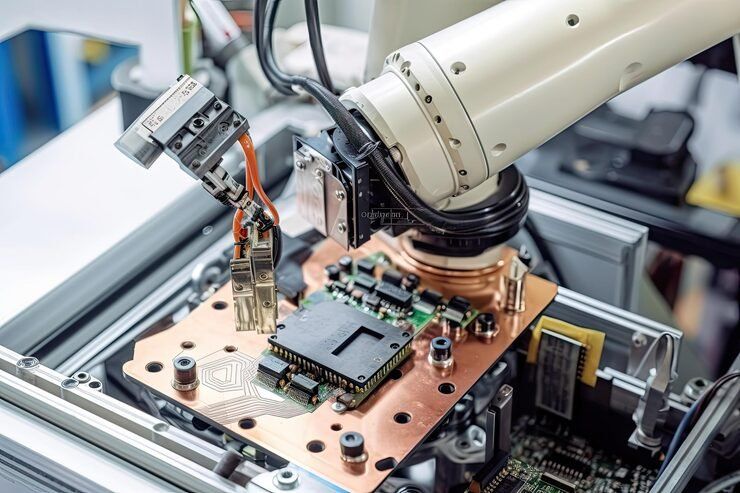
Why Industrial Robotics Components Matter
Industrial robots perform repetitive and precision-oriented tasks across many manufacturing environments. Their performance depends on the interaction between individual components.
Industrial robotics components can support:
Precise robotic movement
Position and speed control
Automated material handling
Welding and joining
Assembly operations
Machine tending
Packaging and palletizing
Quality inspection
Object detection
Force and torque measurement
Human-machine safety
The mechanical and electronic architecture of a robot must be matched to the intended production application.
Types of Industrial Robotics Components
Robot Manipulators
The manipulator is the mechanical structure that provides robotic movement. It typically includes links, joints, shafts, bearings, gear systems, and structural frames.
Common industrial robot configurations include:
Articulated robots
SCARA robots
Cartesian robots
Delta robots
Cylindrical robots
Collaborative robots
Servo Motors
Servo motors provide controlled rotational movement for robot joints and other motion axes. They are selected according to torque, speed, acceleration, precision, and duty-cycle requirements.
Gearboxes and Reducers
Gearboxes reduce motor speed while increasing available torque. Robotic joints commonly use precision reduction technologies such as harmonic-drive and planetary gear systems.
Bearings
Bearings support rotating components and help maintain controlled movement. High-precision bearings can be important in robotic joints, rotary axes, and end-effector assemblies.
Robot Controllers
The robot controller coordinates movement, trajectory planning, communication, input/output signals, and application logic.
Controllers may communicate with programmable logic controllers, industrial networks, machine vision systems, safety equipment, and production-management platforms.
Servo Drives
Servo drives regulate motor speed, torque, position, and acceleration. They receive control commands and adjust electrical power supplied to servo motors.
Encoders
Encoders provide position or speed feedback to the robot control system. Optical, magnetic, and absolute encoder technologies can be used depending on the application.
End Effectors
End effectors are devices mounted at the end of a robotic arm to interact with workpieces.
Examples include:
Robotic grippers
Vacuum grippers
Welding torches
Screwdrivers
Cutting tools
Dispensing tools
Magnetic grippers
Tool changers
Sensors
Industrial robots use sensors to detect position, force, torque, proximity, temperature, pressure, and other operating conditions.
Machine Vision Components
Machine vision systems combine cameras, lenses, lighting, image-processing hardware, and software to identify objects, inspect products, determine positions, and guide robotic movement.
Industrial Robot Cables
Robotic cables are designed for repeated bending and movement. They can carry electrical power, control signals, data, and communication signals between robotic components.
Robotics Technologies
Six-Axis Robotics
Six-axis articulated robots provide multiple rotational degrees of freedom, allowing them to reach complex positions and orientations.
They are widely used for welding, assembly, machine tending, material handling, painting, and other applications.
SCARA Robotics
SCARA systems provide fast horizontal movement and are commonly used in electronics assembly, packaging, picking, and precision assembly.
Cartesian Robotics
Cartesian robots use linear axes to provide movement along defined X, Y, and Z coordinates. They are commonly applied to material handling, machining, dispensing, and automated assembly.
Delta Robotics
Delta robots use parallel-link structures to achieve high-speed movement. They are frequently used for sorting, picking, packaging, and food-processing applications.
Collaborative Robotics
Collaborative robots incorporate sensing and control technologies designed for applications where robots operate in proximity to people under defined safety conditions.
Autonomous Mobile Robotics
Mobile robotic platforms combine drive systems, sensors, controllers, navigation technologies, and communication systems to move materials within industrial facilities.
Manufacturing Processes for Robotics Components
Industrial robotics components require precision manufacturing because small dimensional variations can influence robot accuracy and repeatability.
1. Engineering and Design
Manufacturers establish dimensions, load requirements, motion characteristics, material specifications, tolerances, and operating conditions.
Computer-aided design and simulation are commonly used to evaluate component geometry and mechanical performance.
2. Material Selection
Materials can include alloy steel, stainless steel, aluminum, engineering plastics, ceramics, composites, and specialized alloys.
Material selection depends on strength, weight, wear resistance, thermal stability, corrosion resistance, and operating conditions.
3. Precision Machining
Robot components such as shafts, gears, housings, joints, and mounting components can be manufactured through CNC turning, milling, grinding, honing, and other precision processes.
4. Gear Manufacturing
Robotic gear systems require controlled tooth geometry and dimensional accuracy. Processes can include gear cutting, grinding, heat treatment, and surface finishing.
5. Heat Treatment
Heat treatment can modify hardness, strength, wear resistance, and fatigue performance of metallic components.
6. Surface Finishing
Grinding, polishing, coating, plating, anodizing, and other surface treatments can improve component characteristics and dimensional consistency.
7. Electronic Assembly
Controllers, servo drives, sensors, encoders, communication modules, and control boards are assembled and tested according to their electrical specifications.
8. Calibration and Testing
Robotics components may undergo dimensional inspection, electrical testing, torque testing, endurance testing, vibration testing, positional accuracy testing, and environmental testing.
Global Manufacturers and Suppliers
The industrial robotics ecosystem includes companies specializing in robots, motion control, gear systems, bearings, sensors, controllers, drives, end effectors, machine vision, and automation technologies.
Examples of established companies active in industrial robotics and related technologies include:
ABB
FANUC
KUKA
Yaskawa Electric
Rockwell Automation
NVIDIA
Other suppliers specialize in specific component categories such as precision bearings, gear reducers, servo motors, sensors, cables, machine vision, grippers, and robot safety systems.
Industrial Applications
Automotive Manufacturing
Robotic components are used in welding, painting, assembly, machine tending, material handling, and inspection.
Electronics Manufacturing
Precision robots support component placement, assembly, inspection, testing, dispensing, and packaging.
Metalworking
Robots equipped with specialized end effectors can perform welding, cutting, grinding, polishing, and material-handling tasks.
Food Processing
Robotic systems can perform high-speed picking, sorting, packaging, palletizing, and product handling.
Pharmaceutical Manufacturing
Robotic automation can support packaging, laboratory handling, material transfer, inspection, and controlled production processes.
Warehousing and Logistics
Robotic systems use sensors, motors, controllers, grippers, navigation systems, and communication technologies for automated material movement and order handling.
Plastics Manufacturing
Robots can remove molded parts, handle components, perform trimming, inspect products, and transfer materials between production stages.
Industrial Robotics Components Comparison
| Component | Primary Function | Typical Application |
|---|---|---|
| Servo motor | Controlled motion | Robot joints |
| Gearbox | Speed reduction and torque transmission | Robotic axes |
| Bearing | Rotational support | Joints and rotary axes |
| Encoder | Position feedback | Motion control |
| Servo drive | Motor control | Robotic motion |
| Controller | Robot coordination | Automation cells |
| Sensor | Detection and measurement | Process monitoring |
| End effector | Workpiece interaction | Handling and assembly |
| Vision system | Image-based detection | Inspection and guidance |
| Robot cable | Power and data transmission | Moving robot axes |
Factors to Consider When Selecting Robotics Components
Payload Requirements
Component selection should correspond to the robot's payload and the weight of the end effector and workpiece.
Precision and Repeatability
Applications involving assembly, inspection, machining, or electronics may require high positional accuracy and repeatability.
Speed and Duty Cycle
Motors, gearboxes, bearings, and drives must withstand the expected acceleration, speed, operating hours, and production cycles.
Environmental Conditions
Dust, moisture, chemicals, temperature, vibration, and cleanroom requirements can influence component selection.
Compatibility
Motors, drives, controllers, encoders, communication systems, and mechanical components must operate together as an integrated system.
Maintenance
Component accessibility, lubrication requirements, replacement intervals, diagnostics, and spare-part availability can affect long-term operation.
Communication
Modern robotic systems may use industrial communication technologies such as Ethernet-based networks and fieldbus systems to connect robots with PLCs, sensors, vision systems, and factory-control platforms.
Future Trends in Industrial Robotics Components
Industrial robotics components are increasingly incorporating advanced sensors, compact servo systems, higher-performance controllers, intelligent drives, and industrial networking.
Artificial intelligence and machine vision are expanding the ability of robotic systems to recognize objects, adapt to changing conditions, and perform more complex inspection and handling tasks.
Digital twins can also connect virtual robot models with physical equipment data for simulation, commissioning, monitoring, and process optimization.
Another development is the increasing integration of robotics with smart manufacturing platforms. Robot controllers, sensors, production equipment, and manufacturing software can exchange operational information through connected industrial networks.
FAQs
What are industrial robotics components?
Industrial robotics components are the mechanical, electrical, electronic, sensing, control, and interface elements used to construct and operate industrial robotic systems.
What are the main components of an industrial robot?
Common components include robot joints, servo motors, gearboxes, bearings, encoders, servo drives, controllers, sensors, cables, and end effectors.
What is the role of a robot controller?
A robot controller coordinates robot motion, trajectory planning, input/output signals, communication, and application-specific control functions.
How are robotic components manufactured?
Manufacturing can involve precision machining, gear manufacturing, heat treatment, surface finishing, electronic assembly, calibration, and performance testing.
Where are industrial robotics components used?
They are used in automotive, electronics, metalworking, food processing, pharmaceutical manufacturing, plastics production, logistics, packaging, and many other industrial applications.
Conclusion
Industrial robotics components form the technical foundation of modern robotic automation. Servo motors, gearboxes, bearings, encoders, controllers, sensors, drives, cables, machine vision systems, and end effectors work together to provide controlled movement and automated task execution.
Advances in precision manufacturing, sensing, artificial intelligence, machine vision, motion control, and industrial networking are expanding robotic capabilities across manufacturing and logistics. Understanding component types, robotics technologies, manufacturing processes, and application requirements helps engineers and industrial buyers evaluate robotic systems according to their operational needs.