Industrial vacuum pumps are mechanical or fluid-based systems designed to remove gases and vapors from enclosed spaces and create controlled vacuum conditions. They are used across manufacturing, chemical processing, pharmaceuticals, food processing, electronics, packaging, metallurgy, laboratories, and other industrial environments.
Different vacuum technologies provide different pressure ranges, pumping speeds, contamination characteristics, and operating requirements. Understanding pump construction, manufacturing methods, selection factors, and industrial applications helps organizations identify an appropriate vacuum technology for a particular process.
Context
What Are Industrial Vacuum Pumps?
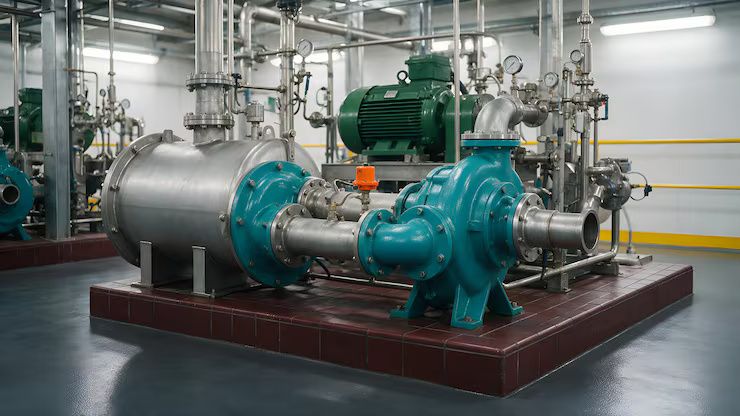
An industrial vacuum pump removes gas molecules from a chamber, vessel, pipeline, or process system. By continuously extracting gas, the pump reduces pressure below atmospheric pressure and creates a vacuum environment.
The required vacuum level varies considerably between applications. Some processes need only a relatively low vacuum, while semiconductor processing, freeze drying, analytical equipment, and specialized coating processes can require much deeper vacuum conditions.
How Vacuum Pumps Work
Vacuum pumps operate using different mechanical, fluid, or physical principles. Mechanical pumps generally use moving components to capture and transport gas, while other technologies use high-speed rotors, liquid rings, diaphragms, or specialized physical effects.
A simplified vacuum pumping cycle includes:
- Gas enters the pump or inlet chamber.
- Internal components capture or compress the gas.
- Gas pressure increases within the pumping mechanism.
- The gas is discharged from the pump.
- The process repeats until the required pressure condition is reached.
Actual performance depends on pump design, gas composition, temperature, leakage, piping configuration, and operating conditions.
Major Vacuum Pump Technologies
Several technologies are used in industrial vacuum systems.
| Vacuum Technology | Operating Principle | Typical Applications |
|---|---|---|
| Rotary Vane Pump | Rotating vanes compress gas | General industrial vacuum |
| Dry Screw Pump | Rotating screws transport gas | Chemical and process systems |
| Liquid Ring Pump | Rotating liquid forms compression chambers | Wet and vapor-heavy processes |
| Diaphragm Pump | Flexible diaphragm moves gas | Chemical and laboratory processes |
| Scroll Pump | Orbiting scrolls compress gas | Clean and dry applications |
| Roots Blower | Lobed rotors move gas | High-volume vacuum systems |
| Turbomolecular Pump | High-speed rotor transfers gas molecules | High-vacuum applications |
| Diffusion Pump | Vapor jets transfer gas molecules | Specialized high-vacuum systems |
The selection depends on the required vacuum level, pumping speed, process gas, contamination tolerance, operating temperature, and maintenance requirements.
Wet and Dry Vacuum Pumps
Industrial vacuum pumps can also be categorized according to whether operating fluids are used in the compression process.
Wet pumps may use oil or another liquid within the pumping mechanism. These designs can provide established performance for many industrial applications but require consideration of fluid contamination and maintenance.
Dry vacuum pumps operate without introducing lubricating fluid into the compression chamber. Dry technologies are often considered when process contamination must be minimized.
Importance
Why Industrial Vacuum Pumps Matter
Vacuum technology plays an important role in processes where atmospheric pressure would interfere with production or product quality. Removing air, moisture, vapors, or other gases can support controlled processing conditions.
Vacuum systems are used for applications ranging from packaging and material handling to chemical evaporation and semiconductor manufacturing.
Manufacturing of Vacuum Pumps
Industrial vacuum pump manufacturing involves precision machining, component assembly, sealing, testing, and performance verification.
Common manufacturing stages include:
- Material selection
- Component machining
- Rotor or chamber production
- Surface treatment
- Seal and bearing installation
- Motor integration
- Pump assembly
- Leak testing
- Vacuum performance testing
- Noise and vibration evaluation
- Final inspection
Materials may include cast iron, stainless steel, aluminum alloys, engineered polymers, and specialized coatings depending on the application.
Key Pump Components
The internal construction varies according to pump type, but many systems include several important components.
Pump chamber: Provides the space where gas is captured and compressed.
Rotors or moving elements: Transfer or compress gas through the pump.
Bearings: Support rotating components and maintain alignment.
Seals: Reduce unwanted gas leakage between moving and stationary components.
Motor: Supplies mechanical energy to operate the pumping mechanism.
Inlet and outlet connections: Connect the pump to the vacuum process and exhaust system.
Global Manufacturers and Suppliers
Industrial vacuum pump manufacturers and suppliers typically provide equipment for specific pressure ranges, industries, and process conditions. Their product portfolios may include individual pumps, pump packages, accessories, controllers, filtration systems, and complete vacuum systems.
When comparing equipment, organizations can examine technical parameters such as ultimate pressure, pumping speed, inlet capacity, motor power, gas compatibility, operating temperature, noise level, maintenance requirements, and available configurations.
The term “global manufacturer” can refer to companies with production facilities, engineering operations, distribution networks, or industrial customers across multiple regions. Supplier structures vary between direct manufacturers, authorized distributors, system integrators, and specialized vacuum equipment companies.
Industrial Vacuum Applications
Vacuum pumps are used in many industrial processes.
Food packaging: Vacuum extraction removes air from packaging before sealing, depending on the packaging process.
Pharmaceutical manufacturing: Vacuum systems can support drying, evaporation, solvent recovery, filtration, and other controlled processes.
Chemical processing: Pumps can assist with distillation, drying, degassing, evaporation, and vapor handling.
Semiconductor manufacturing: High- and ultra-high-vacuum systems are used in specialized fabrication and processing environments.
Metallurgy: Vacuum technology can support melting, heat treatment, degassing, and controlled material processing.
Plastics manufacturing: Vacuum systems can assist with material drying, extrusion processes, and pneumatic conveying.
Packaging machinery: Vacuum generators and pumps can support product handling, sealing, forming, and evacuation.
Vacuum coating: Vacuum pumps create controlled environments for physical and chemical coating processes.
Recent Updates
Energy-Efficient Vacuum Technologies
Energy consumption has become an important consideration for industrial vacuum systems. Variable-speed drives, improved motor designs, optimized pumping mechanisms, and automated control systems can adjust pump operation according to process demand.
Instead of operating continuously at a fixed output, some systems can modify operating conditions according to changes in vacuum requirements.
Smart Vacuum Systems
Modern vacuum equipment increasingly incorporates sensors and digital monitoring. Pressure, temperature, vibration, motor load, and other parameters can be collected for operational analysis.
Connected monitoring can help operators identify changes in pump behavior and schedule inspection activities based on equipment conditions.
Predictive Maintenance
Condition monitoring is increasingly being applied to rotating vacuum equipment. Vibration analysis, temperature monitoring, pressure trends, and motor-current information can provide indicators of changing equipment conditions.
Predictive maintenance programs use these measurements alongside historical information to determine when inspection or maintenance activities may be appropriate.
Dry Vacuum Technology
Dry vacuum systems continue to attract attention in applications where oil contamination needs to be minimized. Dry screw, dry scroll, dry claw, and other technologies can be configured for different industrial processes.
The appropriate technology depends on the gas composition, pressure range, moisture level, temperature, and required cleanliness.
Vacuum System Integration
Industrial vacuum equipment is increasingly designed as part of a complete system rather than as an isolated pump. Controllers, sensors, filtration, condensers, valves, piping, and cooling equipment can all influence overall vacuum performance.
System-level design can therefore be important when the application involves complex gas mixtures, vapors, multiple chambers, or changing process conditions.
Laws or Policies
Industrial Equipment Safety
Industrial vacuum systems should be designed, installed, operated, and maintained according to applicable workplace and equipment-safety requirements.
Safety considerations can include rotating components, electrical equipment, hot surfaces, pressure differences, chemical exposure, exhaust gases, and stored energy.
Pressure and Process Safety
Although vacuum equipment operates below atmospheric pressure, vacuum systems can still present mechanical and process hazards. Chambers, vessels, piping, and connected equipment should be appropriate for their intended pressure conditions.
Where hazardous gases or chemicals are involved, additional containment, ventilation, monitoring, and emergency procedures may be required.
Environmental Requirements
Pump exhaust can contain process vapors, solvents, particulates, or other substances. Depending on the application and jurisdiction, exhaust treatment or filtration may be required.
Organizations should evaluate applicable environmental requirements for emissions, waste fluids, contaminated filters, and other process residues.
Quality and Maintenance Procedures
Industrial facilities commonly establish documented procedures for pump installation, inspection, lubrication where applicable, component replacement, cleaning, testing, and shutdown.
Maintenance records can help organizations track operating conditions and identify recurring equipment issues.
Tools and Resources
Vacuum Gauges and Sensors
Accurate pressure measurement is fundamental to vacuum system operation. Different gauges are appropriate for different pressure ranges and gas conditions.
Common technologies include:
- Pirani gauges
- Capacitance manometers
- Thermocouple gauges
- Cold-cathode gauges
- Ionization gauges
- Mechanical vacuum gauges
Vacuum Leak Detection
Leaks can significantly affect vacuum performance. Depending on the system, leak detection may involve pressure-decay testing, tracer-gas techniques, or other diagnostic methods.
Helium leak detection is commonly associated with demanding high-vacuum applications where very small leaks need to be identified.
Vacuum Control Systems
Controllers can coordinate pump operation with valves, sensors, and process equipment. Automated control can help maintain a defined pressure range and manage pump sequencing.
Engineering and Selection Tools
Vacuum system engineers may use pump curves, pressure-flow calculations, piping specifications, gas-load estimates, and process data when selecting equipment.
Important parameters include:
- Required operating pressure
- Ultimate pressure
- Pumping speed
- Gas composition
- Vapor load
- Operating temperature
- Contamination level
- Duty cycle
- Exhaust requirements
- Available utilities
FAQs
What is an industrial vacuum pump?
An industrial vacuum pump is equipment designed to remove gas from a controlled space and reduce its pressure below atmospheric pressure. Different pump technologies support different vacuum ranges and process conditions.
Which vacuum pump technologies are commonly used?
Common technologies include rotary vane, dry screw, liquid ring, diaphragm, scroll, Roots, turbomolecular, and diffusion pumps. Selection depends on the required vacuum level and process characteristics.
What are dry vacuum pumps used for?
Dry vacuum pumps are used in applications where process contamination from oil or other pumping fluids needs to be minimized. Examples include certain pharmaceutical, chemical, electronics, and laboratory processes.
How are vacuum pumps manufactured?
Manufacturing generally involves precision component production, machining, assembly, sealing, motor integration, leak testing, performance testing, and final inspection.
How do I select an industrial vacuum pump?
Selection should consider operating pressure, pumping speed, gas composition, vapor load, temperature, contamination requirements, duty cycle, exhaust conditions, and system configuration.
What industries use vacuum pumps?
Vacuum pumps are used in food processing, pharmaceuticals, chemicals, semiconductor manufacturing, metallurgy, plastics, packaging, coating, laboratories, and many other industrial processes.
Conclusion
Industrial vacuum pumps provide controlled pressure conditions for a broad range of manufacturing and processing activities. Rotary vane, dry screw, liquid ring, diaphragm, scroll, Roots, turbomolecular, and other technologies each have distinct operating characteristics.
Manufacturing quality, pump configuration, process compatibility, monitoring technology, and system design all influence vacuum performance. Modern systems increasingly incorporate digital sensors, variable-speed operation, condition monitoring, and integrated controls.
For industrial applications, selecting a vacuum technology requires evaluation of the required pressure range, pumping speed, gas composition, vapor load, contamination requirements, operating conditions, and applicable safety procedures.