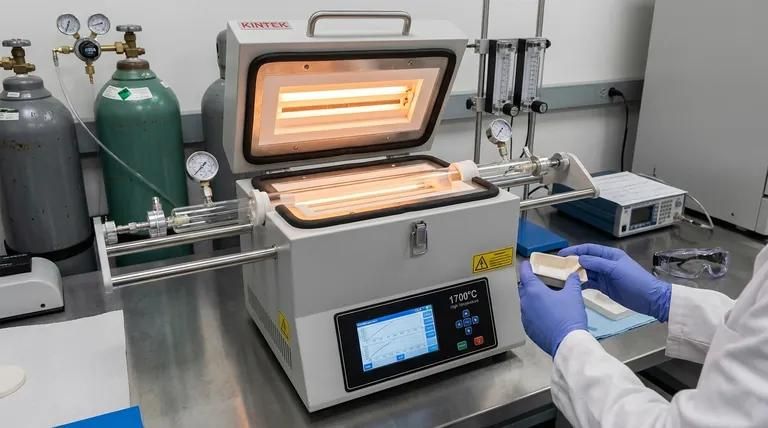
Laboratory tube furnaces are specialized heating systems used to heat materials under controlled temperature conditions. They are widely used in materials science, chemistry, metallurgy, ceramics, semiconductor research, and industrial testing laboratories. Their tubular heating chamber allows samples to be heated within a defined zone, making them suitable for experiments that require controlled thermal conditions and repeatable processing.
A laboratory tube furnace typically consists of a heating element, a temperature controller, a thermocouple, an insulated chamber, and a tube that holds or surrounds the sample. Depending on the design, the furnace may operate in normal atmospheric conditions, an inert gas environment, a vacuum system, or a controlled atmosphere. Understanding the types, working principles, applications, and temperature control methods of tube furnaces helps laboratories select appropriate equipment for their research and testing requirements.
What Is a Laboratory Tube Furnace?
Definition and Basic Design
A laboratory tube furnace is a thermal processing device that uses electrical heating elements to generate heat around a tubular chamber. Samples are placed inside the tube or in a suitable sample holder, allowing controlled heating without requiring a large conventional furnace chamber. The tube may be made from materials such as quartz, alumina, or other heat-resistant ceramics, depending on the maximum operating temperature and chemical environment.
The heating chamber is generally surrounded by thermal insulation to reduce heat loss and improve temperature uniformity. A control system regulates the electrical power supplied to the heating elements, while a temperature sensor measures the thermal conditions near the sample or within the heating zone. Some models have a single heating zone, whereas advanced systems provide multiple zones for creating more uniform temperatures or controlled temperature gradients.
How a Tube Furnace Works
The working principle of a tube furnace is based on converting electrical energy into heat through resistance heating. When electrical current passes through the heating element, the element generates heat. This energy transfers through radiation and conduction, and sometimes convection, to the furnace tube and the sample inside it.
The temperature controller compares the measured temperature with the selected setpoint and adjusts the heating power accordingly. This feedback process helps maintain the required temperature during an experiment. Depending on the application, the furnace may heat a sample gradually, hold it at a specific temperature, or cool it according to a programmed schedule.
Major Types of Laboratory Tube Furnaces
Single-Zone Tube Furnaces
A single-zone tube furnace uses one primary heated region along the tube. It is commonly used for general laboratory heating, annealing, calcination, and materials testing. The temperature controller regulates the heating zone to provide the required thermal conditions for the sample.
These furnaces are useful for experiments that do not require complex temperature profiles. Their relatively straightforward design also makes them suitable for laboratory environments where researchers need repeatable heating cycles for routine materials research and thermal processing.
Multi-Zone Tube Furnaces
A multi-zone tube furnace contains two or more independently controlled heating regions. Each zone can be assigned a separate temperature setting, allowing researchers to create a controlled thermal gradient along the tube. This design is useful for processes in which different parts of a sample or reaction chamber need different temperatures.
Multi-zone furnaces are used in chemical vapor deposition research, catalyst studies, semiconductor materials development, and other experiments involving temperature-dependent reactions. Their performance depends on the number of heating zones, the placement of temperature sensors, the tube dimensions, and the thermal properties of the materials being processed.
Split-Hinge Tube Furnaces
A split-hinge tube furnace has a heating chamber that opens along a hinged section. This arrangement provides easier access to the working tube and sample assembly, particularly in experimental systems that require frequent inspection or changes to the internal setup.
Split designs are useful when researchers need to access a tube without dismantling the entire heating system. However, the tube, insulation, and heating elements must be handled according to the manufacturer's instructions to avoid damage and maintain safe operating conditions.
High-Temperature Tube Furnaces
High-temperature tube furnaces are designed for experiments that require temperatures beyond the capabilities of standard laboratory heating systems. Depending on the model and heating element, certain specialized furnaces can operate at temperatures above 1,000°C, with some designs reaching substantially higher limits.
These systems are used in ceramic sintering research, advanced materials processing, crystal growth studies, and high-temperature chemical experiments. The maximum operating temperature depends on the heating element, insulation, tube material, atmosphere, and duration of use. A furnace's rated maximum temperature should not automatically be treated as its recommended continuous operating temperature.
Vacuum and Controlled-Atmosphere Tube Furnaces
Vacuum tube furnaces are designed to operate with a suitable vacuum system, allowing researchers to reduce the presence of atmospheric gases during processing. Controlled-atmosphere furnaces introduce selected gases, such as nitrogen or argon, to establish a defined environment around the sample.
These configurations are used in oxidation-sensitive materials research, metallurgy, semiconductor processing, and chemical experiments. Their performance depends on the sealing system, gas flow arrangements, pressure rating, tube material, and compatibility of the sample with the selected atmosphere.
Important Components of a Laboratory Tube Furnace
Heating Elements and Thermal Insulation
Heating elements are responsible for generating the heat needed to reach the selected operating temperature. Depending on the furnace design, they may use resistance materials such as metallic alloys, silicon carbide, or molybdenum disilicide. Different elements have different temperature capabilities, operating characteristics, and compatibility requirements.
Thermal insulation surrounds the heated region and helps reduce energy loss to the surrounding environment. Good insulation supports efficient heating and helps maintain a more stable temperature profile. The quality of the insulation, the geometry of the heating chamber, and the condition of the furnace components can influence heating efficiency and temperature uniformity.
Furnace Tubes and Sample Holders
The furnace tube contains or surrounds the sample during heating. Quartz tubes are often used in applications where their temperature limits and chemical compatibility are appropriate, while alumina and other ceramic tubes may be selected for higher-temperature or specialized environments.
The tube material must be compatible with the operating temperature, gas atmosphere, pressure conditions, and substances being processed. Sudden temperature changes, mechanical stress, or chemical attack can damage a tube. Sample holders and boats should also be selected to avoid unwanted reactions or contamination during experiments.
Temperature Sensors and Controllers
Temperature sensors, commonly thermocouples, measure the temperature within or near the heating zone. The controller uses this information to regulate the heating elements and maintain the desired thermal conditions. Some systems provide digital displays, programmable heating ramps, automatic hold periods, and temperature alarms.
The accuracy of temperature control depends on sensor placement, calibration, controller performance, heating-zone design, and the location of the sample. A sensor reading may differ from the actual sample temperature, particularly when a temperature gradient exists along the tube or when the sample has a different thermal response from the furnace components.
Temperature Control in Laboratory Tube Furnaces
Temperature Ramps and Holding Periods
A temperature ramp describes how quickly the furnace increases or decreases its temperature. A controlled heating rate can help prevent thermal shock, reduce unwanted reactions, and support repeatable experimental conditions. The appropriate rate depends on the material's thermal properties, sample size, and purpose of the experiment.
A holding period, sometimes called a dwell time, is the interval during which the furnace maintains a selected temperature. This stage may be necessary for processes such as annealing, calcination, or sintering. Researchers typically define the ramp rate, target temperature, holding duration, and cooling conditions according to the material and experimental procedure.
PID Temperature Control
Many modern laboratory furnaces use proportional-integral-derivative, or PID, control. This method uses feedback from a temperature sensor to adjust heating power and reduce the difference between the measured temperature and the setpoint. The proportional component responds to the current error, the integral component accounts for accumulated error, and the derivative component responds to changes in that error.
Proper controller tuning can improve temperature stability and reduce overshoot, in which the temperature rises above the desired setting. However, PID control alone cannot guarantee perfect uniformity throughout the tube. Heating-element design, insulation, airflow, sample placement, and the thermal properties of the materials also influence the temperature distribution.
Temperature Uniformity and Calibration
Temperature uniformity describes how closely temperatures match across a defined region of the heating chamber. This characteristic is important when samples must receive consistent thermal treatment. Multi-zone heating systems can help improve uniformity or create intentional temperature gradients, depending on the experimental objective.
Calibration and temperature verification help establish confidence in the readings provided by the control system. Laboratories may use appropriate reference sensors and documented verification procedures to assess furnace performance. Calibration intervals should be determined by equipment specifications, usage patterns, laboratory quality requirements, and the consequences of measurement errors.
Industrial and Laboratory Applications of Tube Furnaces
Materials Science and Metallurgy
Tube furnaces are used in materials science to investigate how heat affects the physical and chemical properties of metals, alloys, powders, and other materials. Processes such as annealing and controlled oxidation can help researchers study changes in hardness, microstructure, phase composition, and material stability.
In metallurgy research, controlled heating conditions are important because small differences in temperature or holding time can affect experimental results. Tube furnaces provide a defined heating environment for laboratory-scale experiments before researchers consider larger-scale thermal processing methods.
Ceramic and Advanced Materials Research
Ceramic materials often require carefully controlled heating to remove volatile components, develop desired structures, or achieve sintering. Tube furnaces can be used for laboratory studies involving ceramic powders, refractory materials, and selected advanced composites.
The required temperature profile depends on the material composition and processing objective. Researchers must consider heating and cooling rates because abrupt changes can cause cracking, deformation, or other defects. The furnace tube and sample holders must also withstand the temperatures and chemical conditions involved.
Chemical Processing and Catalyst Research
In chemical research, tube furnaces can provide controlled thermal conditions for studying reactions, catalyst performance, and the behavior of solid materials at elevated temperatures. Gas may be passed through the tube to establish a specific reaction environment when the system is designed for that purpose.
The choice of tube material, gas delivery system, temperature profile, and exhaust arrangements depends on the experiment. Researchers must evaluate potential chemical hazards, including flammable gases, toxic substances, corrosive vapors, and pressure buildup, before operating a furnace in a reactive atmosphere.
Semiconductor and Electronic Materials Research
Tube furnaces are used in some semiconductor and electronic materials laboratories for thermal treatment, oxidation studies, diffusion research, and the preparation of selected functional materials. Controlled heating can influence material structure, electrical characteristics, and the behavior of thin films or powders.
Different semiconductor processes require specific temperature profiles and atmospheric conditions. The required level of contamination control depends on the material and process. A laboratory tube furnace should therefore be selected according to the experimental requirements rather than assuming that every furnace is suitable for semiconductor manufacturing.
Factors to Consider When Selecting a Tube Furnace
Maximum Temperature and Heating Capacity
The maximum operating temperature is an important selection factor, but the required working temperature should also be considered. Operating continuously near a furnace's upper limit may affect component life or restrict the range of practical heating schedules. The heating rate, sample load, tube dimensions, and thermal mass influence how quickly a system reaches the target temperature.
Laboratories should consider the temperatures required for current experiments and any foreseeable research needs. The selected system should also be compatible with the intended sample size and processing conditions.
Tube Material and Atmosphere Compatibility
The furnace tube must withstand the intended temperature and remain compatible with the sample, process gases, and any reaction products. Quartz, alumina, and other materials have different temperature limits, thermal properties, and chemical resistance. Selecting an unsuitable tube may lead to contamination, deterioration, or mechanical failure.
The atmosphere also affects equipment selection. Vacuum operation, inert gas processing, and reactive gas experiments may require different seals, flow controls, pressure monitoring, and safety arrangements. Compatibility should be confirmed from the manufacturer's technical documentation.
Control Accuracy and Laboratory Requirements
Control accuracy, temperature uniformity, programming functions, and calibration support are relevant when evaluating laboratory heating equipment. Research applications that depend on precise thermal profiles may require more advanced control and verification procedures than routine heating tasks.
Laboratories should also consider maintenance requirements, electrical specifications, ventilation arrangements, available space, and the training needed for operators. Equipment selection should be based on documented technical requirements rather than maximum temperature alone.
Laboratory Tube Furnace Safety and Maintenance
Safe Operating Practices
Tube furnaces can present risks associated with high temperatures, electricity, hot surfaces, reactive gases, and fragile tubes. Operators should follow the equipment manual, wear appropriate personal protective equipment, and allow the furnace and tube to cool sufficiently before handling them. Suitable laboratory ventilation is important when experiments may release fumes or reaction products.
Experiments involving flammable, toxic, or reactive gases require additional risk assessment and equipment specifically designed for those conditions. Gas connections, flow controls, exhaust systems, and pressure limitations must be suitable for the intended process. A furnace should never be used for an atmosphere or pressure condition beyond its approved design.
Routine Inspection and Maintenance
Regular inspection can help identify worn insulation, damaged tubes, deteriorating seals, loose electrical connections, or unusual changes in heating performance. The frequency of inspection depends on operating conditions, usage, and manufacturer guidance. Maintenance should be performed by appropriately trained personnel with the equipment isolated and cooled as required.
Temperature sensors and controllers should be checked according to laboratory procedures. Keeping records of operating conditions, calibration, maintenance, and unusual events can help laboratories investigate performance changes and maintain consistent experimental results.
Frequently Asked Questions About Laboratory Tube Furnaces
What Is the Main Purpose of a Laboratory Tube Furnace?
A laboratory tube furnace provides controlled heating for small samples and experimental materials. It is commonly used in materials science, metallurgy, ceramics, chemical research, and selected semiconductor studies. Its tubular chamber allows researchers to establish defined thermal conditions for different processes.
What Is the Difference Between a Single-Zone and Multi-Zone Tube Furnace?
A single-zone tube furnace has one primary heated region, whereas a multi-zone furnace contains multiple heating regions that may be controlled independently. Multi-zone systems can support improved temperature uniformity or create controlled temperature gradients for specialized experiments.
How Does a Tube Furnace Control Temperature?
A tube furnace typically uses a temperature sensor and an electronic controller to regulate electrical power to its heating elements. Advanced systems may use PID control and programmable temperature profiles to manage heating ramps, holding periods, and cooling stages.
Which Materials Are Used for Furnace Tubes?
Common materials include quartz, alumina, and other suitable ceramics. The choice depends on operating temperature, chemical compatibility, atmosphere, and pressure requirements. Not every tube material is appropriate for every experimental condition.
What Determines the Maximum Temperature of a Tube Furnace?
The maximum temperature depends on the heating elements, insulation, furnace construction, tube material, atmosphere, and manufacturer specifications. The rated maximum temperature should be distinguished from the recommended continuous operating temperature.
Conclusion
Laboratory tube furnaces are important tools for controlled thermal processing, materials research, and laboratory experimentation. Their different configurations, including single-zone, multi-zone, split-hinge, high-temperature, vacuum, and controlled-atmosphere designs, support a wide range of scientific and industrial applications.
Reliable performance depends on appropriate temperature control, suitable tube materials, compatible process conditions, regular calibration, and safe operating practices. By understanding these factors, laboratories can select suitable thermal processing equipment and establish repeatable heating procedures for research and testing. Careful equipment selection and maintenance also help support the reliability of experimental results over time.