
The Plastic Extrusion Process is one of the most widely used methods for producing continuous plastic products with consistent shapes and dimensions.
From pipes and tubing to sheets, films, profiles, and insulation layers, extrusion supports many applications across construction, packaging, automotive, electrical, medical, and consumer industries.
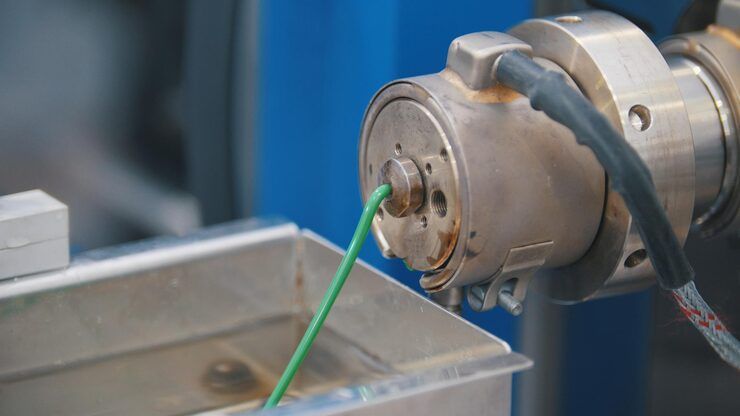
The basic principle is straightforward: plastic material is heated until it becomes workable, pushed through a shaped opening called a die, and then cooled to retain the required profile. However, achieving a stable and consistent result depends on many interconnected factors, including material selection, temperature control, screw design, pressure, cooling, and line speed.
Understanding how plastic extrusion works provides useful insight into modern manufacturing and explains why different types of Plastic Extrusion Machine and Plastic Extrusion Equipment are designed for specific production requirements.
What Is the Plastic Extrusion Process?
The Plastic Extrusion Process is a continuous manufacturing method in which plastic material is melted, mixed, and forced through a die to create a product with a fixed cross-sectional shape.
Unlike batch-based molding processes, extrusion is designed for continuous production. Once the material enters the extrusion line and the process reaches stable operating conditions, the output can move continuously through downstream equipment for cooling, sizing, cutting, winding, or other finishing operations.
Common products made through extrusion include:
- Plastic pipes and tubes
- Sheets and films
- Window and door profiles
- Cable insulation
- Flexible hoses
- Plastic strips
- Sealing profiles
- Automotive components
- Packaging materials
The final shape depends largely on the geometry of the die and the characteristics of the selected polymer.
How Does Plastic Extrusion Work?
A typical extrusion line consists of several stages that work together. Each stage affects the quality and consistency of the final product.
1. Material Feeding
Plastic resin usually enters the extrusion system in pellet, granule, or powder form. The material is transferred into a hopper before moving toward the heated barrel.
Depending on the application, manufacturers may use virgin resin, recycled material, additives, colorants, or carefully controlled blends.
Material preparation is important because moisture, contamination, or inconsistent composition can affect processing stability and product quality.
2. Melting and Conveying
Inside the barrel, a rotating screw moves the material forward.
Heating elements around the barrel raise the material temperature, while mechanical energy generated by screw rotation also contributes to melting.
The screw generally performs several functions:
- Conveying solid material
- Compressing the polymer
- Melting the material
- Mixing additives
- Building pressure before the die
The screw design must match the material and production requirements because different polymers behave differently during processing.
3. Mixing and Homogenization
Before reaching the die, the molten plastic needs to become sufficiently uniform.
The extrusion system works to distribute heat and material consistently throughout the melt. Proper mixing helps reduce variations in color, composition, and physical properties.
For applications involving multiple materials or additives, this stage becomes particularly important.
4. Filtration and Melt Preparation
Some extrusion systems use screens or filtration components to remove unwanted particles from the molten material.
A screen changer may also be incorporated into certain production lines to support continuous operation when filtration elements need to be replaced.
The purpose is to maintain a cleaner and more consistent melt before it reaches the die.
5. Die Formation
The molten plastic is pushed through the die, which determines the basic shape of the extruded product.
Different dies can produce:
- Flat sheets
- Tubes
- Pipes
- Films
- Complex profiles
- Coated wires
Die design is a critical part of Plastic Extrusion Machinery because even small variations in flow distribution can affect wall thickness, dimensions, and surface quality.
6. Cooling and Sizing
After leaving the die, the plastic remains hot and must be cooled carefully.
Depending on the product, cooling may involve:
- Water baths
- Cooling tanks
- Air cooling
- Vacuum sizing systems
- Specialized cooling rollers
The cooling stage helps the material maintain its intended dimensions. For products such as pipes and profiles, sizing equipment may be used to control the final shape more precisely.
7. Pulling, Cutting, or Winding
Once the extruded product has stabilized, downstream equipment moves it through the production line.
Depending on the product, the final stage may involve:
- Haul-off systems
- Cutters
- Rollers
- Winders
- Stacking equipment
Rigid products may be cut into specific lengths, while flexible films, sheets, and cables may be wound into rolls.
Main Types of Plastic Extrusion
Different extrusion methods are used according to the desired product and material.
Sheet and Film Extrusion
This process produces thin or relatively flat plastic materials used in packaging, construction, agriculture, and industrial applications.
Film extrusion may involve specialized die systems and stretching techniques to achieve the required thickness and mechanical properties.
Pipe and Tube Extrusion
Pipe extrusion produces continuous hollow products with controlled internal and external dimensions.
The process is widely associated with applications involving:
- Water systems
- Drainage
- Irrigation
- Electrical conduits
- Industrial fluid handling
Cooling and sizing are especially important because dimensional accuracy directly affects how the finished pipe performs.
Profile Extrusion
Profile extrusion creates products with specialized cross-sectional shapes.
Examples include:
- Window frames
- Door profiles
- Trim components
- Seals
- Decorative sections
The die must be carefully designed to distribute molten material evenly across the profile.
Cable Extrusion
Cable extrusion applies a continuous plastic insulation or protective layer around a wire or conductor.
The process requires precise control of material flow, temperature, and cooling to achieve uniform coverage.
Key Components of a Plastic Extrusion Machine
A Plastic Extrusion Machine is made up of interconnected components that control material movement and processing conditions.
| Component | Main Function |
|---|---|
| Hopper | Holds and feeds raw material |
| Barrel | Contains the processing zone |
| Screw | Moves, melts, and mixes material |
| Heaters | Provide controlled thermal energy |
| Die | Forms the molten plastic |
| Screen system | Helps filter contaminants |
| Cooling system | Stabilizes the product |
| Haul-off | Controls product movement |
| Cutter or winder | Handles final product collection |
The exact configuration depends on the product being manufactured and the polymer being processed.
Understanding Plastic Extrusion Equipment
Plastic Extrusion Equipment includes the broader collection of machines and supporting systems used throughout the extrusion line.
This may include:
- Material dryers
- Feeders
- Extruders
- Screen changers
- Melt pumps
- Dies
- Cooling tanks
- Vacuum calibration units
- Haul-off systems
- Cutting equipment
- Winding systems
Together, these components form an integrated production system rather than a single standalone machine.
Materials Used in Plastic Extrusion
A wide range of thermoplastics can be processed through extrusion.
Common materials include:
- Polyethylene (PE)
- Polypropylene (PP)
- Polyvinyl chloride (PVC)
- Polystyrene (PS)
- Acrylonitrile butadiene styrene (ABS)
- Polyamide (PA)
- Thermoplastic elastomers (TPE)
Each polymer has different melting characteristics, flow behavior, thermal sensitivity, and cooling requirements. Therefore, Plastic Processing Machinery must be configured according to the material being processed.
Factors That Affect Extrusion Quality
Consistent extrusion requires control over several variables.
Important factors include:
- Material moisture
- Melt temperature
- Screw speed
- Feed rate
- Melt pressure
- Die temperature
- Cooling rate
- Haul-off speed
- Die design
If these variables are not properly balanced, manufacturers may experience defects such as uneven thickness, surface irregularities, dimensional variation, or unstable output.
For example, increasing line speed without adjusting material flow and cooling conditions can affect product dimensions. Similarly, excessive temperature may degrade heat-sensitive polymers.
Advantages of Continuous Plastic Production
The continuous nature of extrusion makes it particularly useful for products with consistent cross-sectional shapes.
Key advantages include:
- Continuous production capability
- Consistent product profiles
- Efficient material processing
- Compatibility with many thermoplastic materials
- Integration with automated downstream equipment
- Ability to produce long-length products
Extrusion can also be adapted for specialized processes such as co-extrusion, where multiple polymer layers are produced together to create a combined structure.
Common Challenges in Plastic Extrusion
Although extrusion is highly established, maintaining stable production requires careful process control.
Common challenges include:
- Material degradation
- Moisture-related defects
- Uneven melt flow
- Die buildup
- Inconsistent cooling
- Dimensional variation
- Equipment wear
Regular monitoring and preventive maintenance help maintain process stability. Operators also need to understand how changes in material, temperature, pressure, and speed affect the finished product.
Role of Automation in Plastic Extrusion Machinery
Modern Plastic Extrusion Machinery increasingly incorporates sensors and automated controls.
These systems can monitor variables such as:
- Temperature
- Pressure
- Screw speed
- Production rate
- Product dimensions
Automation helps operators identify process changes more quickly and maintain consistent operating conditions. Advanced production environments may also connect extrusion equipment with broader manufacturing data systems for monitoring and process analysis.
Frequently Asked Questions
What is the Plastic Extrusion Process?
The Plastic Extrusion Process is a continuous manufacturing method in which plastic material is melted and pushed through a shaped die to create products with consistent cross-sectional profiles.
What products are made using plastic extrusion?
Common products include pipes, tubes, sheets, films, profiles, cable insulation, hoses, seals, and various industrial components.
What does a Plastic Extrusion Machine do?
A Plastic Extrusion Machine melts, mixes, conveys, and pressurizes plastic material before forcing it through a die to create a continuous product.
What is the role of Plastic Extrusion Equipment?
Plastic Extrusion Equipment includes the machines and supporting systems used for feeding, melting, forming, cooling, sizing, cutting, and collecting extruded products.
Which materials can be processed through extrusion?
Many thermoplastics can be extruded, including polyethylene, polypropylene, PVC, polystyrene, ABS, polyamide, and thermoplastic elastomers. Processing conditions vary according to the material.
Conclusion
The Plastic Extrusion Process is a fundamental method for producing continuous plastic products with controlled shapes and dimensions. From material feeding and melting to die formation, cooling, sizing, and final collection, every stage contributes to the quality and consistency of the finished product.
Understanding the relationship between a Plastic Extrusion Machine, Plastic Extrusion Equipment, and supporting Plastic Processing Machinery provides a clearer view of how modern plastic manufacturing operates. The choice of polymer, screw design, die configuration, temperature control, cooling method, and production speed all influence the final result.
As manufacturing continues to adopt automation and improved process monitoring, Plastic Extrusion Machinery is becoming increasingly integrated with digital control and production management systems. Even with these technological developments, the core principles remain the same: consistent material preparation, controlled melting, stable flow, accurate forming, and carefully managed cooling are essential for reliable continuous plastic production.