Steel is one of the world's most widely used engineering materials and serves as the foundation for modern construction, manufacturing, transportation, infrastructure, and energy industries. It is an alloy primarily made from iron and carbon, with additional elements added to improve strength, corrosion resistance, toughness, heat resistance, or other mechanical properties.
From structural beams used in skyscrapers to automotive components, industrial machinery, pipelines, railway systems, and household appliances, steel plays a central role in countless applications. Advances in steel manufacturing processes, automation, digital quality control, and production machinery have enabled manufacturers to produce a wide variety of steel grades for specialized industrial requirements.
Context
What Is Steel?
Steel is an iron-based alloy containing controlled amounts of carbon and, in many cases, alloying elements such as chromium, nickel, manganese, molybdenum, vanadium, and silicon. The composition determines its mechanical properties and intended application.
Steel is valued because it combines:
- High strength
- Good durability
- Formability
- Weldability
- Recyclability
- Wide application versatility
How Steel Is Manufactured
Steel production begins with raw materials such as iron ore or recycled steel scrap. These materials are processed through several stages before becoming finished steel products.
A simplified production workflow includes:
- Raw material preparation
- Ironmaking
- Steelmaking
- Secondary refining
- Continuous casting
- Rolling and shaping
- Heat treatment (when required)
- Surface finishing
- Quality inspection
Each stage influences the final material properties.
Major Steel Production Methods
| Production Method | Typical Purpose |
|---|---|
| Blast Furnace–Basic Oxygen Furnace (BF-BOF) | Large-scale steel production from iron ore |
| Electric Arc Furnace (EAF) | Steel production using recycled scrap and direct reduced iron |
| Secondary Metallurgy | Composition adjustment and impurity removal |
| Continuous Casting | Producing billets, blooms, and slabs |
| Hot Rolling | Forming structural products and plates |
| Cold Rolling | Improving dimensional accuracy and surface finish |
Importance
Role in Modern Industry
Steel supports nearly every industrial sector, including:
- Construction
- Automotive manufacturing
- Shipbuilding
- Aerospace
- Railway infrastructure
- Energy production
- Heavy machinery
- Manufacturing equipment
- Consumer products
Its combination of strength and versatility makes it suitable for demanding engineering environments.
Infrastructure Development
Bridges, buildings, industrial plants, airports, ports, and transportation networks depend heavily on structural steel components for long-term performance.
Manufacturing Applications
Steel is commonly used to manufacture:
- Industrial machine frames
- Pressure vessels
- Pipelines
- Storage tanks
- Fasteners
- Bearings
- Gears
- Shafts
- Cutting tools
- Industrial equipment
Sustainability
Steel is one of the most recycled engineering materials. Recycled scrap is widely used in electric arc furnace production, reducing the demand for virgin raw materials and supporting circular manufacturing practices.
Steel Production Machinery
Modern steel plants rely on highly automated equipment throughout the manufacturing process.
Ironmaking Equipment
Typical machinery includes:
- Blast furnaces
- Coke ovens
- Sinter plants
- Pelletizing systems
- Raw material handling equipment
Steelmaking Equipment
Steelmaking commonly uses:
- Basic oxygen furnaces
- Electric arc furnaces
- Ladle furnaces
- Vacuum degassing units
- Continuous casting machines
Rolling Mills
Rolling mills shape steel into different forms, including:
- Plates
- Sheets
- Bars
- Rods
- Structural sections
- Rails
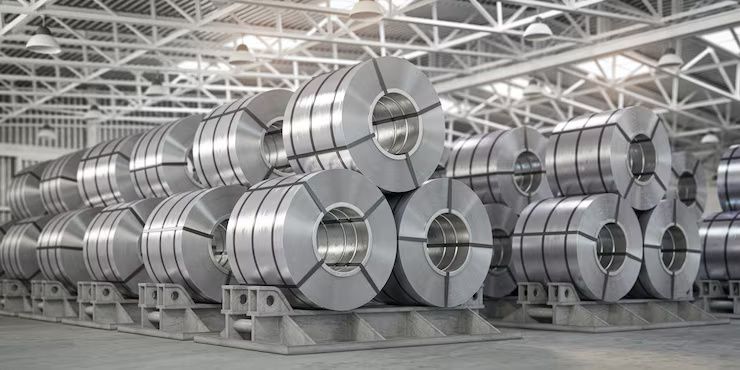
- Coils
Automation Systems
Modern facilities increasingly integrate:
- Industrial robots
- PLC-based control systems
- Artificial intelligence
- Machine vision
- Predictive maintenance
- Digital production monitoring
These technologies improve process consistency and equipment utilization.
Material Grades
Different grades are developed for different engineering applications.
| Steel Grade Category | Common Characteristics |
| Carbon Steel | General engineering and structural applications |
| Alloy Steel | Enhanced mechanical properties |
| Stainless Steel | Corrosion resistance |
| Tool Steel | Wear resistance and hardness |
| High-Strength Low-Alloy (HSLA) Steel | High strength with reduced weight |
| Spring Steel | Elasticity and fatigue resistance |
Material selection depends on factors such as mechanical loading, corrosion exposure, operating temperature, fabrication method, and applicable engineering standards.
Supplier Insights
Steel suppliers support industries through raw material distribution, processing, inventory management, and logistics.
Organizations often evaluate suppliers based on:
- Material quality
- Grade availability
- Production capability
- Certification
- Delivery performance
- Traceability
- Technical documentation
- Supply chain reliability
For critical industrial applications, documentation and quality records are commonly reviewed alongside material specifications.
Industrial Applications
Steel is used across numerous industries.
Construction
Applications include:
- Structural beams
- Reinforcement bars
- Columns
- Bridges
- Industrial buildings
Automotive
Steel components are used in:
- Vehicle frames
- Body structures
- Suspension systems
- Transmission parts
- Safety components
Energy
Steel supports:
- Oil and gas pipelines
- Wind turbine towers
- Power plants
- Offshore platforms
- Hydroelectric facilities
Manufacturing
Industrial equipment made from steel includes:
- CNC machines
- Presses
- Conveyors
- Pumps
- Compressors
- Material handling systems
Recent Updates
Between 2024 and 2026, steel manufacturing has continued to adopt digital technologies and sustainability-focused production methods.
Key trends include:
- Increased electric arc furnace adoption
- Greater use of recycled steel scrap
- AI-assisted process optimization
- Smart factory integration
- Digital quality inspection
- Predictive maintenance systems
- Energy-efficiency improvements
- Automated production monitoring
Manufacturers are also investing in lower-emission production technologies and enhanced supply chain visibility.
Laws or Policies
Steel manufacturing is influenced by regulations covering:
- Occupational health and safety
- Environmental emissions
- Air quality
- Waste management
- Energy efficiency
- Product quality
- Industrial machinery safety
Many manufacturers also comply with internationally recognized quality management standards and material testing specifications required by customers and industry sectors.
Tools and Resources
Useful resources related to steel manufacturing include:
- Material selection guides
- Steel grade comparison charts
- Mechanical property databases
- CAD/CAM software
- Manufacturing simulation tools
- Quality inspection systems
- Supply chain management software
- ERP platforms
- Predictive maintenance software
- Industrial standards documentation
These resources help engineers, manufacturers, procurement teams, and quality professionals evaluate materials and production requirements.
FAQs
What is steel made from?
Steel is primarily made from iron and carbon, with additional alloying elements added to achieve specific mechanical or corrosion-resistant properties.
What are the main steel manufacturing processes?
The primary processes include ironmaking, steelmaking, refining, continuous casting, rolling, heat treatment, finishing, and quality inspection.
What machinery is used in steel production?
Steel production machinery includes blast furnaces, electric arc furnaces, continuous casting machines, rolling mills, ladle furnaces, and automated inspection systems.
How are steel grades selected?
Material grades are selected according to strength, toughness, corrosion resistance, temperature requirements, fabrication methods, and intended industrial application.
Why is steel widely used in industry?
Steel combines strength, durability, recyclability, and versatility, making it suitable for construction, transportation, manufacturing, infrastructure, energy, and engineering applications.
Conclusion
Steel remains one of the most essential materials used across global industries due to its versatility, mechanical performance, and adaptability. Modern steel manufacturing combines advanced production machinery, automation, digital quality control, and diverse material grades to meet a wide range of engineering requirements. As production technologies continue to evolve, steel is expected to remain a fundamental material supporting infrastructure, manufacturing, transportation, and industrial development.