
Automotive assembly systems are the equipment, technologies, and production processes used to combine individual vehicle components into a complete automobile. These systems bring together parts such as engines, transmissions, body panels, seats, electrical wiring, braking systems, and electronic controls. They are used in passenger car, commercial vehicle, electric vehicle, and specialized vehicle manufacturing.
The development of automotive assembly systems is closely connected to the growth of mass production. Early vehicle factories relied heavily on manual labor and relatively simple tools. The introduction of moving assembly lines made it possible to organize production into repeatable stages, while later advances in robotics, computer control, and digital monitoring increased the level of automation.
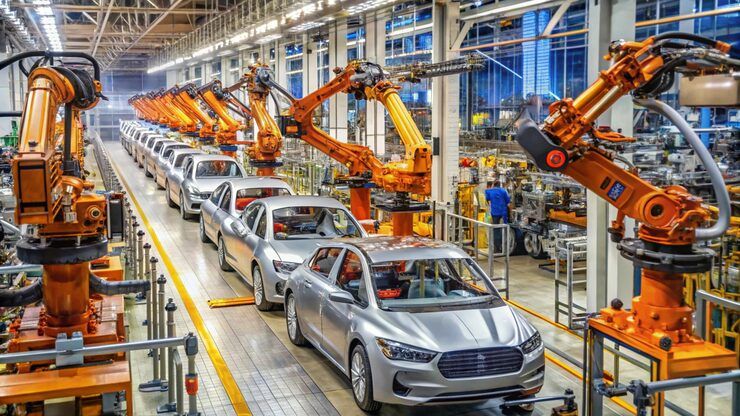
Modern automotive assembly combines human expertise with mechanical equipment and software. Some production tasks require precise automated movements, while others depend on skilled workers performing inspections, fitting components, or completing complex assembly operations. The level of automation varies according to vehicle design, production volume, factory layout, and manufacturing requirements.
Main types of automotive assembly systems
Automotive factories use several types of assembly equipment, often arranged into interconnected production lines.
Body-in-white systems: Join stamped metal panels to create the basic vehicle body before painting.
Powertrain assembly systems: Assemble engines, transmissions, electric motors, and related components.
Final assembly lines: Install seats, dashboards, lighting, wheels, interior fittings, and other vehicle components.
Automated fastening systems: Use controlled tools to tighten bolts, screws, and other fasteners to specified requirements.
Robotic welding systems: Join metal components using programmed welding equipment.
Material handling systems: Move parts and vehicle bodies between production stations using conveyors, automated guided vehicles, or other transport equipment.
Inspection and testing systems: Check dimensions, electrical connections, mechanical operation, and selected vehicle functions.
These systems can operate as individual workstations or as parts of a larger integrated production environment. Their arrangement determines how components move through the factory and how assembly activities are coordinated.
How an automotive assembly line works
A typical vehicle manufacturing process begins with component preparation and body construction. Metal panels are stamped into required shapes, joined into a vehicle structure, and transferred to painting operations. The painted body then moves to final assembly, where mechanical, electrical, and interior components are installed.
After assembly, the vehicle undergoes inspections and functional tests. Depending on the manufacturing process, checks may include brake operation, lighting, steering, electronic systems, fluid levels, and water leakage. Vehicles that do not meet the specified requirements may be directed to further inspection or corrective work.
Importance
Automotive assembly systems are important because vehicle manufacturing involves thousands of components that must fit together accurately and function as a coordinated product. Inconsistent assembly can affect vehicle safety, reliability, appearance, and long-term performance. Structured production systems help manufacturers control these processes and maintain consistent assembly procedures.
Automation also helps address repetitive tasks, physically demanding operations, and production activities that require consistent positioning or tightly controlled movements. However, automated equipment still requires maintenance, programming, monitoring, and appropriate safety measures.
Key benefits and practical applications
Automotive assembly technologies support several important manufacturing activities.
Production consistency: Standardized procedures and controlled tools help reduce variation between assembled vehicles.
Manufacturing efficiency: Conveyors and coordinated workstations organize the movement of components through production stages.
Quality control: Sensors, machine vision, and inspection equipment can identify certain defects during assembly.
Worker safety: Robots and mechanical handling equipment can perform some hazardous or strenuous tasks when properly designed and safeguarded.
Traceability: Digital records can link selected components, fastening results, inspection outcomes, and production batches.
Flexible manufacturing: Programmable equipment and adjustable workstations can support different vehicle configurations, depending on system design.
These benefits depend on how the equipment is selected, integrated, maintained, and operated. Automation alone does not eliminate manufacturing defects or guarantee consistent output.
Who uses automotive assembly systems?
Vehicle manufacturers use assembly systems to produce passenger cars, vans, trucks, buses, and other motor vehicles. Automotive component manufacturers also use specialized assembly equipment to produce modules such as instrument panels, seats, braking assemblies, steering components, battery packs, and lighting systems.
Industrial automation engineers design and integrate equipment, while production operators manage assembly activities. Maintenance technicians inspect machinery and address equipment faults, and quality teams verify that components and completed vehicles meet established specifications.
Automotive assembly systems also affect component suppliers, logistics operators, and consumers. Reliable production coordination helps manage the flow of parts through the supply chain, while effective quality control supports vehicle performance and manufacturing traceability.
Traditional and automated assembly methods
Automotive factories use different levels of automation depending on the task and production requirements.
Assembly method | Main function | Typical application |
|---|---|---|
Manual assembly | Workers install and fit components | Interior fittings and selected final assembly tasks |
Semi-automated assembly | Workers operate equipment that assists specific tasks | Controlled fastening and component positioning |
Robotic assembly | Programmed robots perform repeatable movements | Welding, adhesive application, and material handling |
Flexible assembly systems | Programmable equipment supports multiple configurations | Production lines handling different vehicle models |
Integrated digital assembly | Equipment and software exchange production data | Quality monitoring and production tracking |
Many factories combine these methods rather than using a single approach throughout the facility. The appropriate arrangement depends on component design, required precision, production volume, available floor space, and worker safety.
Recent Updates
Automotive assembly systems are evolving as manufacturers introduce electric vehicles, expand digital production monitoring, and adopt more flexible automation equipment. Recent developments emphasize adapting existing production lines, improving component traceability, and connecting equipment with manufacturing software. Adoption varies according to the manufacturer, vehicle platform, and factory investment plans.
Electric vehicle assembly technologies
Electric vehicles have introduced additional assembly requirements, particularly for battery packs, electric drive units, power electronics, and high-voltage electrical connections. Battery assembly may involve cell inspection, module or pack integration, controlled fastening, thermal management components, and electrical testing.
Manufacturers must also account for the safety requirements associated with high-voltage systems. Specialized tools, electrical isolation procedures, and appropriate worker training are important when assembling or inspecting these components.
Robotics, artificial intelligence, and machine vision
Industrial robots continue to perform tasks such as spot welding, material transfer, adhesive application, and component positioning. Advances in machine vision allow equipment to examine selected features, identify component locations, and detect certain assembly irregularities.
Artificial intelligence is also being explored for production planning, visual inspection, and equipment monitoring. These applications can help analyze large amounts of operational information, but their results depend on training data, system configuration, and verification procedures.
Collaborative robots, sometimes called cobots, are designed for applications where people and robots may work in shared areas under defined safety conditions. Their use requires a task-specific risk assessment; the label alone does not establish that an application is safe.
Digital manufacturing and connected production lines
Manufacturing execution systems (MES) and industrial data platforms can connect assembly stations with production records. They may track component identifiers, record fastening measurements, monitor equipment status, and help supervisors identify production interruptions.
Digital twins can represent assembly equipment or production lines in a virtual environment. Engineers may use these models to study layout changes, simulate material movement, or evaluate production scenarios before modifying physical equipment.
Another continuing trend is flexible manufacturing. Reconfigurable fixtures, programmable robots, and adaptable conveyors can help some factories accommodate different vehicle models or component variations. The actual flexibility depends on the equipment design and the amount of change required between production configurations.
Laws or Policies
Automotive assembly systems are affected by regulations and standards relating to machinery safety, workplace conditions, vehicle performance, electrical equipment, and environmental protection. Requirements differ between countries and may depend on the type of vehicle, the manufacturing activity, and whether equipment is used within a factory or incorporated into a finished vehicle.
Manufacturing regulations in India
In India, automotive manufacturers must consider applicable factory safety requirements, occupational health and safety provisions, electrical safety rules, and environmental regulations. The Occupational Safety, Health and Working Conditions Code, 2020, is part of the country's labour-law framework, with applicable obligations depending on its commencement and the relevant implementing rules.
Vehicle manufacturers must also account for applicable Central Motor Vehicles Rules and vehicle standards administered through the relevant Indian regulatory framework. These requirements concern matters such as vehicle construction, safety, testing, and conformity, depending on the vehicle category and applicable provisions.
Factories using industrial robots and automated machinery should assess risks involving moving equipment, electrical systems, stored energy, maintenance access, and interaction between workers and machines. Appropriate guarding, emergency stops, isolation procedures, and training may be required under applicable rules and technical standards.
International standards and safety frameworks
Several international standards are relevant to automotive assembly equipment:
ISO 10218: Addresses safety requirements for industrial robots and robotic applications.
ISO 12100: Provides principles for machinery risk assessment and risk reduction.
ISO 13849: Covers safety-related parts of machinery control systems.
IATF 16949: Defines quality management system requirements for automotive production and relevant component organizations.
ISO 14001: Provides a framework for environmental management.
Standards may be adopted voluntarily or required through regulations, customer contracts, or industry-specific arrangements. Manufacturers must determine which editions and requirements apply to their particular equipment and operations.
Tools and Resources
Automotive manufacturers use engineering software, automation platforms, technical documentation, and inspection tools to plan and manage assembly operations. These resources help engineers coordinate equipment, assess production layouts, and monitor manufacturing quality.
Common software and equipment resources
Computer-aided design (CAD): Creates digital models of vehicle components, fixtures, and assembly equipment.
Manufacturing execution systems: Track production progress, work instructions, quality records, and component traceability.
Programmable logic controllers (PLCs): Control machinery, conveyors, sensors, and automated production sequences.
Robotic simulation software: Helps engineers evaluate robot movements, reach, cycle sequences, and potential collisions before physical deployment.
Machine vision systems: Use cameras and image-processing software to inspect selected components and assembly features.
Maintenance management software: Organizes equipment inspections, maintenance schedules, fault histories, and repair activities.
Examples of industrial automation technologies used in automotive production include Siemens SIMATIC automation systems, ABB industrial robotics, FANUC robots, and Rockwell Automation control platforms. Each has distinct capabilities, compatibility considerations, and application requirements.
Planning and evaluation resources
Before installing or modifying an assembly line, manufacturers typically review the production layout, component specifications, equipment interfaces, safety requirements, and expected production sequence.
Useful planning documents include:
Process flow diagrams showing each assembly stage.
Equipment specifications describing operating ranges and interface requirements.
Risk assessments covering machinery, electrical hazards, and human interaction.
Quality control plans defining inspection points and acceptance criteria.
Maintenance schedules and records for production equipment.
Traceability plans identifying which components and production measurements must be recorded.
These documents help teams coordinate engineering, production, maintenance, and quality activities throughout the manufacturing process.
FAQs
What are automotive assembly systems?
Automotive assembly systems combine machinery, tools, conveyors, robots, and software to assemble vehicle components into completed vehicles. They can include manual, semi-automated, and fully automated production stages.
How are robots used in automotive assembly lines?
Industrial robots perform tasks such as welding, adhesive application, component handling, painting, and precise positioning. Their applications depend on the equipment configuration, programmed movements, and required safety controls.
What equipment is used for electric vehicle assembly?
Electric vehicle production may use battery module and pack assembly equipment, controlled fastening tools, robotic handling systems, electrical testing equipment, and systems for assembling electric motors and power electronics.
How does automation improve automotive manufacturing?
Automation can support repeatable production tasks, consistent equipment movements, faster material handling, and digital quality monitoring. Actual results depend on system integration, maintenance, component design, and production conditions.
Which standards apply to automotive assembly equipment?
Relevant standards may include ISO 10218 for industrial robot safety, ISO 12100 for machinery risk assessment, and IATF 16949 for automotive quality management systems. Applicable requirements depend on the equipment, factory location, and intended use.
Conclusion
Automotive assembly systems combine mechanical equipment, robotics, digital controls, and human expertise to manufacture vehicles through coordinated production stages. Developments in electric vehicle production, machine vision, connected manufacturing, and flexible automation are changing how assembly lines are designed and operated. Machinery safety, quality management, workforce training, and regulatory compliance remain important throughout the manufacturing process. The specific technologies used depend on vehicle design, production needs, and factory capabilities.