
Industrial assembly tools are devices and equipment used to join, fasten, position, align, and secure components during manufacturing. They are essential in industries such as automotive production, electronics, aerospace, machinery, medical equipment manufacturing, and industrial appliance assembly. These tools range from simple hand-operated screwdrivers to automated fastening systems integrated into production lines.
Industrial assembly developed alongside the growth of mechanized manufacturing and standardized production methods. As factories began producing larger quantities of complex products, manufacturers needed tools that could improve consistency, simplify repetitive tasks, and help workers assemble components accurately. Advances in electric motors, pneumatic systems, sensors, and digital controls have since expanded the range of available assembly technologies.
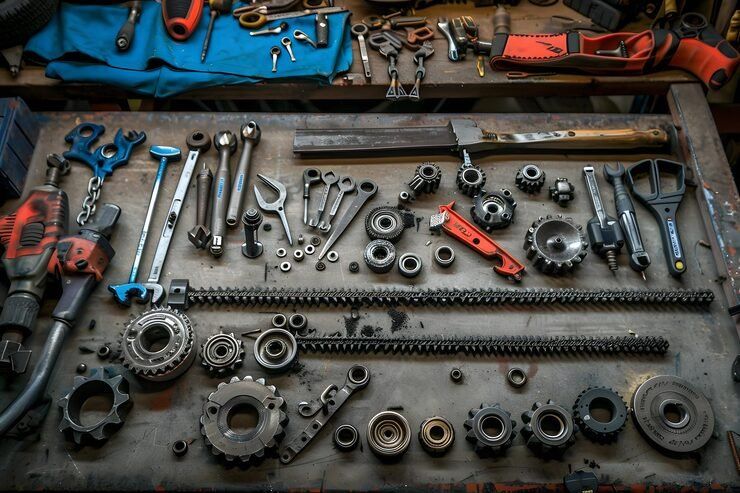
Modern industrial assembly tools can be operated manually, powered by electricity or compressed air, or controlled by computer-based systems. Some are designed for individual workstations, while others form part of automated production cells that coordinate multiple assembly operations.
Main types of industrial assembly tools
Industrial assembly equipment can be grouped according to its operating method and intended application.
Hand tools: Wrenches, screwdrivers, pliers, hex keys, and manual torque tools used for fastening and adjustment.
Electric assembly tools: Powered screwdrivers, nut runners, drills, and tightening tools used for repetitive operations.
Pneumatic assembly tools: Equipment powered by compressed air, including impact wrenches, air screwdrivers, and pneumatic fastening devices.
Hydraulic tools: Equipment that uses pressurized fluid to generate force for demanding assembly and fastening applications.
Precision torque tools: Devices designed to apply and measure a specified level of rotational force during tightening.
Automated assembly systems: Machines that combine feeding mechanisms, robotic handling, sensors, and fastening equipment to perform repeated assembly tasks.
Positioning and alignment tools: Fixtures, jigs, clamps, and locating devices that hold components in the correct position during assembly.
The appropriate tool depends on the material, component geometry, fastening requirements, production volume, and acceptable tolerances. A small electronics assembly operation, for example, may require precision electric screwdrivers, while heavy machinery production may use hydraulic equipment and large powered fastening systems.
How industrial assembly tools operate
Most assembly operations involve several stages. Components are first identified and positioned, then aligned and joined using an appropriate fastening or joining method. The completed assembly may subsequently undergo inspection to confirm that connections, dimensions, and other specified requirements have been met.
For a bolted connection, a powered nut runner may tighten the fastener to a specified torque or follow a programmed tightening sequence. In another application, a fixture may hold two components together while an operator installs screws or performs a joining operation. Some systems record process measurements so that production teams can review whether an assembly step followed its defined parameters.
Importance
Industrial assembly tools influence product quality, production consistency, worker productivity, and workplace safety. Incorrect fastening, poor alignment, or unsuitable tool selection can lead to loose connections, damaged components, excessive rework, or premature equipment failure. These problems can affect the reliability of products ranging from household appliances to vehicles and industrial machinery.
Appropriate tools help workers perform assembly tasks with greater control. Torque-controlled equipment, for example, can reduce variation between fasteners when configured and maintained correctly. Fixtures can limit component movement, while specialized gripping tools can help workers handle parts that are difficult to position manually.
Industrial applications across major sectors
Industrial assembly tools are used in many manufacturing environments.
Automotive manufacturing: Powered nut runners, torque wrenches, robotic fastening systems, and alignment fixtures are used to assemble vehicle structures, engines, seats, and interior components.
Electronics manufacturing: Precision screwdrivers, small-part handling tools, and controlled fastening systems support the assembly of circuit boards, enclosures, and electronic devices.
Aerospace manufacturing: Precision fastening tools and inspection equipment support the assembly of aircraft structures and other components subject to strict technical requirements.
Heavy machinery manufacturing: Hydraulic tools, large torque systems, lifting fixtures, and alignment equipment help assemble industrial machines and structural components.
Medical equipment manufacturing: Controlled fastening and positioning tools are used when assembling instruments, equipment housings, and mechanical components under applicable quality requirements.
Household appliance production: Electric screwdrivers, clamps, fixtures, and automated assembly equipment support the manufacture of refrigerators, washing machines, and other appliances.
The requirements differ significantly across these sectors. Aerospace and certain medical applications may involve specialized documentation and inspection procedures, while high-volume consumer manufacturing often places considerable emphasis on repeatability and production flow.
Benefits and limitations
Industrial assembly tools can reduce repetitive manual effort, improve fastening consistency, and support more predictable production processes. Automated systems may also record information such as tightening torque, rotation angle, cycle completion, and tool status.
However, these technologies have limitations. Powered tools require maintenance, pneumatic systems depend on suitable compressed-air infrastructure, and automated equipment may require programming and integration with other production systems. Even sophisticated tools can produce incorrect results when operators use unsuitable settings, damaged fasteners, poorly maintained equipment, or inaccurate measurement systems.
Recent Updates
Industrial assembly tools continue to develop through improvements in digital measurement, connected equipment, robotics, and process monitoring. Recent trends from 2024 to 2026 reflect a growing emphasis on traceable assembly operations, adaptable production equipment, and the integration of manual workstations with automated manufacturing systems.
Smart and connected assembly tools
Connected assembly tools can exchange operational information with factory software. Depending on the equipment, this information may include torque measurements, tightening angles, tool identification, cycle results, and maintenance alerts. Production teams can use these records to investigate assembly problems and identify recurring process variations.
Digital torque control is particularly relevant where fastener tightness affects product performance or safety. Some systems can detect incomplete tightening sequences or flag measurements outside configured limits. These functions support inspection, but they do not replace proper tool calibration, process validation, or final quality checks.
Robotics and automated fastening
Industrial robots are increasingly used for repetitive fastening, component positioning, and assembly operations that require consistent movement. Robotic systems can combine machine vision, force sensors, automatic screw feeding, and programmable tightening tools to complete multiple steps within a production cell.
Collaborative robots, often called cobots, are another area of development. They are designed to operate in applications where people and robots may share a workspace, subject to an appropriate risk assessment and safety measures. Their suitability depends on the task, payload, operating speed, tooling, and surrounding equipment.
Data-driven quality and predictive maintenance
Manufacturers are also integrating assembly equipment with production monitoring systems. Data from powered tools can help identify repeated tightening errors, unusual cycle times, and changes in equipment performance. Maintenance teams may use operating histories and condition data to plan inspections before tool problems interrupt production.
These capabilities vary by manufacturer and tool model. A connected tool does not necessarily include every monitoring function, and reliable analysis requires accurate measurements, compatible software, and clearly defined operating limits.
Laws or Policies
Industrial assembly tools are affected by requirements covering machinery safety, electrical equipment, workplace health, product quality, and environmental management. The applicable rules depend on where equipment is manufactured, imported, installed, and used, as well as the industry in which it operates.
Industrial safety requirements in India
In India, manufacturers and factory operators must consider applicable occupational safety legislation, factory requirements, electrical safety provisions, and relevant state-level rules. The Occupational Safety, Health and Working Conditions Code, 2020, is part of the country's labour-law framework, but its application depends on commencement provisions and applicable rules.
Employers and factory operators should assess risks associated with powered tools, rotating parts, compressed air, hydraulic pressure, noise, vibration, and repetitive movements. Appropriate protective equipment, operator training, equipment inspection, and maintenance procedures help address these hazards.
Electrical assembly tools may also be subject to relevant electrical safety standards and product requirements. Industrial facilities should verify the specific requirements applicable to their equipment and operations rather than assuming that one general standard covers every tool.
International standards and technical requirements
Several international standards and regulatory frameworks are relevant to industrial assembly equipment.
ISO 12100: Provides principles for machinery risk assessment and risk reduction.
ISO 6789: Covers hand torque tools used for tightening threaded fasteners, including requirements relating to design and conformity assessment.
IEC 60204-1: Addresses electrical equipment of machinery.
ISO 9001: Establishes requirements for quality management systems, including controlled processes and documented procedures.
EU machinery legislation: Establishes safety and conformity requirements for machinery placed on the European Union market, subject to the applicable legal framework and transition arrangements.
These standards address different aspects of safety, measurement, and quality management. Their applicability depends on the equipment, its intended use, and the relevant legal or contractual requirements. Following a standard does not automatically establish compliance with every regulation.
Tools and Resources
Selecting industrial assembly tools involves evaluating the application, technical specifications, workplace conditions, and production requirements. Manufacturers and engineering teams can use equipment documentation, measurement records, and assembly planning resources to compare suitable options.
Tools and platforms used in assembly operations
Common resources include:
Torque measurement equipment: Torque testers and calibration devices help verify whether tightening tools operate within specified measurement limits.
Computer-aided design (CAD) software: Supports component design, dimensional checks, fixture planning, and assembly layout development.
Manufacturing execution systems (MES): Track production activities and can record assembly results when integrated with compatible tools.
Computerized maintenance management systems (CMMS): Maintain equipment histories, inspection schedules, and records of repairs or calibration activities.
Robotic simulation software: Helps engineers plan robot movements, evaluate workcell layouts, and identify potential interference before physical deployment.
Technical product documentation: Provides tool specifications, operating instructions, maintenance requirements, and information about compatible accessories.
Industrial equipment manufacturers such as Bosch Rexroth, Atlas Copco, Stanley Black & Decker, Ingersoll Rand, and Desoutter produce various types of industrial fastening or assembly equipment. Their product ranges differ, so the suitability of a particular tool depends on its technical specifications and intended application.
Factors to evaluate when selecting tools
Several factors help determine whether an assembly tool is appropriate for a particular process.
Selection factor | What to examine |
|---|---|
Torque requirements | Required tightening range and measurement accuracy |
Component material | Material strength, surface sensitivity, and thread characteristics |
Production volume | Expected operating frequency and cycle requirements |
Ergonomics | Tool weight, grip design, vibration, and operator comfort |
Power source | Manual operation, electricity, compressed air, or hydraulic power |
Maintenance | Inspection frequency, calibration needs, and replacement parts |
Data integration | Compatibility with factory software and traceability systems |
Safety | Guarding, operating procedures, and relevant workplace hazards |
Tool selection should account for the complete assembly process rather than a single specification. For example, a tool with an appropriate torque range may still be unsuitable if its weight, access requirements, or operating speed creates difficulties at the workstation.
FAQs
What are industrial assembly tools?
Industrial assembly tools are hand-operated, powered, or automated devices used to fasten, align, position, and join components during manufacturing. Common examples include torque wrenches, electric screwdrivers, pneumatic nut runners, clamps, and robotic fastening systems.
What is the difference between electric and pneumatic assembly tools?
Electric assembly tools use electrical power, while pneumatic tools operate using compressed air. Electric tools may support digital controls and data recording, whereas pneumatic tools are common in environments with established compressed-air systems. Performance depends on the specific model and application.
How do torque-controlled assembly tools improve quality?
Torque-controlled tools apply or monitor a defined tightening level during fastening. When correctly configured and calibrated, they can reduce variation and help identify assembly errors. Torque alone does not always confirm that a joint is correctly assembled, because factors such as friction and fastener condition also affect the result.
Which industries use automated assembly tools?
Automotive, electronics, aerospace, medical equipment, heavy machinery, and household appliance manufacturers use automated assembly equipment. The technology selected depends on component design, production volume, precision requirements, and applicable safety standards.
How often should industrial assembly tools be calibrated?
Calibration frequency depends on the tool type, manufacturer instructions, operating conditions, usage intensity, and required measurement accuracy. Tools used in critical fastening applications may need more frequent verification. Documented inspection and calibration schedules help maintain measurement reliability.
Conclusion
Industrial assembly tools support manufacturing through fastening, positioning, alignment, and automated joining operations. Their capabilities range from simple manual devices to connected torque systems and robotic assembly equipment. Recent developments emphasize digital monitoring, production traceability, and integration with factory software. Appropriate tool selection, regular maintenance, operator training, and compliance with applicable safety requirements remain important across industrial applications.