
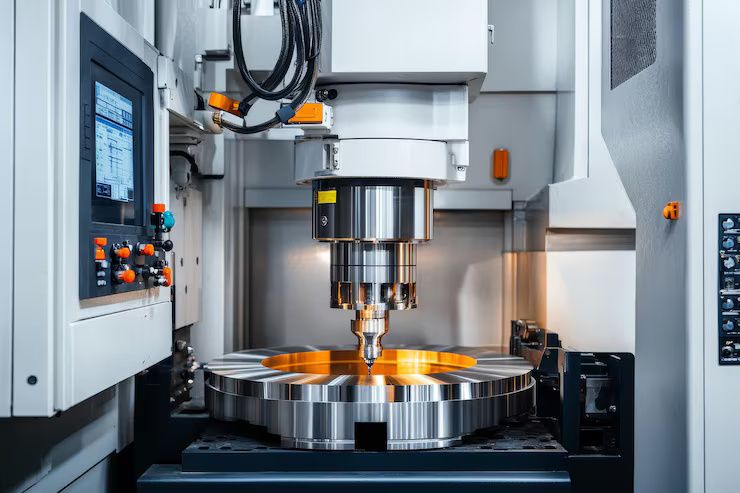
CNC machines, or computer numerical control machines, use programmed instructions to control machining operations such as cutting, drilling, milling, turning, and shaping.
They are widely used because computer-controlled movements can provide consistent results across repeated production tasks.
CNC machining combines automation, precision, tooling, software, and material knowledge. Understanding how these elements work together helps students, operators, engineers, manufacturers, and other readers better understand modern production processes.
Context
A CNC machine follows coded instructions that define movements, speeds, tool changes, and machining operations. The instructions are commonly created using computer-aided manufacturing (CAM) software and converted into machine-readable programs.
Traditional machining often requires substantial manual control, while CNC machining automates many movement and positioning tasks. Depending on the machine type, CNC systems can control several axes simultaneously.
Common CNC machine categories include:
- CNC milling machines
- CNC turning centers and lathes
- CNC routers
- CNC grinding machines
- CNC machining centers
- Multi-axis machining systems
The general CNC production process begins with a digital design. The design is converted into machining instructions, the appropriate workholding and cutting tools are selected, and the program is loaded into the control system.
Before machining begins, the operator typically checks workpiece positioning, tool offsets, program coordinates, machine condition, and safety systems. The machine then executes the programmed sequence while sensors and control systems may monitor operating conditions.
| CNC Process Stage | Main Purpose |
|---|---|
| Digital design | Defines the required geometry |
| CAM programming | Creates machining instructions |
| Tool selection | Matches tools with operations and materials |
| Setup | Positions the workpiece and establishes references |
| Machining | Removes or forms material according to the program |
| Inspection | Checks dimensions and surface characteristics |
| Process review | Identifies adjustments for future production |
Precision depends on several factors, including machine geometry, thermal conditions, tool condition, workholding, programming accuracy, material properties, and measurement methods. ISO 230-1 provides methods for testing geometric accuracy of machine tools under specified conditions.
Importance
CNC machining matters because modern production frequently requires repeatable dimensions and controlled manufacturing processes. Computerized control can help reduce variation caused by manually repeating machine movements.
The technology affects several groups:
- Engineers who design components and manufacturing processes
- CNC programmers who prepare machining instructions
- Operators who set up and monitor equipment
- Quality personnel who verify finished dimensions
- Students learning manufacturing technology
- Industries producing aerospace, automotive, medical, electronics, energy, and general engineering components
Automation can also connect CNC equipment with broader production systems. Machine monitoring, digital work instructions, tool data, inspection equipment, and production records can form part of a connected manufacturing environment.
Precision does not depend on automation alone. A poorly prepared program, incorrect tool offset, unsuitable cutting parameters, worn tooling, or inaccurate workholding can still produce defective parts. For this reason, CNC production requires both technology and process knowledge.
Another important consideration is measurement. Dimensional inspection can use calipers, micrometers, gauges, coordinate measuring machines, optical systems, or other suitable equipment depending on the required tolerance.
Recent Updates
Recent CNC developments increasingly focus on connected manufacturing, automation, data analysis, and improved machine monitoring. Modern control systems can integrate information from sensors, machine controls, tooling systems, and production software.
Artificial intelligence and machine learning are also being explored for applications such as anomaly detection, predictive maintenance, process monitoring, and machining optimization. These applications are intended to identify unusual machine behavior or production patterns before they create larger process problems.
Another development is greater integration between CAD/CAM platforms and CNC controls. Digital workflows can reduce manual data transfer and provide better continuity between product design, toolpath creation, simulation, machining, and inspection.
Multi-axis machining continues to support complex geometries by allowing cutting tools to approach workpieces from multiple directions. Automated tool changing, robotic material handling, pallet systems, and in-process measurement can further reduce manual intervention.
Digital twins are another area of development. A digital representation of a machine or production process can be used to simulate operations, study potential problems, and evaluate process changes before physical production.
Energy and resource efficiency are also receiving greater attention. Manufacturers are examining spindle behavior, idle time, coolant usage, compressed air consumption, tooling efficiency, and overall machine utilization when assessing production processes.
These developments do not eliminate the need for human oversight. CNC programming, process validation, maintenance, measurement, and safety decisions still require appropriate technical knowledge.
Laws or Policies
CNC machine requirements vary according to the country, workplace, machine type, and application. Organizations should consult the regulations applicable to their specific location rather than assuming that one standard applies everywhere.
In the United States, OSHA's general machine-guarding requirements under 29 CFR 1910.212 require appropriate guarding for hazards such as points of operation, rotating parts, flying chips, and sparks.
OSHA also identifies requirements related to hazardous energy control, electrical safety, abrasive wheels, and other machine-specific hazards. Its machine-guarding resources specifically reference CNC-related safety considerations and ANSI B11 machine-tool standards.
ISO 12100 provides principles and a methodology for machinery risk assessment and risk reduction. ISO states that the current ISO 12100:2010 edition was reviewed and confirmed in 2022.
In India, the Bureau of Indian Standards provides machinery-related conformity assessment information under Scheme-X. Its product-specific information includes guidelines for metal-cutting machines and was updated on April 1, 2026.
Applicable requirements can include:
- Machine guarding
- Emergency-stop arrangements
- Electrical safety
- Risk assessment
- Hazardous-energy control
- Operator protection
- Equipment inspection
- Applicable conformity assessment requirements
Because regulations can change, organizations should verify requirements through the relevant government or standards authority before implementing a CNC installation.
Tools and Resources
Several types of tools help people understand, program, operate, and evaluate CNC machining processes.
CAD software is used to create digital component designs, while CAM software generates toolpaths and machining instructions. CNC simulation tools can help visualize tool movement and identify potential collisions before machining.
Useful resources include:
- Manufacturer documentation for CNC controls and equipment
- CAM programming references
- CNC programming manuals
- Tool manufacturer technical information
- Metrology and measurement references
- OSHA machine-safety resources
- ISO machine-tool standards
- Bureau of Indian Standards resources for applicable Indian requirements
Production teams may also use setup sheets, tool lists, inspection records, maintenance schedules, and process checklists. These documents help establish repeatable procedures and provide information for troubleshooting.
A basic CNC learning workflow can include:
- Understand machine axes and coordinates.
- Learn basic G-code and M-code concepts.
- Study cutting tools and workholding.
- Practice CAD and CAM workflows.
- Learn machine safety and risk assessment.
- Study measurement and inspection methods.
- Use simulation before running unfamiliar programs.
FAQs
What is a CNC machine?
A CNC machine is computer-controlled manufacturing equipment that performs programmed movements to cut, shape, drill, turn, grind, or otherwise process material.
How does CNC automation improve production?
Automation allows programmed machine movements to be repeated consistently. It can also integrate tool changes, probing, monitoring, and material handling into a broader production process.
What affects CNC machining precision?
Machine condition, thermal stability, tooling, workholding, programming, material characteristics, calibration, and measurement methods can all influence precision.
Is CNC machining suitable for complex parts?
Yes. Multi-axis CNC systems can produce complex geometries that may be difficult to manufacture using simpler machining arrangements. However, suitability depends on the part geometry, material, tolerance, tooling, and required process.
Why is CNC machine safety important?
CNC machines contain moving components, rotating tools, cutting tools, electrical systems, and potentially flying chips or debris. Appropriate guarding, procedures, training, and risk controls help reduce workplace hazards.
Conclusion
CNC machines combine computer control, mechanical systems, cutting tools, software, and measurement to support accurate and repeatable manufacturing. Their importance continues to grow as production environments adopt automation, connected equipment, advanced monitoring, and digital manufacturing workflows.
Understanding CNC technology requires more than learning machine commands. Knowledge of programming, tooling, workholding, inspection, maintenance, risk assessment, and applicable regulations is equally important.
As CNC technology develops, greater integration between machines, software, sensors, robotics, and data systems is expected. Human oversight remains important for safe operation, process validation, quality control, and responsible manufacturing decisions.