Construction machinery plays an important role in excavation, material handling, lifting, grading, compaction, road building, and other site activities.
Understanding construction equipment and its functions helps project teams choose appropriate machinery for different tasks, plan work areas, and reduce avoidable operational risks.
Modern construction machinery includes mechanical, hydraulic, electrical, and digital systems. Excavators, bulldozers, loaders, cranes, graders, compactors, and other machines are designed for specific applications, although some equipment can perform several functions when fitted with suitable attachments.
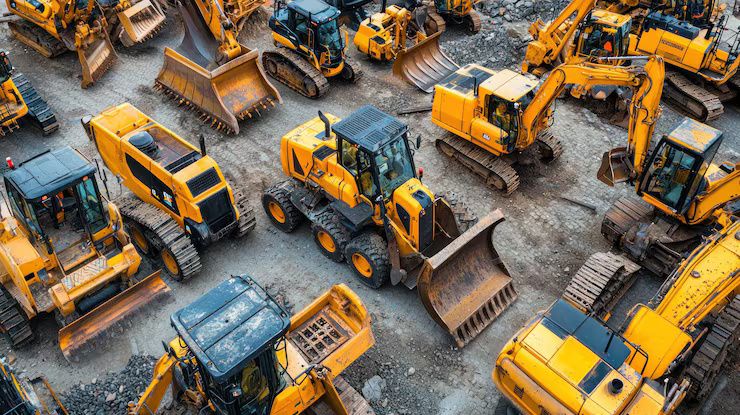
Context
Construction machinery refers to powered equipment used to perform physical tasks that would otherwise require substantial manual effort. Its development has progressed from basic mechanical machines to equipment that combines hydraulics, electronic controls, sensors, and digital monitoring.
The purpose of construction equipment is generally to move earth, transport materials, prepare surfaces, lift loads, or support specialized construction activities. Selecting equipment depends on factors such as the type of work, site conditions, material characteristics, working space, and required operating capacity.
| Equipment | Primary Function | Common Application |
|---|---|---|
| Excavator | Digging and material handling | Trenches, foundations, earthwork |
| Bulldozer | Pushing and spreading material | Site preparation and grading |
| Wheel loader | Loading and moving materials | Aggregate and soil handling |
| Motor grader | Surface shaping | Roads and site grading |
| Crane | Lifting and positioning loads | Structural construction |
| Roller/compactor | Compacting surfaces | Roads, soil, and foundations |
| Backhoe loader | Digging and loading | Utility and general construction |
| Skid-steer loader | Compact material handling | Restricted work areas |
Excavators normally use a boom, arm, and bucket to dig and move materials. Bulldozers use a front blade for pushing soil and other materials. Motor graders provide more precise surface shaping, while compactors apply pressure or vibration to improve material density.
Equipment attachments can significantly change machine functions. Buckets, breakers, augers, forks, grapples, and other attachments allow compatible machines to perform different tasks.
Importance
Understanding construction machinery matters because inappropriate equipment selection can affect productivity, site movement, material handling, and safety. Operators and project planners need to understand what a machine is designed to do and the conditions under which it can operate safely.
The information is useful for several groups, including equipment operators, construction managers, engineers, site supervisors, maintenance personnel, and workers who operate around mobile machinery.
Important considerations include:
- Machine dimensions and operating weight
- Rated capacity and attachment specifications
- Ground conditions and available working space
- Visibility around the equipment
- Required operator training
- Manufacturer operating instructions
- Inspection and maintenance requirements
- Environmental conditions such as dust, heat, rain, or unstable terrain
Ground conditions are particularly important for heavy equipment and lifting operations. For example, OSHA's U.S. construction crane rules require suitable ground conditions capable of supporting the equipment, with supporting materials used when necessary.
Correct equipment selection can also help reduce unnecessary movement between work areas. Matching machine capabilities with the task can make work planning more predictable and can reduce the likelihood of using equipment outside its intended application.
Recent Updates
Construction machinery is increasingly incorporating telematics, electronic controls, machine sensors, automated functions, and digital maintenance information. These technologies can provide data about operating hours, location, machine status, fuel or energy use, and maintenance indicators.
Telematics is particularly relevant to modern earth-moving machinery. ISO/TS 15143-3 defines a communication framework for exchanging telematics data from mobile earth-moving and road-construction machinery. ISO is also developing a third edition that is intended to replace the 2020 edition.
Electrification is another important development, particularly for compact construction equipment and machinery used in areas where noise and local emissions are significant considerations. Battery-electric systems can change operating patterns because charging requirements, battery capacity, ambient temperature, and duty cycles become important planning factors.
Automation and machine-control technologies are also developing. Positioning systems, grade-control systems, cameras, sensors, and digital displays can assist operators with tasks such as grading, positioning, and monitoring.
Emission controls remain an important area of development for diesel-powered machinery. In the United States, EPA regulations cover nonroad diesel engines used in equipment such as excavators and other construction machinery, including requirements associated with Tier 4 emission standards.
Laws or Policies
Construction machinery regulations vary by country, state, and project type. Operators and organizations should follow the rules applicable to their location rather than relying on general international guidance.
In the United States, OSHA's construction regulations include requirements covering material-handling equipment and earthmoving machinery. Section 1926.602 addresses equipment such as scrapers, loaders, crawler tractors, bulldozers, off-highway trucks, graders, and similar equipment.
Crane operations are subject to additional requirements. OSHA's Subpart CC covers power-operated equipment used to hoist, lower, and horizontally move suspended loads. Operator training, certification, and evaluation requirements also apply to many types of equipment covered by the crane standard.
European machinery regulation is also evolving. Regulation (EU) 2023/1230 establishes updated machinery requirements and is scheduled to apply from January 14, 2027, with certain provisions applying earlier.
Environmental regulations can also affect equipment selection and operation. In the United States, EPA rules establish emissions requirements for nonroad diesel engines used in construction equipment.
For any project, relevant national regulations, workplace safety requirements, environmental rules, manufacturer instructions, and local construction codes should be reviewed before equipment is operated.
Tools and Resources
Reliable technical resources can help users understand machinery specifications, operating requirements, safety procedures, and maintenance information.
Useful resources include:
- Manufacturer operation and maintenance manuals
- Government workplace safety databases
- Environmental regulator publications
- ISO machinery standards and technical documents
- Equipment inspection checklists
- Site risk-assessment templates
- Maintenance records and operating-hour logs
- Telematics and machine-monitoring platforms
- Load charts for applicable lifting equipment
Manufacturer documentation should be treated as an important reference because operating limits can differ between models, attachments, and configurations.
For crane and lifting activities, load charts and manufacturer specifications are particularly important. OSHA also provides construction crane and derrick guidance covering subjects such as operator qualification, safety requirements, and compliance information.
Digital monitoring systems can complement traditional records by collecting machine data electronically. However, digital information does not replace required inspections, operator judgment, or applicable regulatory procedures.
FAQs
What is construction machinery?
Construction machinery includes powered equipment designed for tasks such as excavation, grading, lifting, loading, transportation, drilling, and compaction. Different machines are designed for different operating conditions and applications.
What are the main types of construction equipment?
Common types include excavators, bulldozers, loaders, graders, cranes, compactors, backhoe loaders, dump trucks, and specialized drilling or paving equipment. Their functions depend on machine design and attachments.
Why is equipment selection important?
Equipment selection affects how effectively a particular task can be performed. Factors such as machine capacity, dimensions, ground conditions, attachment compatibility, and site layout should be considered before operation.
What safety information should operators understand?
Operators should understand the manufacturer's instructions, machine controls, operating limits, inspection procedures, site hazards, and applicable workplace regulations. Some equipment categories also have specific training or qualification requirements.
How is construction machinery becoming more advanced?
Modern machinery increasingly uses telematics, sensors, digital displays, machine-control systems, automation, and electrified powertrains. These technologies can improve monitoring and provide additional information for equipment management.
Conclusion
Understanding construction machinery tips, equipment types, and machine functions provides a useful foundation for safer and more organized construction work. Each machine has particular capabilities, limitations, operating requirements, and appropriate applications.
Technology is also changing how construction equipment is monitored and operated. Telematics, electronic controls, emissions technologies, electrification, and machine-control systems are becoming increasingly relevant across the industry.
A practical approach is to combine manufacturer information with applicable regulations and site-specific assessments. This helps ensure that equipment selection and operation are based on documented technical information rather than assumptions.
As construction projects become more technologically connected, understanding both traditional machinery functions and newer digital systems will remain useful for operators, supervisors, engineers, and other construction professionals.