Food processing technology combines scientific methods, equipment, and controlled procedures to transform raw agricultural materials into safe, stable, and usable food products.
It covers activities such as cleaning, sorting, cutting, heating, cooling, drying, fermentation, preservation, packaging, and storage.
Modern food processing equipment helps manufacturers maintain consistent product characteristics while managing hygiene, temperature, moisture, texture, and shelf stability. Understanding the basic methods and technologies provides useful context for students, food professionals, consumers, and anyone interested in how processed foods are produced.
Context
Food processing has existed for thousands of years, beginning with simple techniques such as drying, salting, smoking, and fermentation. Industrial food processing later introduced mechanical equipment, controlled heating, refrigeration, automated monitoring, and standardized production methods.
The main purpose of food processing technology is to make raw materials safer, more stable, easier to handle, or more suitable for particular food products. Processing can also influence texture, flavor, appearance, nutritional characteristics, and storage stability.
Common stages in a food processing system include:
- Receiving and inspecting raw materials
- Cleaning and sorting
- Cutting, grinding, or milling
- Mixing and formulation
- Heating or cooling
- Preservation and stabilization
- Packaging and labeling
- Storage and distribution
Different foods require different processing conditions. Grain products may involve milling and baking, while dairy products can involve pasteurization, homogenization, fermentation, and refrigeration. Fruits and vegetables may undergo washing, cutting, blanching, freezing, drying, or canning.
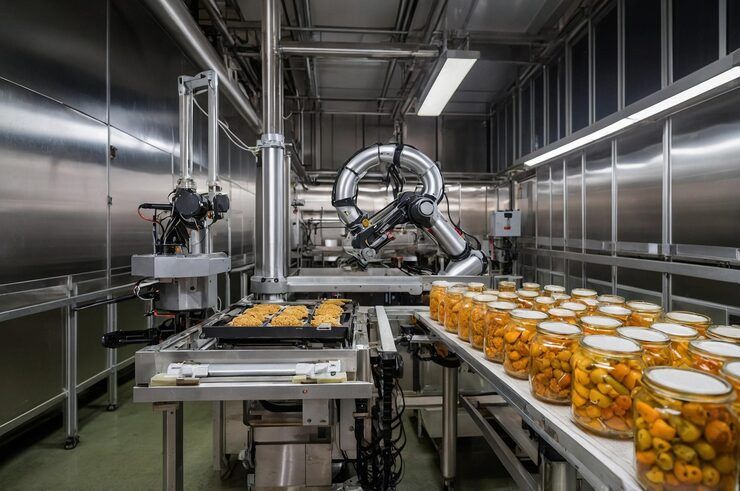
Food processing equipment is designed around these individual operations. Examples include conveyors, mixers, grinders, mills, heat exchangers, pasteurizers, dryers, evaporators, refrigeration systems, filling equipment, and packaging machines.
| Processing stage | Common equipment | Main purpose |
|---|---|---|
| Cleaning | Washers, screens | Remove soil and unwanted material |
| Size reduction | Cutters, mills, grinders | Change particle size or shape |
| Mixing | Blenders, mixers | Combine ingredients uniformly |
| Heating | Steam systems, heat exchangers | Control temperature and reduce hazards |
| Cooling | Chillers, refrigeration units | Lower product temperature |
| Drying | Tray, spray, or tunnel dryers | Reduce moisture |
| Packaging | Fillers and sealers | Protect and contain food |
Importance
Food processing technology matters because it connects food science with practical production. Properly controlled processing can reduce microbial hazards, extend storage stability, improve consistency, and make many agricultural materials easier to prepare and distribute.
Food safety is a central consideration. Processing conditions such as temperature, time, acidity, moisture, and sanitation can affect microbial growth and product stability. Monitoring these factors helps reduce risks associated with biological, chemical, and physical hazards.
The field affects several groups:
- Food manufacturers and processors
- Farmers and agricultural producers
- Food scientists and engineers
- Quality and safety personnel
- Packaging and logistics teams
- Consumers and households
- Government food regulators
Automation has also changed food processing operations. Sensors and computerized controls can continuously monitor temperatures, pressures, flow rates, moisture levels, and other process variables. Data collection can make it easier to identify deviations and document production conditions.
Equipment selection depends on the characteristics of the food and the intended process. Factors can include product viscosity, particle size, moisture content, heat sensitivity, acidity, required throughput, hygiene requirements, and the desired final characteristics.
Recent Updates
Recent developments in food processing technology have focused on automation, energy efficiency, food safety, traceability, and improved control of processing conditions.
Digital monitoring is becoming more common in modern processing environments. Sensors can collect information from production equipment, while software can organize process data for analysis and record keeping. This approach can support faster identification of abnormal conditions.
Artificial intelligence and machine learning are also being explored for applications such as quality inspection, predictive equipment maintenance, process optimization, and detection of product defects. These technologies are generally used alongside established food science and safety controls rather than replacing them.
Another important area is non-thermal processing. High-pressure processing, pulsed electric fields, ultraviolet treatment, and related technologies are being studied or applied for selected foods. These approaches can reduce microbial hazards while potentially preserving certain sensory or nutritional characteristics better than some conventional heat treatments.
Energy efficiency is another area of development. Heat recovery systems, improved refrigeration controls, efficient drying technologies, and optimized process scheduling can reduce energy use in suitable facilities.
Food traceability is also receiving increased attention. Digital records, batch identification, and connected monitoring systems can help organizations track ingredients and finished products through different stages of the food chain.
Laws or Policies
Food processing facilities must follow the food safety and labeling requirements applicable to their country and product category. Requirements commonly cover sanitation, ingredient controls, processing conditions, contaminants, allergens, packaging, labeling, records, and traceability.
In the United States, the Food Safety Modernization Act framework includes preventive controls for human food. Covered facilities generally need a food safety plan based on hazard analysis and risk-based preventive controls, subject to applicable exemptions and modified requirements. FDA requirements include controls related to processes, sanitation, allergens, monitoring, corrective actions, and verification.
In India, the Food Safety and Standards Authority of India maintains regulations under the Food Safety and Standards Act, 2006. These include rules covering licensing and registration, food product standards, contaminants, food recall, packaging, labeling and display, food safety auditing, and other areas.
FSSAI regulations are periodically amended as food science, processing technology, analytical methods, and food categories develop. Its 2026 regulatory information includes amendments and notifications concerning areas such as licensing, laboratories, vegan food requirements, and other food standards.
Internationally, Codex food hygiene principles and HACCP-based approaches are widely used as references for managing food safety hazards. However, specific legal obligations depend on the jurisdiction, food category, and processing activity.
Tools and Resources
Several resources can help people understand food processing technology and related requirements.
Useful resources include:
- FDA food safety and FSMA information for U.S. regulatory guidance
- FSSAI regulations and notifications for India
- Codex Alimentarius publications for international food standards
- Food science textbooks and technical manuals
- Food safety hazard-analysis templates
- Temperature and moisture monitoring records
- Equipment maintenance and calibration logs
- Process-flow diagrams for documenting production stages
Process calculations may involve temperature conversion, moisture content, concentration, heat transfer, residence time, or production throughput. Spreadsheet tools can help organize measurements and compare process records.
For regulatory work, official government publications should take priority over informal summaries. Regulations can change, and requirements may differ according to the product, facility, location, and processing method.
FAQs
What is food processing technology?
Food processing technology is the application of science, engineering, equipment, and controlled methods to transform raw food materials into safe, stable, and usable food products.
What are common food processing methods?
Common methods include heating, cooling, drying, freezing, fermentation, pasteurization, sterilization, milling, grinding, mixing, and controlled packaging.
What equipment is used in food processing?
Equipment varies by product and process. Common examples include conveyors, washers, cutters, mixers, grinders, heat exchangers, pasteurizers, dryers, refrigeration systems, filling equipment, and packaging machines.
Why is temperature control important?
Temperature can influence microbial growth, chemical reactions, texture, and product stability. Appropriate temperature control is therefore an important part of many food processing systems.
What regulations apply to food processing?
Requirements depend on the country and product. In India, FSSAI regulations cover areas such as food standards, hygiene, licensing, packaging, labeling, and recall. In the United States, FDA regulations under FSMA include risk-based preventive controls for covered facilities.
Conclusion
Food processing technology combines traditional preservation methods with modern equipment, automation, monitoring, and food safety practices. Its applications range from simple operations such as cleaning and milling to advanced processes involving controlled heating, drying, refrigeration, and non-thermal technologies.
Understanding equipment, processing methods, safety principles, and regulatory requirements provides a foundation for evaluating how food products are prepared and maintained throughout the production chain.
As technology develops, digital monitoring, automation, energy efficiency, traceability, and alternative processing methods are likely to remain important areas of food processing research and application.
For accurate regulatory information, readers should consult the relevant government authority and current regulations for their location and food category.