Hydraulic actuators are mechanical devices that convert hydraulic fluid energy into controlled mechanical movement. They are widely used in construction equipment, industrial machinery, manufacturing systems, agricultural equipment, mining machinery, material-handling equipment, and mobile hydraulic systems.
Hydraulic actuators generally produce either linear or rotary movement. Hydraulic cylinders are the most common linear actuators, while hydraulic motors are widely used for continuous rotary movement. Their performance depends on hydraulic pressure, fluid flow, actuator design, load conditions, seals, materials, and control valves.
Context
What Are Hydraulic Actuators?
A hydraulic actuator receives pressurized hydraulic fluid and converts that energy into mechanical motion. The hydraulic pump generates fluid flow, while valves regulate where the fluid travels and how the actuator responds.
For linear movement, pressurized fluid acts on a piston inside a cylinder. For rotary movement, hydraulic pressure drives a motor mechanism that produces shaft rotation.
The actuator is therefore one part of a larger hydraulic circuit that can include a reservoir, pump, valves, filters, hoses, fittings, sensors, and control equipment.
Main Types of Hydraulic Actuators
Hydraulic actuators can be divided into linear and rotary categories.
| Actuator Type | Motion | Typical Applications |
|---|---|---|
| Single-Acting Cylinder | Linear, one powered direction | Lifting and clamping |
| Double-Acting Cylinder | Linear, two powered directions | Excavators and presses |
| Telescopic Cylinder | Extended linear stroke | Dump bodies and lifting equipment |
| Tie-Rod Cylinder | Linear | Industrial machinery |
| Welded Cylinder | Linear | Mobile hydraulic equipment |
| Hydraulic Motor | Continuous rotary | Drives and rotating equipment |
| Vane Motor | Rotary | Industrial machinery |
| Piston Motor | Rotary | Heavy-duty hydraulic drives |
| Gear Motor | Rotary | Conveyors and auxiliary drives |
The appropriate configuration depends on required force, stroke, speed, pressure, load direction, installation space, and operating environment.
Hydraulic Cylinders
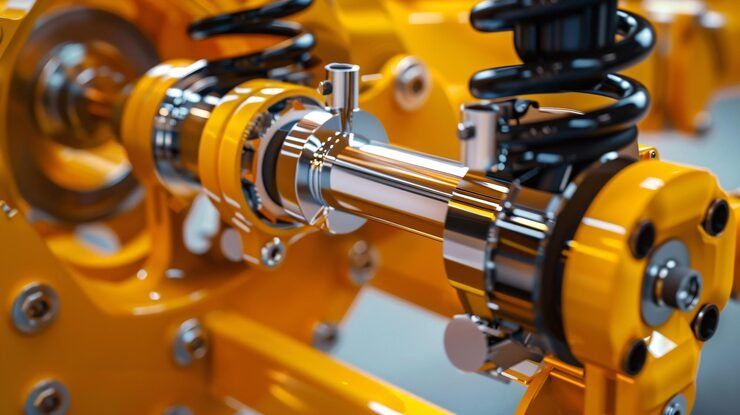
Hydraulic cylinders are the primary linear hydraulic actuators. A cylinder generally consists of a barrel, piston, piston rod, seals, gland, and mounting components.
When pressurized fluid enters one side of the cylinder, the piston moves and transfers force through the rod. A double-acting cylinder can receive hydraulic pressure on both sides of the piston, allowing controlled movement in both directions.
Hydraulic Motors
Hydraulic motors convert hydraulic energy into rotary mechanical motion. They are used for equipment such as winches, conveyors, drilling systems, track drives, and industrial rotating machinery.
Common hydraulic motor designs include gear, vane, and piston motors. Each design has different characteristics related to torque, speed, efficiency, pressure, and operating range.
Importance
Why Hydraulic Actuators Matter
Hydraulic actuators can generate substantial force and torque from relatively compact components. This makes them useful in machinery that must move heavy loads or perform demanding mechanical operations.
Their ability to provide controlled movement also makes them suitable for lifting, pressing, clamping, digging, rotating, positioning, and material handling.
Force and Pressure Relationship
For a hydraulic cylinder, generated force is related to hydraulic pressure and the effective piston area.
A larger piston area can produce greater force at the same hydraulic pressure, while hydraulic flow primarily influences actuator movement speed.
Actual performance is affected by pressure losses, friction, seal behavior, load conditions, and hydraulic circuit design.
Motion Control
Hydraulic actuators are controlled through valves that regulate pressure, direction, and flow. Directional valves determine movement direction, while flow-control arrangements can influence actuator speed.
Proportional and servo valves can provide more precise control where applications require variable movement or accurate positioning.
Load Handling
Hydraulic actuators are frequently used where large loads must be moved or controlled. Construction machinery provides a common example: hydraulic cylinders move excavator booms, arms, buckets, and other attachments.
Industrial presses and lifting equipment similarly rely on hydraulic cylinders to generate controlled mechanical force.
Hydraulic Motion Technologies
Single-Acting Hydraulic Cylinders
Single-acting cylinders use hydraulic pressure to generate movement in one direction. The return movement can occur through gravity, an external load, or a spring depending on the design.
They are commonly used in lifting and pushing applications where powered movement is required primarily in one direction.
Double-Acting Hydraulic Cylinders
Double-acting cylinders use hydraulic pressure on both sides of the piston. This provides powered movement in both extension and retraction directions.
They are widely used in excavators, loaders, agricultural machinery, industrial presses, automated machinery, and material-handling systems.
Telescopic Hydraulic Cylinders
Telescopic cylinders contain multiple nested stages. When extended, these stages provide a long stroke relative to the cylinder's retracted length.
They are frequently used in dump trucks, tipping systems, lifting platforms, and applications where installation space is limited.
Differential Cylinders
Differential cylinders have different effective areas on the two sides of the piston because the rod occupies part of the piston area.
This results in different force and speed characteristics during extension and retraction.
Rotary Hydraulic Actuators
Rotary actuators produce angular rather than continuous shaft rotation in some designs. They can use vane or rack-and-pinion mechanisms to convert hydraulic pressure into controlled angular movement.
They are useful for positioning, valve operation, material handling, and industrial automation.
Manufacturing Processes
Cylinder Barrel Manufacturing
Cylinder barrels may be manufactured from steel tubing or other engineered materials. Internal surfaces require controlled dimensions and surface characteristics to support piston and seal operation.
Processes can include cutting, machining, honing, surface treatment, and dimensional inspection.
Piston and Rod Manufacturing
Pistons are machined to controlled dimensions so they can operate within the cylinder barrel while maintaining the required sealing arrangement.
Piston rods commonly undergo precision machining and surface treatment. Chrome plating or other surface technologies may be used in selected designs to improve surface properties and corrosion resistance.
CNC Machining
CNC machining is widely used for hydraulic actuator components. It can produce piston rods, pistons, glands, mounting components, ports, and other precision parts.
Dimensional accuracy is important because actuator performance depends on controlled clearances and alignment.
Welding
Welded cylinders use fabricated barrel and end components joined through controlled welding processes. Welding procedures need to account for material properties, structural loads, and dimensional requirements.
Heat Treatment
Selected components may undergo heat treatment to modify hardness, strength, wear characteristics, or dimensional stability.
The specific process depends on the material and the mechanical demands placed on the component.
Seal Assembly
Hydraulic actuators use seals to control fluid leakage and prevent contaminants from entering the cylinder.
Common sealing components include piston seals, rod seals, wipers, O-rings, and guide rings. Seal material is selected according to pressure, temperature, hydraulic fluid, and operating conditions.
Testing
Finished hydraulic actuators may undergo pressure testing, leakage testing, dimensional inspection, stroke verification, and functional testing.
Testing requirements vary according to actuator type, application, and manufacturer specifications.
Suppliers and Manufacturers
Hydraulic Actuator Manufacturers
Hydraulic actuators are manufactured by companies specializing in industrial hydraulics, mobile hydraulics, construction equipment, agricultural machinery, automation, and heavy machinery.
Some manufacturers focus on standard cylinders and motors, while others produce customized actuators for specific load, stroke, pressure, mounting, or environmental requirements.
Hydraulic Actuator Suppliers
Suppliers may provide complete cylinders, hydraulic motors, seal kits, replacement rods, pistons, glands, mounting components, and repair components.
Technical compatibility is important when selecting a replacement actuator or component. Equipment model, dimensions, pressure rating, stroke length, mounting configuration, fluid type, and application requirements should be checked.
Custom Hydraulic Actuators
Specialized applications may require cylinders with unusual stroke lengths, mounting arrangements, bore dimensions, operating pressures, or environmental protection.
Custom actuator designs can be developed according to the mechanical load, available installation space, operating cycle, and hydraulic circuit.
Industrial Applications
Construction Equipment
Excavators, loaders, bulldozers, cranes, drilling machines, and other construction equipment use hydraulic actuators extensively.
Cylinders can control booms, arms, buckets, blades, stabilizers, steering systems, and lifting mechanisms.
Manufacturing Machinery
Hydraulic cylinders are used in presses, forming machines, injection molding systems, machine tools, clamping systems, and automated production equipment.
They can provide controlled force for forming, pressing, positioning, and holding operations.
Agricultural Equipment
Tractors, harvesters, sprayers, loaders, balers, and agricultural implements use hydraulic actuators for lifting, steering, positioning, and attachment control.
Mining Equipment
Mining machinery can use hydraulic cylinders and motors for drilling, lifting, excavation, material handling, crushing, and equipment positioning.
These actuators may operate under high loads, vibration, dust, and demanding environmental conditions.
Material Handling
Forklifts, cranes, lifting platforms, warehouse machinery, and specialized handling equipment use hydraulic actuators for lifting, tilting, positioning, and controlled movement.
Energy and Process Equipment
Hydraulic actuators can also be used in industrial energy systems, process equipment, turbine-related mechanisms, dam and water-control systems, and specialized valve actuation.
Recent Updates
Electro-Hydraulic Actuators
Modern systems increasingly combine hydraulic power with electronic control. Sensors can measure position, pressure, temperature, and load while electronic controllers regulate hydraulic valves.
This architecture can improve coordination between hydraulic movement and automated machine functions.
Smart Actuator Monitoring
Sensors and connected control systems can provide information about actuator position, pressure, temperature, and operating cycles.
This information can support condition monitoring and maintenance planning.
Energy-Efficient Hydraulic Systems
Variable-displacement pumps, load-sensing circuits, proportional valves, and electronically controlled hydraulic systems can adjust hydraulic output according to actual machine requirements.
These technologies can reduce unnecessary fluid flow and pressure losses in appropriately designed systems.
Electrification and Hybrid Equipment
Electric construction and industrial equipment can combine electric motors with hydraulic pumps and actuators. This creates electro-hydraulic architectures in which electrical and hydraulic technologies work together.
Advanced Materials and Coatings
Developments in materials, surface treatments, sealing compounds, and rod coatings can improve resistance to wear, corrosion, temperature, and demanding operating conditions.
Laws or Policies
Hydraulic Safety
Hydraulic actuators can operate at high pressure and can store significant mechanical and hydraulic energy. Maintenance personnel should follow appropriate shutdown, isolation, pressure-release, and verification procedures.
Machinery Safety
Machines using hydraulic actuators should incorporate appropriate guarding, emergency controls, load-control measures, and maintenance procedures according to applicable safety requirements.
Pressure Requirements
Some hydraulic equipment may fall under pressure-related regulations depending on its design and application. Organizations should determine which requirements apply to their specific equipment.
Environmental Requirements
Hydraulic fluids, contaminated components, seals, filters, and other maintenance materials should be handled according to applicable environmental and waste-management requirements.
Tools and Resources
Hydraulic actuator maintenance and testing can involve pressure gauges, flow meters, dimensional measurement equipment, hydraulic test benches, seal installation tools, alignment equipment, and electronic diagnostic systems.
Hydraulic circuit diagrams are useful for understanding how actuators connect to pumps, valves, reservoirs, filters, and other components.
Manufacturer manuals, actuator drawings, cylinder specifications, seal catalogs, maintenance records, and hydraulic schematics can also support component identification and technical maintenance.
FAQs
What are hydraulic actuators?
Hydraulic actuators are devices that convert hydraulic fluid energy into mechanical movement. They can generate linear movement through cylinders or rotary movement through hydraulic motors.
What are the main types of hydraulic actuators?
Major types include single-acting cylinders, double-acting cylinders, telescopic cylinders, differential cylinders, hydraulic motors, and rotary hydraulic actuators.
How does a hydraulic cylinder work?
Pressurized hydraulic fluid acts on a piston inside the cylinder. The resulting force moves the piston and piston rod, producing controlled linear mechanical movement.
Where are hydraulic actuators used?
Hydraulic actuators are used in construction equipment, agricultural machinery, manufacturing systems, mining equipment, cranes, material-handling systems, energy equipment, and industrial automation.
What factors affect hydraulic actuator selection?
Important factors include required force or torque, stroke or rotation range, operating pressure, flow rate, speed, mounting configuration, load conditions, hydraulic fluid, temperature, and environmental conditions.
Conclusion
Hydraulic actuators convert pressurized fluid energy into controlled mechanical movement and form an essential part of many industrial and mobile hydraulic systems. Hydraulic cylinders provide linear movement, while hydraulic motors and rotary mechanisms provide rotational or angular movement.
Manufacturing involves precision machining, welding, heat treatment, surface finishing, sealing, assembly, and testing. Modern actuator systems increasingly incorporate sensors, electronic controls, condition monitoring, and energy-management technologies.
Applications range from excavators and agricultural machinery to industrial presses, mining equipment, cranes, manufacturing systems, and specialized energy equipment. Appropriate actuator selection depends on mechanical requirements, hydraulic conditions, installation constraints, environmental factors, and applicable safety procedures.