
Hydrogen production equipment includes the technologies, machines, and supporting systems used to generate hydrogen from different feedstocks and energy sources.
These systems can range from electrolyzers that split water into hydrogen and oxygen to equipment used for reforming, purification, compression, drying, and storage. Understanding hydrogen production equipment helps explain how hydrogen moves from an energy source or raw material to a usable gas.
Hydrogen is increasingly discussed as part of the transition toward lower-emission energy systems. Its environmental profile depends strongly on how it is produced and what energy source is used. Learning about the types, operating principles, applications, and regulatory considerations of hydrogen production equipment provides a useful foundation for understanding this developing technology.
Context
Hydrogen production equipment refers to the collection of equipment used to generate and prepare hydrogen for subsequent applications. Hydrogen itself is not a primary energy source in the same way as sunlight, wind, or natural gas. It is an energy carrier that can be produced through several different processes.
One widely used method is steam methane reforming, in which natural gas reacts with steam at high temperatures to produce hydrogen-rich gas. Another important approach is electrolysis. In an electrolyzer, electricity is used to split water into hydrogen and oxygen.
Electrolysis can use electricity from different sources. When renewable electricity such as wind or solar power is used, the resulting hydrogen is commonly described as renewable or green hydrogen. Other production pathways include biomass conversion, coal or oil-based processes, and emerging methods such as methane pyrolysis.
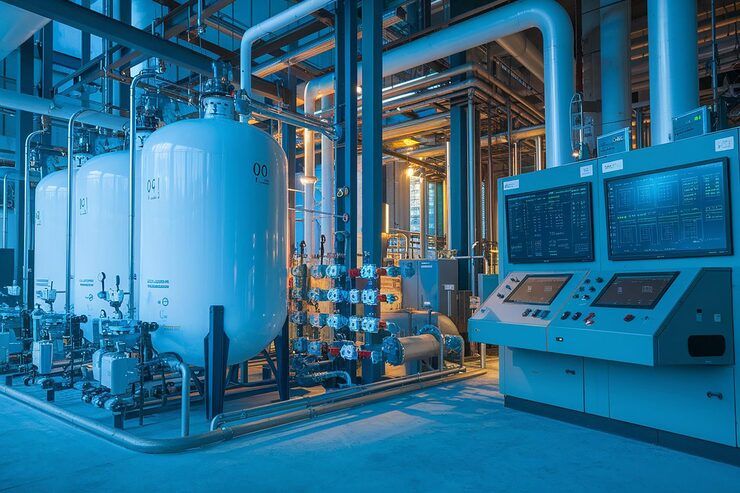
A hydrogen production system normally contains more than the primary hydrogen-generation unit. Depending on the application, it may include:
- Feedwater or feedstock preparation equipment
- Hydrogen generation equipment
- Gas purification systems
- Gas drying equipment
- Cooling and heat-management systems
- Pressure-control equipment
- Compression equipment
- Storage systems
- Monitoring and control systems
- Safety equipment
The exact configuration depends on the production method, hydrogen purity requirements, operating pressure, production scale, and intended application.
Importance
Hydrogen production equipment matters because the equipment selected and the way it operates influence hydrogen purity, efficiency, reliability, emissions, and overall system performance. Different industries have different hydrogen requirements, so there is no single production technology appropriate for every situation.
Industrial facilities may use hydrogen in chemical processing, petroleum refining, metal processing, semiconductor manufacturing, and other applications. Hydrogen is also being studied for fuel-cell vehicles, stationary power systems, energy storage, and certain high-temperature industrial processes.
Electrolyzers have received particular attention because they can connect electricity systems with hydrogen production. During periods when renewable electricity is available, electricity can be converted into hydrogen and potentially used later. This concept is sometimes called power-to-hydrogen.
Hydrogen production also affects several groups:
- Energy producers evaluating different generation pathways
- Industrial facilities requiring specific hydrogen purity levels
- Engineers designing hydrogen systems
- Governments developing hydrogen strategies
- Researchers developing improved electrolyzer technologies
- Communities located near hydrogen production facilities
The environmental impact depends on the complete production pathway. Hydrogen produced using fossil fuels without carbon management can have substantially different emissions from hydrogen produced using low-carbon electricity.
Recent Updates
Hydrogen technology has continued to develop, particularly in electrolyzer design, renewable hydrogen integration, efficiency improvements, and large-scale project planning.
Three electrolyzer technologies are especially important today: alkaline, proton exchange membrane (PEM), and solid oxide electrolyzers. Alkaline systems are a mature technology and commonly use an alkaline electrolyte. PEM systems use a polymer electrolyte membrane and can respond relatively quickly to changes in electricity input. Solid oxide electrolyzers operate at high temperatures and can potentially achieve high efficiency when suitable heat is available.
| Technology | Main Feature | Typical Consideration |
|---|---|---|
| Alkaline | Established electrolysis approach | Mature technology and large-scale applications |
| PEM | Polymer electrolyte membrane | Fast response and compact system designs |
| Solid Oxide | High-temperature operation | Integration with heat sources |
| Steam Methane Reforming | Converts natural gas into hydrogen-rich gas | Carbon emissions require consideration |
| Methane Pyrolysis | Produces hydrogen and solid carbon | Developing technology |
Modern hydrogen facilities increasingly use digital monitoring and automated control systems. Sensors can track pressure, temperature, flow, gas composition, and electrical performance.
Another development is the integration of electrolyzers with renewable electricity and grid-management systems. Researchers and manufacturers are also working on improved catalysts, membranes, electrodes, power electronics, and balance-of-plant components.
Hydrogen storage and transportation technologies are developing alongside production equipment. Depending on the application, hydrogen may be compressed, liquefied, or converted into other chemical carriers.
Laws or Policies
Hydrogen production facilities must follow applicable environmental, electrical, industrial, building, pressure-vessel, fire-safety, and occupational-safety requirements. The exact rules depend on the country, production technology, facility size, and location.
International standards and technical guidelines are also important. Organizations such as the International Organization for Standardization (ISO), International Electrotechnical Commission (IEC), and National Fire Protection Association (NFPA) publish standards relevant to hydrogen systems and related equipment.
In the United States, hydrogen facilities can be affected by requirements from agencies such as the Occupational Safety and Health Administration (OSHA), Environmental Protection Agency (EPA), and Department of Energy (DOE). Hydrogen production projects may also need to address local building, electrical, environmental, and fire requirements.
In Europe, hydrogen policy is connected with broader renewable-energy and decarbonization objectives. The European Union has developed strategies and regulatory frameworks addressing renewable and low-carbon hydrogen.
India has also established the National Green Hydrogen Mission, which aims to develop green hydrogen production and related capabilities. Its policy framework addresses areas such as production, demand creation, infrastructure, research, and domestic ecosystem development.
Because regulations can change, organizations planning hydrogen facilities should consult the current requirements issued by the relevant national and local authorities.
Tools and Resources
Several technical resources can help people understand hydrogen production equipment and evaluate different production pathways.
Useful resources include:
- International Energy Agency (IEA) reports on hydrogen and energy systems
- International Renewable Energy Agency (IRENA) publications
- U.S. Department of Energy hydrogen resources
- ISO standards relating to hydrogen technologies
- IEC standards concerning electrical and hydrogen-related systems
- National Fire Protection Association hydrogen safety guidance
- Government hydrogen strategy documents
- Technical papers and academic research on electrolyzers
Calculations can also help compare production pathways. Common parameters include electricity consumption per kilogram of hydrogen, water consumption, hydrogen production rate, operating pressure, efficiency, and carbon intensity.
For an electrolyzer, a basic assessment may consider:
Hydrogen production rate = operating capacity × hydrogen output factor
Energy efficiency can then be examined by comparing the energy contained in the produced hydrogen with the electricity and other energy inputs required by the system.
More detailed engineering studies normally include equipment specifications, heat balances, electrical requirements, water quality, gas purification, compression, safety systems, maintenance requirements, and operating conditions.
FAQs
What is hydrogen production equipment?
Hydrogen production equipment is a group of machines and systems used to generate hydrogen and prepare it for further use. It can include electrolyzers, reformers, purification units, dryers, compressors, controls, and safety systems.
What are the main types of hydrogen production equipment?
Major types include alkaline electrolyzers, PEM electrolyzers, solid oxide electrolyzers, steam methane reforming systems, and emerging technologies such as methane pyrolysis equipment.
How does an electrolyzer produce hydrogen?
An electrolyzer uses electricity to separate water into hydrogen and oxygen. The specific electrochemical process depends on the electrolyzer technology.
Why is water quality important for electrolysis?
Electrolyzers generally require appropriately treated water because impurities can affect membranes, electrodes, catalysts, and overall system performance. Water-treatment requirements vary by technology.
Is all hydrogen produced with the same environmental impact?
No. Environmental impact depends on the feedstock, energy source, production process, emissions management, and other stages of the hydrogen pathway. Hydrogen produced using renewable electricity can have a different emissions profile from hydrogen produced using fossil fuels.
Conclusion
Hydrogen production equipment encompasses a broad range of technologies used to generate, purify, condition, compress, and manage hydrogen. Electrolysis, steam methane reforming, and several emerging production methods each have different technical characteristics and environmental considerations.
Understanding equipment types, operating principles, efficiency factors, safety requirements, and applicable policies makes it easier to evaluate hydrogen production systems objectively. Continued development in electrolyzers, renewable-energy integration, digital controls, and hydrogen infrastructure is expected to influence the technology landscape.
Hydrogen production is also closely connected with energy, industrial, transportation, and environmental policy. As projects develop in different regions, technical standards and government frameworks will remain important considerations.
For anyone studying hydrogen technology, beginning with the basic production pathways and then examining equipment components provides a practical way to understand how complete hydrogen systems operate.