
Industrial automation and robotics are transforming modern manufacturing by improving production consistency, process control, equipment coordination, and operational efficiency. These technologies combine machines, sensors, software, programmable controllers, and robotic systems to perform industrial tasks with reduced manual intervention.
From automotive assembly and electronics manufacturing to pharmaceutical production and food processing, automated systems support a wide range of industrial operations. Understanding their technologies, equipment types, manufacturing processes, and applications helps explain how modern factories operate.
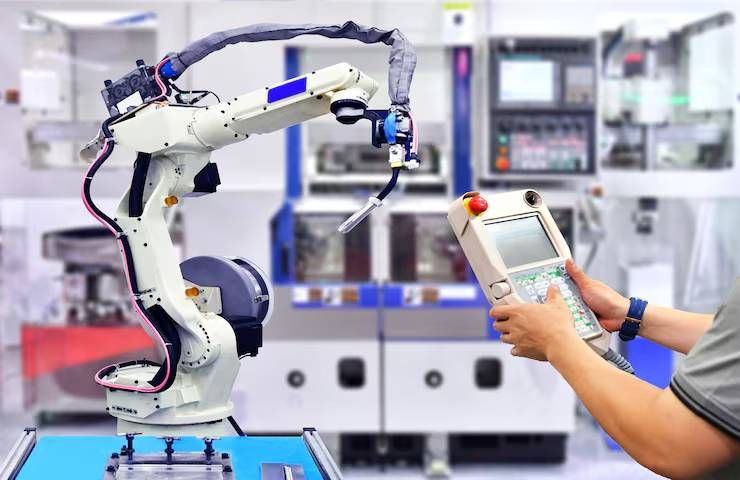
1. Understanding Industrial Automation and Robotics
Industrial automation refers to the use of control systems, machinery, software, and instrumentation to operate industrial processes automatically or with limited human involvement. Robotics focuses on programmable machines that perform physical tasks such as handling materials, assembling components, welding, painting, and inspection.
Although these fields are closely connected, they have different roles. Automation coordinates the broader production process, while robots perform specific physical operations within that process.
For example, an automotive production line may use programmable logic controllers to coordinate conveyors, sensors to detect vehicle components, and robotic arms to perform welding. A manufacturing execution system can track production progress and communicate information to enterprise software.
Main Components of Industrial Automation
Sensors: Detect position, temperature, pressure, movement, proximity, and other operating conditions.
Programmable logic controllers (PLCs): Execute programmed control logic for machines and production lines.
Human-machine interfaces (HMIs): Allow operators to monitor equipment and adjust permitted settings.
Industrial robots: Perform repetitive, precise, or physically demanding operations.
Drives and motion controllers: Regulate motor speed, torque, position, and movement.
Industrial networks: Connect controllers, sensors, robots, and supervisory systems.
Automation software: Supports monitoring, production planning, data collection, and process optimization.
Together, these components enable equipment to operate as an integrated production system.
2. Importance of Industrial Automation in Manufacturing
Industrial automation supports manufacturers in managing complex processes, maintaining consistent output, and coordinating multiple production stages.
Production Consistency
Automated machines follow programmed instructions and repeat movements within defined operating parameters. This can reduce variation between production cycles and improve repeatability.
Productivity and Process Control
Automated systems can coordinate equipment, reduce unnecessary waiting between operations, and maintain continuous production where the process permits it.
Workplace Safety
Robots can perform certain hazardous activities, including handling hot materials, working near chemical processes, or operating in environments unsuitable for routine human access. Proper guarding, risk assessment, and safety controls remain essential.
Quality Monitoring
Sensors, machine vision, and inspection equipment can identify defects, measure dimensions, and monitor process conditions. When integrated with production software, inspection results can support traceability and corrective action.
Data Collection and Visibility
Connected machines can record production quantities, operating states, cycle times, alarms, and equipment performance. These data help engineering and maintenance teams identify recurring problems and improve production planning.
3. Types of Industrial Automation Technologies
Industrial automation includes several technologies designed for different production requirements.
Fixed Automation
Fixed automation uses dedicated equipment configured for a specific manufacturing sequence. It is common in high-volume production environments where product designs and operations remain relatively stable.
Examples include automated transfer lines, dedicated assembly equipment, and certain packaging systems.
Programmable Automation
Programmable automation allows production sequences to be changed through control programs and machine reconfiguration. It is useful when manufacturers produce different batches or product variations.
Examples include programmable machine tools, batch processing equipment, and configurable assembly systems.
Flexible Automation
Flexible automation enables equipment to switch between different products or tasks with limited manual reconfiguration. It often combines programmable machinery, automatic tool changing, robotic handling, and centralized control.
This approach is particularly relevant to manufacturers producing multiple product variants.
Integrated Automation
Integrated automation connects machines, robots, production software, material-handling equipment, and quality systems into a coordinated manufacturing environment.
The objective is to improve information flow and coordination across the production process rather than automate a single machine in isolation.
4. Industrial Robotic Systems and Their Types
Industrial robots are programmable machines designed to perform physical operations within a defined workspace. Their configuration, payload capacity, reach, precision, and speed depend on the intended application.
Articulated Robots
Articulated robots have multiple rotary joints that provide a broad range of movement. They are widely used for welding, painting, assembly, material handling, and machine tending.
SCARA Robots
Selective Compliance Assembly Robot Arm (SCARA) robots are designed for rapid movement and assembly tasks, particularly where horizontal positioning and vertical insertion are important.
Typical applications include electronics assembly, component insertion, and small-part handling.
Cartesian Robots
Cartesian robots move along linear axes, commonly arranged in X, Y, and Z directions. They are used in machine loading, dispensing, packaging, material handling, and automated inspection.
Delta Robots
Delta robots use parallel-link mechanisms that support rapid pick-and-place operations. They are frequently applied to lightweight products in food processing, pharmaceutical packaging, and electronics manufacturing.
Collaborative Robots
Collaborative robots, often called cobots, are designed to support applications in which humans and robots work in close proximity under specified conditions. Their deployment still requires application-specific risk assessment because safe operation depends on the robot, tooling, workpiece, speed, and surrounding equipment.
Autonomous Mobile Robots
Autonomous mobile robots (AMRs) navigate industrial facilities to transport materials, components, and finished products. They can use sensors, mapping technologies, and fleet-management software to move through designated operating areas.
5. Comparison of Industrial Automation and Robotic Equipment
| Equipment or technology | Primary function | Common applications |
|---|---|---|
| PLC systems | Machine and process control | Assembly lines, packaging, conveyors |
| Industrial robotic arms | Programmable physical operations | Welding, painting, handling |
| SCARA robots | Rapid assembly and insertion | Electronics, small components |
| Cartesian systems | Linear movement and positioning | Dispensing, loading, inspection |
| Machine vision systems | Image-based inspection and guidance | Defect detection, robot guidance |
| Industrial sensors | Measurement and condition detection | Process monitoring, safety systems |
| AMRs and automated guided vehicles | Internal material transportation | Warehouses, factories, assembly areas |
| Supervisory control and data acquisition (SCADA) | Supervisory monitoring and control | Utilities, process industries |
| Manufacturing execution systems (MES) | Production tracking and coordination | Production scheduling, traceability |
Equipment selection depends on the required output, process conditions, product characteristics, precision, payload, available floor space, and integration requirements.
6. Industrial Automation and Robotics Manufacturing Processes
Automation systems are developed through a sequence of engineering, equipment integration, programming, and validation activities.
Step 1: Process Analysis and Requirements Definition
Engineers identify the manufacturing tasks, production targets, cycle-time requirements, product dimensions, operating conditions, and safety considerations. They also determine which tasks should be automated and which require human involvement.
Step 2: System Design
The design stage establishes the system architecture, equipment layout, robot configuration, controller selection, sensor placement, and communication requirements.
Computer-aided design (CAD) tools and simulation software may be used to evaluate reach, movement, interference, and production flow before equipment installation.
Step 3: Component Manufacturing and Assembly
Robotic systems contain mechanical structures, joints, gears, actuators, motors, electrical assemblies, control electronics, sensors, and protective enclosures.
Depending on the equipment, components may be produced through machining, casting, forming, fabrication, electronics assembly, and precision finishing. These parts are assembled and aligned according to engineering specifications.
Step 4: Control Programming
Engineers develop PLC logic, robot motion programs, HMI screens, safety sequences, and communication routines. Programs define machine behavior, movement paths, interlocks, alarms, and responses to process conditions.
Step 5: Integration and Calibration
Robots, conveyors, sensors, tools, controllers, and production software are connected into the intended system. Calibration establishes appropriate reference points and verifies positioning or measurement accuracy.
Step 6: Testing and Validation
The integrated system is tested under controlled conditions. Typical checks include repeatability, cycle time, fault recovery, communication reliability, emergency-stop behavior, and safety-system performance.
Step 7: Installation and Operational Monitoring
After installation, engineers verify the system in its production environment. Performance data and maintenance records help identify operational issues and guide later improvements.
7. Global Industrial Automation and Robotics Manufacturers
The global market includes companies specializing in industrial robots, factory automation, motion control, sensors, machine vision, and integrated production technologies.
Representative manufacturers include:
ABB: Industrial robotics, automation systems, motion technologies, and control solutions.
FANUC: Industrial robots, CNC systems, and factory automation equipment.
Yaskawa Electric: Industrial robots, servo drives, and motion-control technologies.
KUKA: Industrial robots, robotic cells, and automated manufacturing systems.
Mitsubishi Electric: PLCs, industrial controllers, drives, and factory automation equipment.
Siemens: Industrial control systems, automation software, and manufacturing digitalization technologies.
Rockwell Automation: Industrial control platforms, automation software, and manufacturing information systems.
Omron: Sensors, controllers, machine vision, and industrial automation equipment.
Universal Robots: Collaborative robotic arms for industrial applications.
Keyence: Industrial sensors, machine vision, measurement systems, and inspection technologies.
These companies operate across different parts of the automation ecosystem. Some focus primarily on robotics or control hardware, while others provide software, sensing equipment, motion systems, or integrated technologies.
Industrial Automation Suppliers and System Integrators
The supply chain includes component manufacturers, robotics distributors, control-system specialists, engineering firms, and system integrators.
Component suppliers may provide motors, gearboxes, sensors, safety devices, PLCs, robot tooling, and industrial communication equipment. System integrators combine these elements into production cells or complete automated lines.
When evaluating manufacturers or suppliers, organizations commonly examine technical compatibility, product documentation, payload and accuracy specifications, spare-parts availability, maintenance requirements, training, safety compliance, and long-term support arrangements.
8. Industrial Applications of Automation and Robotics
Automotive Manufacturing
Robots perform body welding, painting, component handling, sealing, and assembly. Automated inspection systems can verify dimensions and identify visible defects throughout production.
Electronics Manufacturing
Small-component assembly, soldering, circuit-board inspection, precision dispensing, and semiconductor handling rely on controlled movement and accurate positioning.
Food and Beverage Processing
Automation supports filling, sorting, weighing, packaging, palletizing, and process monitoring. Equipment design must account for hygiene, cleaning procedures, and the characteristics of the processed materials.
Pharmaceutical Manufacturing
Automated systems help manage material handling, packaging, laboratory workflows, environmental monitoring, and production traceability. Processes must be designed around applicable quality and regulatory requirements.
Metalworking and Heavy Industry
Robotic welding, machine tending, cutting, casting operations, and material handling can improve repeatability and reduce direct human exposure to hazardous environments.
Warehousing and Logistics
AMRs, automated guided vehicles, conveyor systems, robotic picking equipment, and automated storage systems support internal transportation and inventory movement.
Water and Energy Infrastructure
PLC and SCADA technologies monitor pumps, valves, treatment processes, power equipment, and distributed industrial assets. Automation can help operators respond to changing operating conditions and equipment alarms.
9. Industry 4.0, Artificial Intelligence, and Emerging Trends
Industrial automation increasingly combines physical equipment with connected software, data analytics, and digital engineering.
Industrial Internet of Things
Industrial Internet of Things (IIoT) technologies connect equipment and sensors to monitoring platforms. This makes operating data available for analysis, maintenance planning, and production reporting.
Artificial Intelligence and Machine Vision
AI-based inspection systems can analyze images, recognize patterns, and help identify defects or unusual operating conditions. Their reliability depends on training data, lighting, sensor quality, process variation, and validation.
Digital Twins and Simulation
A digital twin is a digital representation of a physical asset or process that can be updated using operational data. Simulation models help engineers study robot movement, production flow, equipment interactions, and alternative layouts.
Predictive Maintenance
Condition-monitoring systems use vibration, temperature, current, and other measurements to identify potential equipment deterioration. Predictive models can help maintenance teams prioritize inspections, although they require appropriate data and validation.
Connected and Software-Defined Production
Modern factories increasingly connect machine controllers, production systems, and business software. Standardized industrial communication protocols can improve interoperability, but integration across equipment from different vendors still requires careful engineering.
Human-Robot Collaboration
Collaborative applications can support assembly, inspection, and material handling. Successful deployment requires suitable tooling, defined operating limits, risk assessment, and training for personnel working around the system.
10. Safety, Standards, and Implementation Considerations
Industrial automation introduces hazards involving moving machinery, electrical energy, unexpected startup, crushing, impact, and interaction between robots and people.
A structured safety process should identify hazards, estimate risks, and define appropriate safeguards. These may include physical guarding, interlocked access doors, safety-rated sensors, emergency stops, safe-motion functions, lockout procedures, and operator training.
Relevant international standards include ISO 10218 for industrial robot safety and ISO 13849 for safety-related parts of control systems. Applicable requirements depend on the equipment, application, jurisdiction, and current edition of the relevant standard.
Cybersecurity is also important because connected controllers and industrial networks may be exposed to unauthorized access or operational disruption. Segmentation, access controls, secure remote access, backup procedures, patch management, and incident-response planning can reduce these risks.
Before implementing automation, organizations should evaluate production requirements, technical feasibility, workforce training, maintenance capacity, system integration, cybersecurity, and the full lifecycle implications of the equipment.
11. Frequently Asked Questions
What is the difference between industrial automation and robotics?
Industrial automation controls machines and processes through hardware and software. Robotics focuses on programmable machines that perform physical tasks. Robots are often integrated into larger automation systems.
Which industries use industrial robots?
Automotive, electronics, food processing, pharmaceuticals, metalworking, logistics, and many other industries use industrial robots for assembly, handling, inspection, welding, packaging, and transportation.
What equipment is required for an automated production line?
A production line may include PLCs, sensors, robotic arms, conveyors, drives, machine vision systems, safety equipment, HMIs, and production-monitoring software. The exact configuration depends on the manufacturing process.
How does Industry 4.0 relate to industrial automation?
Industry 4.0 combines automation with connected equipment, industrial data, analytics, digital models, and software integration. It aims to improve visibility, coordination, flexibility, and decision-making across manufacturing operations.
What should manufacturers consider when selecting an industrial robot?
Important factors include payload, reach, repeatability, cycle time, workspace, tooling, environmental conditions, programming requirements, safety measures, maintenance, and compatibility with existing equipment.
Can industrial robots work alongside people?
Yes. Robots can be deployed in collaborative applications when the complete application has been appropriately assessed and safeguarded. The robot alone does not determine whether an installation is safe.
Conclusion
Industrial automation and robotics form an important part of modern manufacturing. PLCs, sensors, robotic systems, machine vision, industrial networks, and production software work together to coordinate equipment and improve process control.
As manufacturers adopt connected technologies, AI-based inspection, simulation, and condition monitoring, automation systems are becoming more data-driven and adaptable. Successful implementation still depends on sound engineering, suitable equipment selection, worker training, cybersecurity, and comprehensive safety practices.