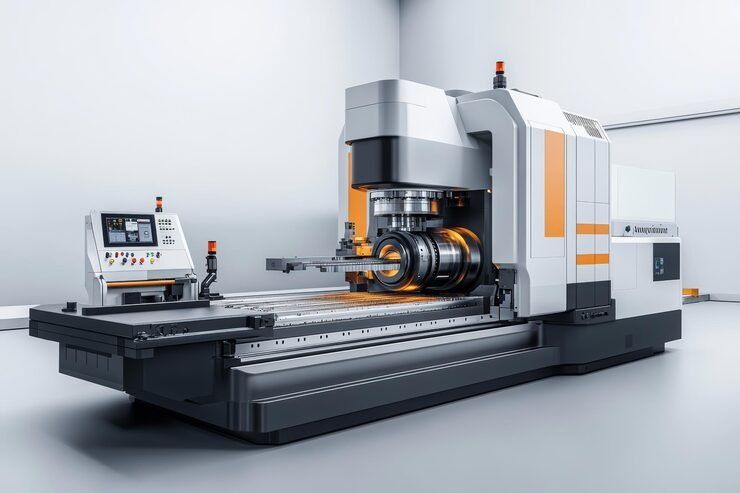
Industrial cutting machines are equipment systems designed to divide, shape, trim, or remove material with controlled mechanical, thermal, abrasive, or high-pressure processes. They are used across metal fabrication, automotive manufacturing, aerospace, construction, packaging, textiles, plastics, electronics, and general industrial production.
Modern cutting equipment ranges from mechanical shears and saws to CNC laser cutters, plasma systems, waterjet machines, ultrasonic cutters, and automated robotic cutting systems. Machine selection depends on material type, thickness, required geometry, production volume, dimensional requirements, and surface characteristics.
Context
What Are Industrial Cutting Machines?
Industrial cutting machines remove or separate material according to a defined geometry. Depending on the technology, the cutting process may use a physical blade, rotating tool, laser beam, plasma arc, abrasive stream, or high-pressure water.
Some machines are manually operated, while others use CNC controllers and automated material handling. Advanced systems can combine cutting with drilling, marking, beveling, or other fabrication processes.
Major Industrial Cutting Machine Types
Industrial cutting machines can be classified according to their cutting mechanism and the material being processed.
| Machine Type | Cutting Technology | Common Materials |
|---|---|---|
| CNC Laser Cutter | Focused laser beam | Steel, aluminum, plastics |
| Plasma Cutting Machine | Ionized gas arc | Conductive metals |
| Waterjet Cutter | High-pressure water and abrasive | Metal, stone, composites |
| CNC Router | Rotating cutting tool | Wood, plastics, composites |
| Band Saw | Continuous toothed blade | Metals, plastics |
| Circular Saw | Rotating circular blade | Metals, wood, composites |
| Guillotine Shear | Straight mechanical blade | Sheet metal |
| Abrasive Cutting Machine | Abrasive wheel | Metals, ceramics |
| Ultrasonic Cutter | High-frequency vibration | Plastics, textiles, composites |
| Slitting Machine | Rotary blades | Films, paper, sheet materials |
The suitable machine depends on material properties, thickness, geometry, tolerance, production requirements, and downstream processing.
Laser Cutting Machines
Laser cutting uses a concentrated beam of light to heat and remove material along a programmed path. Depending on the material and machine configuration, the process can involve melting, vaporization, or thermal separation.
Fiber lasers are widely used for metal cutting, while other laser configurations can be applied to different materials and thickness ranges.
CNC control allows the cutting head to follow complex geometries generated from digital design files.
Plasma Cutting Machines
Plasma cutting uses an electrically conductive, ionized gas stream to melt material and remove it from the cutting zone.
The technology is primarily used for conductive metals such as carbon steel, stainless steel, and aluminum. Plasma systems can handle relatively thick materials and are commonly found in metal fabrication environments.
Waterjet Cutting Machines
Waterjet machines use a high-pressure stream of water, often combined with abrasive particles, to cut material.
Because the process does not rely on a conventional heat-affected cutting zone, waterjet technology can be useful for materials sensitive to thermal effects. Applications include metals, stone, glass, ceramics, composites, and specialized industrial materials.
Importance
Why Industrial Cutting Machines Matter
Cutting is often one of the first major manufacturing operations performed on raw material. The quality of the cut can influence subsequent forming, welding, machining, assembly, and finishing processes.
Accurate cutting can help manufacturers maintain specified dimensions and reduce unnecessary material removal during later production stages.
CNC Cutting Technology
Computer numerical control allows cutting equipment to follow programmed tool paths. A digital design is converted into machine instructions that control movement, cutting speed, power, feed rate, and other parameters.
CNC technology supports repeatable production and allows complex shapes to be produced without manually guiding the cutting tool through every movement.
Automated Material Handling
Industrial cutting lines can integrate loading, unloading, storage, sorting, and material-positioning equipment.
Automation can reduce manual material handling and help coordinate cutting operations with other manufacturing processes.
Cutting Accuracy
Cutting accuracy depends on machine rigidity, drive systems, positioning technology, tool condition, material properties, cutting parameters, and environmental conditions.
Laser systems may use optical positioning, while mechanical machines can rely on encoders and precision drive systems.
Material Utilization
Computerized nesting software can arrange multiple parts within a sheet or plate to improve material utilization.
Nesting algorithms consider part geometry, required spacing, cutting paths, grain direction in selected materials, and production requirements.
Cutting Technologies
Mechanical Cutting
Mechanical cutting uses physical force to separate material. Examples include shearing, sawing, punching, and rotary cutting.
Mechanical systems can be suitable for materials that can be efficiently separated using blades, teeth, or other cutting tools.
Thermal Cutting
Thermal cutting uses heat to melt, vaporize, or otherwise separate material. Laser and plasma cutting are major examples.
Thermal processes are particularly common in metal fabrication because they can produce complex geometries directly from digital designs.
Abrasive Cutting
Abrasive cutting uses hard particles to remove material. Abrasive wheels and abrasive waterjet streams are examples.
The process can be useful for hard materials that are difficult to process with conventional cutting tools.
High-Pressure Water Cutting
Waterjet systems use pressurized water to produce a cutting stream. Abrasive particles can be added when cutting harder materials.
The process can produce intricate profiles and can be used for materials with different thicknesses depending on machine configuration.
Ultrasonic Cutting
Ultrasonic cutting uses high-frequency mechanical vibration to assist material separation.
It can be used for selected plastics, textiles, composites, food-processing materials, and other specialized applications.
Manufacturing Processes
Machine Frame Manufacturing
Industrial cutting machines typically require rigid frames capable of maintaining alignment during operation.
Frames can be fabricated from steel or other structural materials through cutting, forming, welding, machining, and surface treatment.
Precision Component Machining
Critical components such as guide rails, mounting surfaces, shafts, drive components, and tool holders can require precision machining.
CNC machining can produce controlled dimensions and mounting interfaces.
Drive System Assembly
Cutting machines may use ball screws, rack-and-pinion drives, linear motors, servo motors, gear systems, or other motion technologies.
Assembly requires accurate alignment because drive-system errors can affect cutting geometry and positioning.
Cutting Head Manufacturing
Cutting heads differ according to the technology. Laser systems use optical components, plasma systems use electrodes and nozzles, and mechanical machines use blades or rotating tools.
The components must be manufactured and assembled according to the specific cutting process.
CNC Control Integration
Modern machines integrate motors, sensors, controllers, software, and cutting equipment.
The CNC controller coordinates machine movement and cutting parameters according to the programmed geometry.
Testing and Calibration
Finished machines can undergo dimensional checks, positioning tests, cutting trials, electrical testing, and safety verification.
Calibration can establish the relationship between programmed movement and actual machine position.
Industrial Applications
Metal Fabrication
Metal fabrication is a major application area for industrial cutting machines. Laser, plasma, waterjet, saw, and shear systems are used for sheet, plate, tube, and structural material processing.
Cutting can be followed by bending, welding, drilling, machining, coating, or assembly.
Automotive Manufacturing
Automotive production uses cutting equipment for body panels, structural components, exhaust components, interior materials, and various metal and polymer parts.
Robotic and CNC systems can integrate cutting with automated production lines.
Aerospace Manufacturing
Aerospace components often require controlled cutting of aluminum alloys, titanium, composites, and specialized materials.
Laser, waterjet, abrasive, and CNC machining technologies can be selected according to material characteristics and dimensional requirements.
Construction
Construction-material production uses cutting systems for steel sections, pipes, panels, stone, concrete-related materials, insulation products, and other components.
Portable and stationary cutting systems are used according to the application.
Plastics and Composites
CNC routers, waterjets, ultrasonic cutters, and specialized blades can process plastics, fiberglass, carbon-fiber composites, and other engineered materials.
Tool selection depends on material hardness, fiber structure, thickness, and desired edge quality.
Packaging and Textiles
Industrial slitting and cutting machines process paper, cardboard, films, foils, fabrics, nonwoven materials, and other flexible products.
High-speed automated equipment can combine cutting with winding, feeding, inspection, and packaging operations.
Recent Updates
Fiber Laser Technology
Fiber laser systems continue to develop in areas such as beam control, energy efficiency, cutting speed, automation, and material compatibility.
Modern systems can integrate automatic focusing, nozzle monitoring, material detection, and process control.
Robotic Cutting
Robotic arms can carry cutting tools for three-dimensional components and complex geometries.
Robotic cutting is useful when parts have curved surfaces or require multiple orientations that are difficult to process on a conventional flat-bed machine.
Artificial Intelligence and Vision Systems
Machine vision can identify material position, part geometry, defects, and reference points.
AI-based systems can assist with process monitoring, anomaly identification, nesting, and production analysis, depending on the machine architecture.
Automated Tool Management
Advanced machines can monitor tool condition and automatically change cutting tools or adjust operating parameters when appropriate.
This is particularly relevant for production environments where tool wear can influence dimensional quality.
Connected Manufacturing
Industrial cutting machines can connect with manufacturing execution systems, production planning platforms, quality systems, and factory networks.
Machine data can include production quantities, cycle times, alarms, energy consumption, tool usage, and maintenance indicators.
Laws or Policies
Machine Safety
Industrial cutting machines can involve sharp tools, high temperatures, lasers, plasma arcs, high-pressure water, moving components, and flying particles.
Machine guarding, emergency controls, interlocks, operator training, and appropriate protective measures should follow applicable safety requirements.
Laser Safety
Laser cutting equipment requires appropriate controls based on laser classification and machine design. Enclosures, interlocks, warning systems, and controlled access may be necessary.
Electrical Safety
CNC machines contain motors, drives, controllers, power supplies, and other electrical equipment. Installation and maintenance should follow applicable electrical safety requirements.
Environmental Requirements
Cutting processes can generate metal particles, fumes, wastewater, abrasive residues, noise, and other waste streams. Appropriate extraction, filtration, wastewater management, and waste-handling practices depend on the cutting technology and applicable regulations.
Tools and Resources
Industrial cutting operations commonly use CAD/CAM software, CNC controllers, nesting systems, cutting parameter databases, measuring equipment, optical inspection systems, and machine-monitoring platforms.
Maintenance teams may also use alignment tools, calibration equipment, electrical diagnostic instruments, laser measurement systems, and cutting-tool inspection equipment.
Technical documentation such as machine manuals, tooling specifications, material data sheets, cutting charts, electrical diagrams, and maintenance schedules is important for correct operation.
FAQs
What are industrial cutting machines?
Industrial cutting machines are equipment systems used to separate, shape, trim, or remove material using mechanical, thermal, abrasive, waterjet, ultrasonic, or other cutting technologies.
What are the main types of industrial cutting machines?
Major types include laser cutters, plasma cutters, waterjet machines, CNC routers, band saws, circular saws, guillotine shears, abrasive cutters, ultrasonic cutters, and slitting machines.
What materials can industrial cutting machines process?
Depending on the technology, industrial cutting machines can process metals, plastics, composites, wood, stone, glass, ceramics, textiles, paper, films, and other engineered materials.
What is CNC cutting?
CNC cutting uses computer-controlled machine movement to follow programmed cutting paths. It allows complex shapes and repeatable production based on digital design data.
How are industrial cutting machines selected?
Selection depends on material type, thickness, part geometry, dimensional requirements, production volume, cutting speed, edge characteristics, automation requirements, and available workspace.
Conclusion
Industrial cutting machines provide controlled methods for separating and shaping materials across manufacturing and industrial production. Mechanical saws and shears, CNC laser systems, plasma cutters, waterjets, abrasive machines, routers, ultrasonic cutters, and slitting systems each address different material and production requirements.
Modern cutting equipment increasingly combines CNC control, automated material handling, digital nesting, machine vision, process monitoring, and connected manufacturing systems. These technologies can improve process coordination and provide greater visibility into production operations.
Machine selection should consider material characteristics, thickness, geometry, dimensional requirements, production volume, cutting technology, automation level, maintenance requirements, and workplace safety. Proper calibration, tooling management, inspection, and technical documentation are also important for consistent industrial cutting operations.