
Industrial manufacturing relies on precise machining processes to produce components used across industries such as automotive, aerospace, construction, energy, medical equipment, and general engineering.
Among the most essential machine tools in modern workshops is the industrial lathe machine. Known for its versatility and accuracy, a lathe is used to shape, cut, drill, thread, and finish materials into cylindrical or symmetrical components.
As manufacturing technologies continue to evolve, traditional manual equipment now works alongside computer-controlled systems, improving consistency, productivity, and precision. Understanding the different types of lathe machines, their applications, and the technologies behind them helps manufacturers, students, engineers, and business decision-makers better appreciate their role in modern production.
This guide explores industrial lathe machines, including CNC lathe machines, metal lathe machines, precision lathe machines, and manual lathe machines, while explaining their functions, components, and importance in today's manufacturing environment.
What Is an Industrial Lathe Machine?
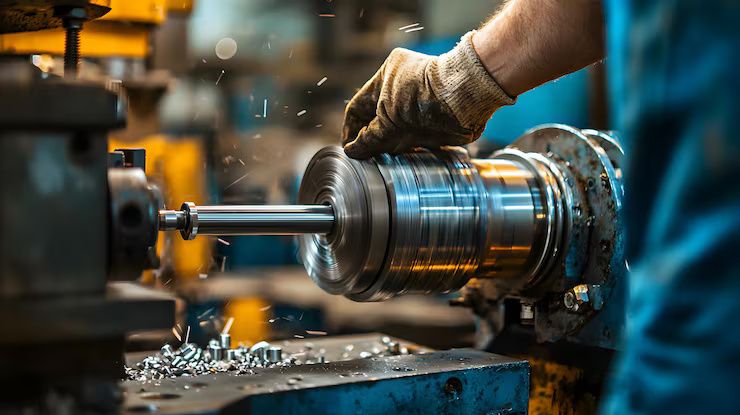
An industrial lathe machine is a machining tool designed to rotate a workpiece while cutting tools remove material to achieve the desired shape, size, or surface finish. Unlike many other machining processes where the cutting tool moves around a stationary object, the lathe rotates the material while the cutting tool moves in controlled directions.
Lathe machines are commonly used to manufacture:
- Shafts
- Bushings
- Rods
- Sleeves
- Cylindrical components
- Machine parts
- Industrial fittings
- Threaded components
Because of their versatility, lathe machines remain one of the most widely used machine tools in manufacturing facilities worldwide.
How Does a Lathe Machine Work?
The basic operating principle is relatively straightforward.
The workpiece is securely mounted on the spindle or chuck, which rotates at controlled speeds. A cutting tool gradually removes material while moving along predetermined paths. Depending on the machining operation, the tool may move parallel, perpendicular, or at an angle to the rotating workpiece.
Common machining operations include:
- Turning
- Facing
- Drilling
- Boring
- Thread cutting
- Knurling
- Grooving
- Parting
Each operation contributes to producing components that meet specific engineering requirements.
Main Components of an Industrial Lathe Machine
Understanding the major parts of a lathe helps explain how the machine performs accurate machining.
| Component | Function |
|---|---|
| Bed | Provides the main structural foundation |
| Headstock | Houses the spindle and drive mechanism |
| Tailstock | Supports longer workpieces and drilling operations |
| Chuck | Holds the workpiece securely |
| Carriage | Moves the cutting tool along the workpiece |
| Tool Post | Holds various cutting tools |
| Lead Screw | Controls threading and automatic feed movement |
| Control System | Operates machine movements and machining parameters |
Each component works together to maintain stability, accuracy, and repeatability during machining.
Types of Industrial Lathe Machines
Different manufacturing requirements call for different lathe designs.
Manual Lathe Machine
A manual lathe machine relies on the operator to control tool movement, spindle speed, and machining operations.
It is commonly used for:
- Educational training
- Maintenance workshops
- Prototype development
- Small production runs
- Repair work
Manual lathes remain valuable because they allow operators to develop a strong understanding of machining fundamentals.
CNC Lathe Machine
A CNC lathe machine uses computer numerical control to automate machining operations according to programmed instructions.
Advantages include:
- High repeatability
- Improved production efficiency
- Complex part manufacturing
- Reduced manual intervention
- Consistent dimensional accuracy
CNC technology has become a cornerstone of modern manufacturing, particularly for high-volume production.
Metal Lathe Machine
A metal lathe machine is specifically designed to machine metallic materials such as steel, aluminum, brass, copper, and various alloys.
Typical applications include:
- Industrial machinery
- Automotive parts
- Aerospace components
- Mechanical engineering
- Tool manufacturing
The machine's rigidity allows it to handle demanding machining operations with excellent precision.
Precision Lathe Machine
A precision lathe machine is engineered for applications requiring exceptionally tight dimensional tolerances and superior surface finishes.
These machines are commonly found in industries where accuracy is critical, including:
- Medical device manufacturing
- Aerospace engineering
- Scientific instruments
- Electronics manufacturing
- High-precision mechanical systems
Materials Commonly Machined
Modern lathe machines can process a wide variety of materials.
Common examples include:
- Carbon steel
- Stainless steel
- Aluminum
- Brass
- Copper
- Titanium
- Engineering plastics
- Composite materials
- Cast iron
The choice of tooling, spindle speed, and cutting parameters depends on the material being machined.
Common Industrial Applications
Industrial lathe machines support manufacturing across numerous sectors.
Some major applications include:
Automotive Manufacturing
Lathe machines produce:
- Engine shafts
- Brake components
- Transmission parts
- Axles
- Bearing housings
Precision machining ensures these components meet strict engineering specifications.
Aerospace Industry
Aircraft components require excellent dimensional accuracy and material integrity.
Lathe machining is used to manufacture:
- Landing gear components
- Engine parts
- Structural fittings
- Hydraulic system components
Energy Sector
Power generation equipment often includes precision-machined rotating components such as:
- Turbine shafts
- Valve bodies
- Pump components
- Couplings
Reliable machining contributes to operational efficiency and equipment longevity.
General Engineering
Machine shops frequently manufacture custom components for industrial equipment, maintenance projects, research facilities, and production machinery.
Advantages of Modern CNC Technology
The transition from manual machining to CNC systems has transformed manufacturing.
Key benefits include:
- Improved machining consistency
- Faster production cycles
- Reduced human error
- Complex geometry manufacturing
- Better quality control
- Enhanced production planning
- Greater operational flexibility
Although manual machines continue to play an important role, CNC technology enables manufacturers to meet increasing demands for precision and productivity.
Comparing Manual and CNC Lathe Machines
| Feature | Manual Lathe Machine | CNC Lathe Machine |
|---|---|---|
| Operation | Operator-controlled | Computer-controlled |
| Production Volume | Low to moderate | Moderate to high |
| Repeatability | Depends on operator skill | Highly consistent |
| Complex Geometry | Limited | Excellent capability |
| Training Requirement | Strong machining skills | Machining and programming knowledge |
| Best Use | Repairs, prototypes, education | Production manufacturing |
Both machine types remain valuable depending on production objectives.
Factors to Consider When Selecting a Lathe Machine
Selecting the appropriate industrial lathe machine depends on several operational requirements.
Important considerations include:
- Material type
- Workpiece dimensions
- Production volume
- Required accuracy
- Automation level
- Available workspace
- Operator expertise
- Future manufacturing needs
Matching machine capabilities with production requirements supports efficient long-term operations.
The Role of Automation in Modern Machining
Automation has significantly expanded the capabilities of modern manufacturing systems.
Today's machining environments often integrate:
- Computer numerical control
- Digital production monitoring
- Automated tool changing
- Robotic material handling
- Machine condition monitoring
- Production scheduling software
These technologies improve workflow efficiency while maintaining consistent manufacturing quality.
Maintenance and Operational Best Practices
Regular maintenance supports machine performance and extends operational life.
Routine practices include:
- Keeping guideways clean
- Lubricating moving components
- Inspecting cutting tools
- Checking spindle alignment
- Monitoring coolant systems
- Verifying machine calibration
- Following recommended maintenance schedules
Preventive maintenance reduces unexpected downtime and helps maintain machining accuracy.
Workplace Safety Around Lathe Machines
Safe operation is an essential part of every machining environment.
Operators should:
- Wear appropriate personal protective equipment.
- Secure workpieces properly before machining.
- Keep hands away from rotating components.
- Remove chips using suitable tools rather than by hand.
- Follow established operating procedures.
- Inspect equipment before beginning work.
- Maintain a clean and organized workspace.
A strong safety culture supports both personnel and production efficiency.
Emerging Trends in Lathe Machine Technology
Manufacturing continues to evolve with advances in digital technology.
Current developments include:
- Smart machine monitoring
- Industrial Internet of Things (IIoT) connectivity
- Artificial intelligence-assisted process optimization
- Predictive maintenance systems
- Digital twins for manufacturing simulation
- Energy-efficient machine designs
- Advanced cutting tool technologies
These innovations help manufacturers improve productivity while supporting more sustainable production practices.
Frequently Asked Questions
What is an industrial lathe machine used for?
An industrial lathe machine is used to rotate a workpiece while cutting tools shape it into precise cylindrical or symmetrical components through operations such as turning, drilling, threading, boring, and facing.
What is the difference between a manual lathe machine and a CNC lathe machine?
A manual lathe machine requires direct operator control, while a CNC lathe machine uses computer programming to automate machining operations with greater consistency and repeatability.
Which materials can a metal lathe machine process?
A metal lathe machine commonly machines steel, aluminum, brass, copper, stainless steel, cast iron, titanium, and various engineering alloys, depending on machine capability and tooling.
Why is a precision lathe machine important?
A precision lathe machine produces components with tight dimensional tolerances and high-quality surface finishes, making it essential for industries such as aerospace, medical devices, electronics, and scientific equipment.
How is modern technology improving lathe machining?
Modern manufacturing technologies such as CNC automation, digital monitoring, predictive maintenance, IIoT connectivity, and advanced software improve machining accuracy, efficiency, productivity, and overall process reliability.
Conclusion
Industrial lathe machines continue to serve as one of the most important foundations of modern manufacturing. From simple repair work using a manual lathe machine to highly automated production with a CNC lathe machine, these versatile machine tools support countless industries that depend on precision-engineered components. Whether machining metals, engineering plastics, or advanced materials, the ability to produce accurate, repeatable parts remains essential for today's manufacturing sector.
Understanding the capabilities of industrial lathe machines, including metal lathe machines and precision lathe machines, allows manufacturers, engineers, students, and industry professionals to make informed decisions about machining processes and production technologies. As automation, digital manufacturing, and smart factory solutions continue to advance, lathe machines will remain a vital part of efficient, high-quality, and future-ready manufacturing operations.