
Industrial lathe machines are among the most important machine tools used in modern manufacturing. They are designed to shape cylindrical and symmetrical components by rotating a workpiece while cutting tools remove material with exceptional precision. From producing simple shafts and bushings to manufacturing complex aerospace and automotive components, lathe machines play a fundamental role in precision engineering and industrial production.
Over the years, lathe technology has evolved from manually operated equipment to highly automated Computer Numerical Control (CNC) systems capable of producing intricate components with remarkable accuracy and repeatability. Modern industrial lathes integrate intelligent controls, advanced tooling, digital monitoring, and automated material handling to improve productivity while maintaining consistent machining quality.
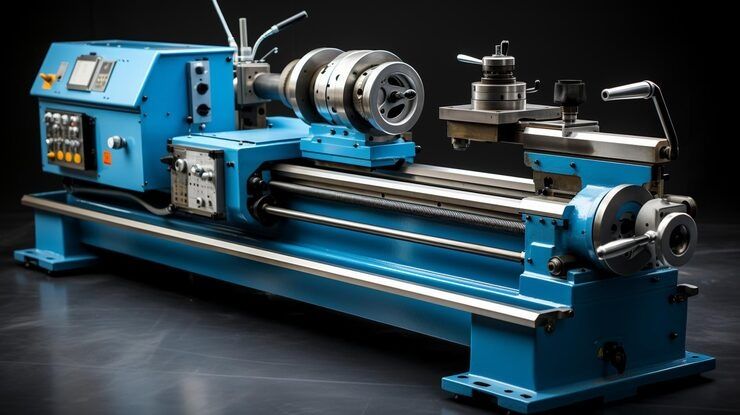
As smart manufacturing and Industry 4.0 continue to transform production environments, industrial lathe machines remain a cornerstone of precision machining. This guide explains how industrial lathe machines work, the different turning technologies available, precision machining systems, and their industrial applications.
What Are Industrial Lathe Machines?
Industrial lathe machines are machine tools used to remove material from a rotating workpiece using stationary cutting tools. This machining process, commonly known as turning, creates precise cylindrical shapes, threads, grooves, tapers, and other machined features required for industrial components.
Lathe machines process a wide variety of materials, including steel, stainless steel, aluminum, brass, copper, titanium, engineering plastics, and composite materials.
A typical industrial lathe system consists of several important components:
- Machine bed
- Headstock
- Spindle
- Chuck
- Tailstock
- Carriage assembly
- Tool post or turret
- Lead screw and feed system
- Control system
Together, these components provide stable, accurate, and efficient machining throughout the manufacturing process.
Why Industrial Lathe Machines Are Important
Precision-machined components are essential in nearly every manufacturing industry. Industrial lathe machines provide the dimensional accuracy, surface finish, and repeatability required for producing high-quality mechanical parts.
Modern turning systems also improve production efficiency by automating repetitive machining operations while reducing manual intervention.
Some important advantages include:
- High machining accuracy
- Excellent surface finish
- Consistent production quality
- Efficient material removal
- Reliable continuous operation
These advantages have made industrial lathe machines indispensable in precision manufacturing.
Types of Industrial Lathe Machines
Different machining applications require specialized lathe designs depending on workpiece size, production volume, and machining complexity.
Engine Lathes
Engine lathes are traditional manually operated machines used for general-purpose machining.
They are widely used in maintenance workshops, tool rooms, educational institutions, and small-scale manufacturing operations.
CNC Lathe Machines
Computer Numerical Control (CNC) lathes automate machining operations through programmed instructions.
These machines provide exceptional accuracy, repeatability, and productivity while reducing setup time and operator involvement.
Turret Lathes
Turret lathes feature multiple cutting tools mounted on a rotating turret.
They enable rapid tool changes, making them suitable for medium- to high-volume production of repetitive components.
Vertical Lathe Machines
Vertical lathes hold the workpiece vertically instead of horizontally.
They are commonly used for machining large, heavy components such as turbine casings, bearings, industrial valves, and large rings.
Swiss-Type Lathes
Swiss-type lathes are designed for manufacturing small, high-precision components.
They are widely used in medical device manufacturing, electronics, aerospace, and watchmaking industries.
Multi-Spindle Lathes
Multi-spindle lathes machine several workpieces simultaneously.
These machines significantly increase production output and are commonly used in mass production environments.
How Industrial Lathe Machines Work
Although lathe configurations vary, most turning operations follow a similar machining sequence.
Workpiece Setup
The raw material is securely mounted in the chuck or between centers.
Proper alignment ensures dimensional accuracy throughout machining.
Machine Programming or Setup
For CNC machines, machining programs define spindle speed, feed rate, cutting path, and tool movements.
Manual lathes require operator adjustments before machining begins.
Material Removal
The spindle rotates the workpiece while cutting tools remove material according to programmed or manual movements.
Multiple machining operations may be performed during a single setup.
Finishing Operations
After rough machining, finishing tools improve dimensional accuracy and surface quality.
Operations such as threading, grooving, chamfering, and polishing may also be completed.
Quality Inspection
Finished components undergo dimensional inspection using precision measuring equipment before moving to assembly or additional manufacturing processes.
Precision Machining Technologies
Modern industrial lathes incorporate advanced technologies that improve machining performance and productivity.
CNC Programming
CNC technology allows complex machining operations to be programmed with exceptional accuracy.
Programs can be stored, modified, and reused for consistent production.
Live Tooling
Live tooling enables rotating cutting tools to perform milling, drilling, and tapping operations directly on the lathe.
This reduces secondary machining operations and improves manufacturing efficiency.
Automatic Tool Changers
Automatic tool changers rapidly switch between cutting tools without interrupting production.
This increases productivity while minimizing downtime.
High-Speed Machining
Advanced spindle systems support high rotational speeds that improve machining efficiency and surface finish while reducing cycle times.
Turning Systems
Modern turning systems combine several technologies to improve machining accuracy and operational flexibility.
Precision Spindle Systems
High-performance spindles provide stable rotation with minimal vibration.
This improves dimensional accuracy and extends tool life.
Servo Drive Systems
Servo motors precisely control spindle speed and axis movement.
These systems ensure smooth machining even during complex operations.
Automatic Bar Feeders
Bar feeders continuously supply raw material to CNC lathes during production.
Automation increases productivity while reducing manual loading requirements.
Tool Monitoring Systems
Modern lathes monitor cutting tool condition, wear, and machining performance in real time.
This improves product quality while reducing unexpected tool failures.
Comparison of Common Industrial Lathe Machines
Each lathe type is designed for specific manufacturing requirements.
| Lathe Machine | Primary Features | Typical Applications | Production Volume |
|---|---|---|---|
| Engine Lathe | Manual operation | General machining | Low |
| CNC Lathe | Computer-controlled | Precision manufacturing | High |
| Turret Lathe | Multiple cutting tools | Repetitive production | Medium to High |
| Vertical Lathe | Vertical spindle | Large industrial components | Medium |
| Swiss-Type Lathe | Ultra-precision machining | Medical and electronics | High |
| Multi-Spindle Lathe | Simultaneous machining | Mass production | Very High |
Automation Technologies in Lathe Machines
Modern industrial lathes increasingly integrate intelligent manufacturing technologies.
Programmable CNC Controls
Advanced CNC controllers coordinate spindle movement, tool paths, feed rates, and machining operations with exceptional precision.
Industrial Robotics
Robotic loading and unloading systems automate material handling while improving production efficiency.
Robots also assist with component inspection and palletizing operations.
Machine Vision Systems
Vision systems verify workpiece positioning, inspect finished parts, and detect machining defects during production.
Industrial Internet of Things
IIoT platforms collect machining data from connected equipment.
Manufacturers can monitor spindle utilization, machine health, production output, and maintenance requirements remotely.
Industrial Applications
Industrial lathe machines support manufacturing across numerous sectors.
Automotive Manufacturing
Automotive manufacturers machine engine components, transmission shafts, brake parts, steering components, and suspension systems.
Aerospace Industry
Aerospace companies use precision lathes to manufacture turbine shafts, landing gear components, fasteners, and structural parts.
Oil and Gas Industry
Lathe machines produce valves, flanges, pipe fittings, drilling equipment, and pump components for demanding operating environments.
Medical Device Manufacturing
Medical manufacturers machine surgical instruments, orthopedic implants, dental components, and diagnostic equipment with exceptional precision.
General Engineering
Machine shops use industrial lathes to manufacture gears, couplings, rollers, bushings, shafts, and custom mechanical components.
Energy Industry
Power generation facilities use lathe machines to manufacture turbine components, generator shafts, bearings, and heavy industrial equipment.
Benefits of Industrial Lathe Machines
Modern turning systems provide numerous manufacturing advantages.
Some important benefits include:
- High dimensional accuracy
- Excellent repeatability
- Faster production cycles
- Reduced material waste
- Greater manufacturing flexibility
These advantages help manufacturers improve productivity while maintaining superior machining quality.
Challenges in Lathe Machining
Although industrial lathe machines are highly reliable, maintaining consistent machining performance requires proper setup, tooling, and maintenance.
Common challenges include cutting tool wear, vibration, thermal expansion, improper workpiece clamping, coolant management, and programming errors.
Routine calibration, preventive maintenance, tool monitoring, and proper machining parameter selection help improve accuracy while extending machine life.
Recent Developments (2024–2026)
Recent years have introduced significant advancements in industrial turning technology.
Manufacturers are increasingly adopting artificial intelligence to optimize cutting parameters and monitor machining performance in real time. Digital twin technology allows engineers to simulate machining operations before production, reducing setup time and improving process planning.
Hybrid CNC lathes equipped with milling capabilities are becoming more common, enabling multiple machining operations within a single setup. Intelligent tool monitoring systems now predict tool wear before failure occurs, helping minimize downtime and improve production consistency.
Energy-efficient spindle drives, automatic chip management systems, and collaborative robotic loading cells are also improving manufacturing flexibility while supporting smart factory initiatives.
Safety Standards and Industry Guidelines
Industrial lathe machines operate under recognized machinery safety and workplace regulations designed to protect operators and maintain reliable production.
Important safety practices include:
- Machine guarding around rotating components
- Emergency stop systems
- Proper workpiece clamping
- Regular spindle and tooling inspections
- Routine maintenance and lubrication
Manufacturers generally design lathe machines according to internationally recognized machine tool safety standards. In India, industrial facilities also consider applicable Bureau of Indian Standards (BIS) requirements together with occupational safety regulations governing machine tool operation.
Tools and Resources
Several technologies support efficient lathe machining and machine maintenance.
Common resources include:
- CAD/CAM software
- CNC programming platforms
- Tool presetting equipment
- Digital measuring instruments
- Tool condition monitoring systems
- Production monitoring software
These technologies improve machining accuracy, reduce setup time, and support efficient manufacturing operations.
Frequently Asked Questions
What are industrial lathe machines used for?
Industrial lathe machines are used to machine cylindrical components by rotating the workpiece while cutting tools remove material with high precision.
What is the difference between a CNC lathe and a manual lathe?
A CNC lathe operates through computer programming for automated, high-precision machining, while a manual lathe requires direct operator control throughout the machining process.
Which materials can be machined on industrial lathes?
Industrial lathes can machine steel, stainless steel, aluminum, brass, copper, titanium, plastics, engineering polymers, and composite materials.
What industries use industrial lathe machines?
Industrial lathes are widely used in automotive, aerospace, medical, oil and gas, energy, defense, electronics, and general engineering industries.
How does automation improve lathe machining?
Automation improves production speed, machining accuracy, tool management, quality consistency, and overall manufacturing efficiency while reducing manual intervention.
Future Trends in Industrial Lathe Machines
Industrial turning technology continues to advance through artificial intelligence, smart automation, and digital manufacturing.
Future lathe machines are expected to incorporate autonomous machining optimization, AI-assisted programming, cloud-connected production monitoring, and advanced predictive maintenance capabilities. Greater integration with robotics, collaborative automation, and digital twin platforms will further improve machining efficiency and production flexibility.
As manufacturers continue embracing Industry 4.0 and intelligent manufacturing systems, industrial lathe machines will remain one of the most important technologies supporting precision engineering and high-quality industrial production.
Conclusion
Industrial lathe machines remain one of the most versatile and essential machine tools in modern manufacturing. Through advanced precision machining technologies, intelligent turning systems, and automated CNC controls, they enable manufacturers to produce high-quality components with exceptional accuracy, efficiency, and consistency.
As machining technologies continue evolving through artificial intelligence, digital monitoring, and smart factory integration, industrial lathe machines will continue to play a central role in precision manufacturing across industries ranging from automotive and aerospace to medical devices and energy production.