Industrial ventilation systems are engineered to control airflow, remove airborne contaminants, regulate indoor air conditions, and support safer and more efficient industrial environments. These systems are used across manufacturing plants, warehouses, chemical facilities, pharmaceutical production areas, food-processing plants, and other industrial workplaces.
Modern industrial ventilation combines fans, ductwork, air-cleaning equipment, filtration technologies, sensors, controls, and air-handling equipment. System design depends on the facility layout, production processes, contaminants, temperature conditions, required airflow, and applicable ventilation standards.
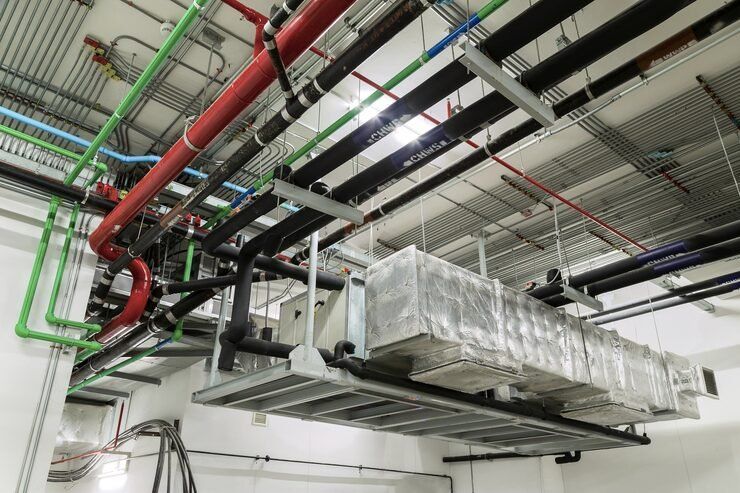
Why Industrial Ventilation Systems Matter
Industrial production can generate dust, fumes, smoke, vapors, heat, gases, and other airborne substances. Without suitable airflow management, these contaminants can accumulate around production areas.
Industrial ventilation systems can help:
Remove airborne contaminants
Control heat and humidity
Improve indoor air movement
Capture dust and fumes at their source
Support cleaner production environments
Reduce contaminant migration between work areas
Maintain controlled airflow conditions
Integrate ventilation with automated facility controls
Ventilation requirements vary considerably between applications, so systems are normally engineered according to process conditions and facility requirements.
Types of Industrial Ventilation Systems
General Dilution Ventilation
General ventilation introduces fresh air while removing contaminated or heated air from a facility. It is commonly used in warehouses, workshops, assembly areas, and manufacturing buildings.
Local Exhaust Ventilation
Local exhaust ventilation captures contaminants close to their source before they disperse throughout the workplace. Capture hoods, extraction arms, ducts, fans, and filtration equipment can form part of these systems.
Dust Extraction Systems
Dust extraction systems are designed to collect particulate matter generated during cutting, grinding, sanding, crushing, mixing, and material-handling operations.
Fume Extraction Systems
Fume extraction systems remove airborne fumes produced by processes such as welding, thermal treatment, metal processing, and chemical operations.
Smoke Extraction Systems
Smoke extraction equipment manages smoke movement and removal in facilities where industrial processes can generate significant smoke or combustion products.
Industrial Air Filtration Systems
Air filtration systems use filters or separation technologies to remove particulate contaminants from air streams. Filter selection depends on particle size, concentration, airflow, temperature, and process conditions.
Industrial Ventilation Equipment
An industrial ventilation installation can contain multiple interconnected components.
Industrial Fans
Fans generate the pressure differential needed to move air through ducts, filters, hoods, and exhaust outlets. Common configurations include axial fans, centrifugal fans, radial fans, and high-pressure industrial fans.
Air Handling Units
Industrial air handling units can combine filtration, heating, cooling, humidification, dehumidification, and air circulation functions.
Ducting Systems
Ductwork transports air between collection points, filtration equipment, fans, and discharge locations. Duct design considers airflow velocity, pressure losses, material compatibility, and maintenance access.
Filtration Equipment
Depending on the contaminant, ventilation systems may use cartridge filters, bag filters, HEPA filters, activated-carbon systems, cyclonic separators, or other separation technologies.
Exhaust Hoods
Hoods are positioned near contamination sources to capture dust, fumes, vapors, or heat before they spread through the facility.
Dampers and Control Devices
Dampers regulate airflow through different sections of the ventilation network. Automated dampers can be integrated with sensors and control systems.
Industrial Ventilation Technologies
Mechanical Ventilation
Mechanical ventilation uses powered fans and air-moving equipment to control airflow. It provides greater control than passive airflow arrangements and can be designed for specific production environments.
Source Capture Technology
Source capture places extraction equipment close to the contaminant-generation point. This approach can reduce the amount of contaminated air that must be moved through a facility.
Air Recirculation
Some facilities use controlled air recirculation after suitable treatment. Filtration and contaminant monitoring are important considerations when designing recirculation systems.
Variable Air Volume Control
Variable air volume systems adjust airflow according to process demand. Sensors and variable-frequency drives can regulate fan operation and reduce unnecessary energy consumption.
Automated Ventilation Control
Modern ventilation systems can integrate sensors, programmable controllers, building management systems, and industrial automation platforms. These technologies allow airflow to respond to temperature, pressure, particulate concentration, occupancy, or production conditions.
Manufacturing Process of Industrial Ventilation Equipment
Manufacturing methods depend on the equipment category.
1. Engineering and Design
Manufacturers establish airflow requirements, pressure conditions, material specifications, equipment dimensions, and operating parameters.
2. Material Selection
Common materials include galvanized steel, carbon steel, stainless steel, aluminum, plastics, and specialized coated materials.
3. Sheet Metal Fabrication
Ducts, housings, casings, hoods, and other components can be produced through cutting, bending, forming, punching, and rolling operations.
4. Welding and Assembly
Structural components, fan housings, frames, duct sections, and equipment bodies are assembled using welding, bolting, riveting, or other joining techniques.
5. Surface Treatment
Components may undergo painting, powder coating, galvanizing, passivation, or other surface treatments depending on environmental and corrosion requirements.
6. Fan and Motor Integration
Fans are assembled with motors, bearings, shafts, impellers, couplings, guards, and drive systems.
7. Filtration Integration
Filter housings, cartridges, bags, separators, and cleaning mechanisms are installed according to the intended application.
8. Testing and Quality Inspection
Manufacturers can conduct dimensional inspection, airflow testing, pressure testing, vibration checks, electrical testing, and other quality-control procedures.
Global Manufacturers and Suppliers
The industrial ventilation market includes manufacturers and suppliers specializing in fans, air handling equipment, dust collectors, filtration systems, ductwork, controls, and complete ventilation installations.
Examples of established companies active in industrial air movement and ventilation-related equipment include:
FläktGroup
Systemair
Greenheck
Howden
Munters
Supplier capabilities vary by region and product category. Industrial buyers commonly evaluate airflow capacity, pressure performance, materials, filtration efficiency, controls, certifications, maintenance requirements, and integration capabilities.
Industrial Applications
Industrial ventilation systems are used across many sectors.
Manufacturing
Factories use ventilation for dust control, heat removal, fume extraction, and process-air management.
Metalworking
Grinding, welding, cutting, casting, and machining operations can require localized extraction and particulate-control systems.
Chemical Processing
Chemical facilities may require specialized ventilation for vapors, gases, temperature control, and contamination management.
Pharmaceutical Manufacturing
Controlled production environments can require carefully managed airflow, filtration, pressure relationships, and contamination control.
Food Processing
Ventilation can help manage heat, humidity, airborne particles, odors, and process emissions.
Warehousing
Large warehouses may require air circulation, temperature management, smoke control, and ventilation around specific operations.
Automotive Manufacturing
Automotive facilities use ventilation for painting, welding, assembly, machining, and other production processes.
Factors to Consider When Selecting a System
Important technical considerations include:
Required airflow: Determine the volume of air that must be moved or replaced.
Contaminant characteristics: Identify dust, fumes, vapors, gases, heat, or other emissions.
Capture requirements: Determine whether contaminants need to be captured at the source.
Filtration: Select appropriate filtration or separation technology.
Pressure: Account for duct resistance, filters, hoods, dampers, and other components.
Materials: Choose materials compatible with temperature, moisture, chemicals, and corrosion conditions.
Controls: Consider sensors, variable-speed drives, PLCs, and automated monitoring.
Maintenance: Provide access for filter replacement, inspection, cleaning, and repairs.
Energy consumption: Evaluate fan efficiency and airflow-control strategies.
Standards: Confirm applicable workplace, environmental, electrical, fire, and building requirements.
Industrial Ventilation System Comparison
| System Type | Primary Function | Typical Application |
|---|---|---|
| General ventilation | Air dilution and circulation | Warehouses and factories |
| Local exhaust | Source contaminant capture | Welding and machining |
| Dust extraction | Particulate removal | Grinding and woodworking |
| Fume extraction | Fume capture | Welding and thermal processes |
| Smoke extraction | Smoke management | Industrial process areas |
| Air filtration | Airborne particle removal | Manufacturing environments |
| Air handling | Conditioned air distribution | Controlled facilities |
| Automated ventilation | Demand-based airflow control | Smart factories |
Future Trends in Industrial Ventilation
Industrial ventilation is increasingly connected with digital monitoring and automation. Sensors can provide real-time information about airflow, pressure, temperature, humidity, particulate levels, and filter conditions.
Predictive maintenance can also use operating data to identify abnormal fan vibration, rising pressure drop, declining airflow, or other equipment conditions.
Energy optimization is another important development. Variable-frequency drives, demand-controlled ventilation, high-efficiency fans, improved filtration, and automated controls can help facilities manage ventilation according to actual operating requirements.
FAQs
What is an industrial ventilation system?
An industrial ventilation system is an engineered arrangement of fans, ducts, filtration equipment, hoods, controls, and related components used to manage airflow and airborne contaminants in industrial facilities.
What are the main types of industrial ventilation?
Common types include general dilution ventilation, local exhaust ventilation, dust extraction, fume extraction, smoke extraction, air filtration, and automated ventilation systems.
What equipment is used in industrial ventilation?
Typical equipment includes industrial fans, air handling units, ductwork, exhaust hoods, filters, dampers, sensors, motors, variable-frequency drives, and control systems.
How are industrial ventilation systems manufactured?
Manufacturing can involve engineering design, material preparation, sheet-metal fabrication, forming, welding, surface treatment, component assembly, filtration integration, electrical installation, and performance testing.
Where are industrial ventilation systems used?
They are used in manufacturing, metalworking, chemical processing, pharmaceutical production, food processing, automotive plants, warehouses, power facilities, and other industrial environments.
Conclusion
Industrial ventilation systems combine air movement, contaminant capture, filtration, exhaust, conditioning, and control technologies to manage industrial air environments. System architecture varies according to production processes, contaminants, facility size, airflow requirements, and operating conditions.
Advances in automation, sensor technology, energy-efficient equipment, filtration, and digital monitoring are expanding the capabilities of modern ventilation systems. Understanding equipment types, manufacturing processes, ventilation technologies, and application requirements helps industrial facilities develop systems suited to their specific operating conditions.