Precision casting machinery includes specialized machines and equipment used to produce metal components with controlled dimensions, complex geometries, and consistent surface characteristics. These systems support processes such as investment casting, wax pattern production, melting, mold preparation, casting, heat treatment, finishing, and inspection.
Precision casting is widely used when components require intricate shapes and controlled dimensional tolerances. Machinery selection depends on alloy type, component geometry, production volume, automation requirements, and quality specifications.
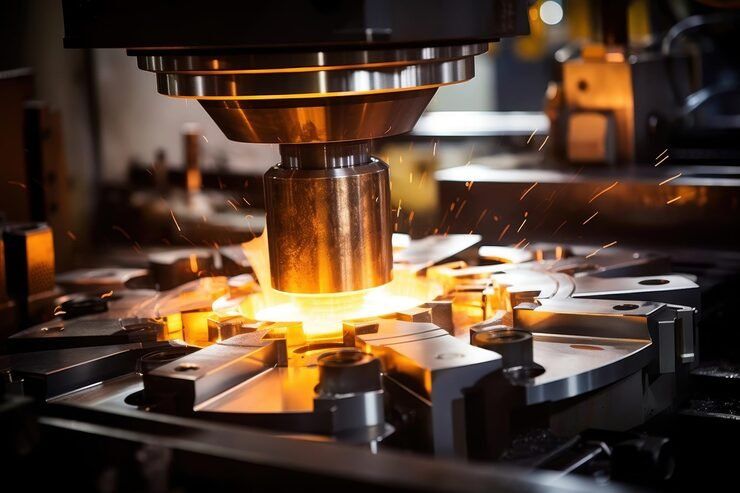
Why Precision Casting Machinery Matters
Precision casting machinery helps manufacturers produce complex metal components while controlling repeatability throughout the production cycle. Automated equipment can reduce variation between production batches and improve process monitoring.
The equipment can also support the production of components that would be difficult or inefficient to manufacture through conventional machining alone.
Industries using precision casting include aerospace, automotive, medical equipment, energy, industrial machinery, defense equipment, and general engineering.
Types of Precision Casting Machinery
Different stages of the casting process require specialized equipment.
Wax Injection Machines
Wax injection machines create accurate wax patterns used in investment casting. Controlled temperature, injection pressure, and cycle timing help maintain pattern consistency.
Melting Furnaces
Melting furnaces heat alloys to their required casting temperatures. Equipment configurations vary according to the metal, production capacity, atmosphere requirements, and temperature range.
Vacuum Casting Machines
Vacuum casting machinery helps control atmospheric conditions during melting and casting. These systems can be particularly useful for alloys that are sensitive to oxidation or contamination.
Ceramic Shell Equipment
Investment casting requires ceramic shell molds around wax patterns. Shell-building equipment supports slurry application, stucco coating, drying, and controlled shell formation.
Heat Treatment Equipment
Heat treatment furnaces modify the mechanical properties and microstructure of cast components. Processes can include annealing, solution treatment, aging, and stress relief.
Inspection Equipment
Dimensional measurement, X-ray inspection, ultrasonic testing, surface inspection, and other technologies can be integrated into quality-control workflows.
Precision Casting Technologies
Several casting technologies are used depending on the component and alloy.
| Technology | Typical Characteristics |
|---|---|
| Investment casting | Complex shapes and controlled dimensions |
| Vacuum casting | Controlled atmosphere and reduced oxidation |
| Lost-wax casting | Detailed component reproduction |
| Centrifugal casting | Rotational casting for selected geometries |
| Pressure-assisted casting | Controlled filling and solidification |
| Automated casting | Higher process repeatability |
Investment casting is particularly associated with complex components because wax patterns can reproduce detailed geometries before the ceramic shell is formed.
Precision Casting Manufacturing Process
The manufacturing process generally follows several stages.
1. Pattern Production
A wax or polymer pattern is produced using an injection machine or another controlled pattern-forming process.
2. Pattern Assembly
Individual patterns can be attached to a central runner system to create a casting tree. The configuration depends on component dimensions and production requirements.
3. Ceramic Shell Formation
The pattern assembly is repeatedly coated with ceramic slurry and refractory material. Controlled drying creates the required mold shell.
4. Wax Removal
The completed shell undergoes a dewaxing process. Steam autoclaves or other controlled heating systems can remove the pattern material.
5. Preheating and Melting
The ceramic shell may be heated before molten alloy is introduced. The selected alloy is melted in a suitable furnace under controlled conditions.
6. Metal Casting
Molten metal enters the ceramic mold and fills the component cavity. Process parameters influence filling behavior, solidification, porosity, and final quality.
7. Shell Removal and Finishing
After solidification, the ceramic shell is removed. Components may then undergo cutting, grinding, blasting, heat treatment, and surface finishing.
8. Inspection
Finished castings can be examined for dimensional accuracy, surface defects, internal discontinuities, and material characteristics.
Automation in Precision Casting
Automation is increasingly used throughout precision casting production. Robotic systems can handle patterns, casting assemblies, molds, and finished components.
Automated material handling can reduce manual handling requirements, while sensors and digital controllers can monitor temperature, pressure, cycle time, and other process variables.
Machine vision can support surface inspection, while digital production systems can record process data for quality analysis and traceability.
Precision Casting Machinery Comparison
| Equipment | Main Function | Typical Application |
|---|---|---|
| Wax injection machine | Pattern production | Investment casting |
| Melting furnace | Alloy melting | Foundries |
| Vacuum casting system | Controlled casting | Sensitive alloys |
| Shell-building equipment | Mold preparation | Investment casting |
| Heat treatment furnace | Property modification | Metal components |
| Inspection equipment | Quality verification | Precision components |
Cost Factors
The cost of precision casting machinery depends on equipment capacity, automation level, furnace technology, temperature requirements, materials compatibility, control systems, inspection capabilities, and production volume.
A basic machine configuration may be suitable for smaller production requirements, while an integrated production line can include pattern production, shell preparation, melting, casting, finishing, heat treatment, and inspection equipment.
Additional factors such as installation, facility requirements, tooling, maintenance, energy consumption, and operator training can also affect the overall project budget.
Industrial Applications
Precision casting machinery supports production across multiple sectors:
Aerospace components
Automotive components
Medical equipment
Industrial pumps and valves
Energy equipment
Turbine components
Defense-related hardware
Industrial machinery
Engineering components
Complex stainless-steel parts
Aerospace and energy applications can require particularly strict dimensional, material, and inspection controls because component performance may depend on consistent casting quality.
How to Select Precision Casting Machinery
Before selecting equipment, manufacturers generally evaluate:
Required casting process
Alloy and material requirements
Component dimensions
Production volume
Required dimensional tolerance
Furnace capacity
Automation requirements
Inspection requirements
Facility and energy requirements
Future production scalability
Equipment should be matched to the complete production workflow rather than evaluated as an isolated machine. Compatibility between pattern production, mold preparation, melting, casting, finishing, and inspection can influence overall manufacturing efficiency.
Frequently Asked Questions
What is precision casting machinery?
Precision casting machinery consists of specialized equipment used for pattern production, mold preparation, melting, casting, finishing, heat treatment, and inspection of precision metal components.
What machines are used in investment casting?
Common equipment includes wax injection machines, ceramic shell systems, dewaxing equipment, melting furnaces, casting systems, heat treatment furnaces, and inspection equipment.
What metals can be used with precision casting machinery?
Depending on equipment configuration, precision casting can process alloys such as stainless steel, carbon steel, aluminum alloys, nickel-based alloys, cobalt-based alloys, and other engineering metals.
How does automation improve precision casting?
Automation can improve process repeatability, material handling, data collection, temperature control, inspection, and production consistency.
Which industries use precision casting?
Aerospace, automotive, energy, medical equipment, industrial machinery, pumps, valves, and engineering industries commonly use precision-cast components.
Conclusion
Precision casting machinery combines pattern-production systems, ceramic-shell equipment, melting technology, casting systems, heat treatment, automation, and inspection equipment into a controlled manufacturing workflow. Advances in automation, digital monitoring, composite tooling, furnace control, and inspection technologies are expanding the capabilities of precision casting production.
Selecting appropriate machinery requires consideration of alloy characteristics, component geometry, production volume, quality requirements, automation level, and complete process integration.