Tunnel Boring Machines (TBMs) are powerful engineering systems used to excavate tunnels through soil, rock, and mixed ground conditions. These machines have transformed modern infrastructure development by making underground construction safer, faster, and more efficient.
From metro rail networks and highway tunnels to water transport systems and underground utilities, TBMs play a crucial role in large-scale construction projects across the world.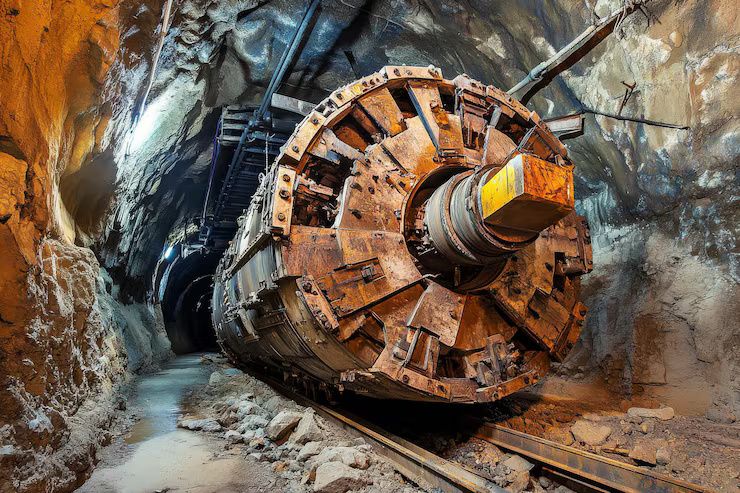
This guide explains the types of tunnel boring machines, their working mechanism, engineering applications, and how they support modern infrastructure development.
What Is a Tunnel Boring Machine?
A Tunnel Boring Machine is a specialized piece of equipment designed to excavate tunnels with precision while minimizing surface disruption. Instead of traditional drilling and blasting methods, TBMs continuously cut through the ground using a rotating cutting head.
The machine simultaneously excavates soil, supports tunnel walls, and transports removed material out of the tunnel. This integrated process makes TBMs highly efficient for long and complex underground projects.
A typical TBM includes:
- Rotating cutter head
- Conveyor or slurry system
- Shield structure
- Hydraulic thrust system
- Control cabin
Each component works together to ensure safe and continuous tunnel excavation.
Why Tunnel Boring Machines Are Important
TBMs are widely used in modern infrastructure because they offer higher precision and safety compared to conventional excavation methods.
They help reduce environmental impact, improve construction speed, and ensure better structural stability during tunneling operations.
Some key advantages include:
- Minimal surface disruption
- High excavation efficiency
- Improved worker safety
- Accurate tunnel alignment
For example, in metro rail projects, TBMs allow tunnels to be constructed beneath densely populated urban areas without disturbing surface traffic or buildings.
Types of Tunnel Boring Machines
Different ground conditions require different types of TBMs. Each machine is designed to handle specific geological environments.
1. Earth Pressure Balance (EPB) Machines
EPB machines are commonly used in soft ground conditions such as clay, silt, and sand.
They maintain pressure at the tunnel face to prevent ground collapse while excavating material.
These machines are widely used in urban metro projects where surface stability is critical.
2. Slurry Shield Machines
Slurry shield TBMs use a pressurized slurry to stabilize the tunnel face during excavation.
The excavated material mixes with the slurry and is transported out of the tunnel through pipelines.
This method is ideal for loose or water-bearing soils.
3. Hard Rock TBMs
Hard rock TBMs are designed to excavate through solid rock formations.
They use strong disc cutters mounted on the rotating head to break rock into smaller fragments.
These machines are commonly used in mountain tunnels, hydroelectric projects, and transportation corridors.
4. Open Face TBMs
Open face TBMs are used in stable ground conditions where tunnel face support is not required.
They provide flexibility in simpler geological environments and are often used in shorter tunnel projects.
Working Mechanism of TBMs
The operation of a tunnel boring machine involves a continuous and highly coordinated process.
Excavation Process
The rotating cutter head breaks soil or rock at the tunnel face.
The cutting tools are designed based on ground conditions to ensure efficient excavation while maintaining stability.
Material Removal
Excavated material is transported out of the tunnel using conveyor belts or slurry pipelines depending on the TBM type.
This continuous removal system ensures uninterrupted excavation progress.
Tunnel Support System
As the machine moves forward, it installs precast concrete segments to support the tunnel walls.
These segments form a stable lining that prevents collapse and ensures long-term structural integrity.
Machine Advancement
Hydraulic jacks push the machine forward using the installed tunnel lining as a support base.
This step-by-step process allows the TBM to advance continuously through the ground.
Engineering Applications of Tunnel Boring Machines
TBMs are widely used in various engineering and infrastructure projects.
Metro and Rail Tunnels
Urban metro systems rely heavily on TBMs for underground construction.
These machines help build tunnels beneath cities without disrupting surface infrastructure or traffic flow.
Road and Highway Tunnels
TBMs are used to construct long road tunnels through mountains or beneath urban areas.
They provide safer and more efficient excavation compared to traditional blasting methods.
Hydroelectric Projects
In hydroelectric systems, TBMs are used to create water diversion tunnels and pressure shafts.
These tunnels play a key role in controlling water flow and supporting energy generation systems.
Utility and Water Tunnels
TBMs are also used for constructing underground pipelines, sewage systems, and water transport tunnels.
These systems help improve urban infrastructure and resource distribution.
Advantages of Tunnel Boring Machines
Tunnel boring technology offers several benefits for modern construction projects.
Key advantages include:
- Reduced surface disturbance
- Higher construction safety
- Continuous excavation process
- Improved tunnel quality and precision
These benefits make TBMs a preferred choice for large-scale underground infrastructure development.
Challenges in TBM Operations
Despite their advantages, TBM operations involve certain challenges.
One major challenge is high operational cost, as these machines require significant investment and maintenance.
Another challenge is geological uncertainty, as unexpected ground conditions can affect performance and progress.
Logistical planning and technical expertise are essential to ensure smooth operation throughout the project.
Future of Tunnel Boring Technology
Tunnel boring technology continues to evolve with advancements in automation, robotics, and digital monitoring systems.
Modern TBMs are increasingly equipped with sensors that monitor pressure, alignment, and machine performance in real time.
Artificial intelligence and predictive maintenance technologies are also being integrated to improve efficiency and reduce downtime.
These innovations are expected to make tunneling faster, safer, and more cost-effective in future infrastructure projects.
Conclusion
Tunnel Boring Machines have revolutionized underground construction by enabling efficient and precise excavation in diverse geological conditions. Their ability to build tunnels with minimal surface disruption makes them essential for modern infrastructure development.
As technology continues to advance, TBMs will play an even greater role in shaping transportation networks, urban infrastructure, and energy systems worldwide. Understanding their types, working mechanisms, and applications highlights their importance in modern engineering and construction industries.