
Turbine manufacturing is the industrial process of designing, producing, assembling, and testing machines that convert energy from moving fluids into mechanical rotation. These fluids may include steam, hot combustion gases, water, or wind-driven air. Turbines are widely used in electricity generation, aviation, industrial processing, renewable energy systems, and large-scale mechanical equipment.
A turbine generally contains a rotating assembly connected to blades or buckets that extract energy from a moving fluid. The rotating shaft can drive an electrical generator, compressor, pump, or other mechanical equipment. The design varies according to the energy source, operating temperature, pressure, rotational speed, and intended application.
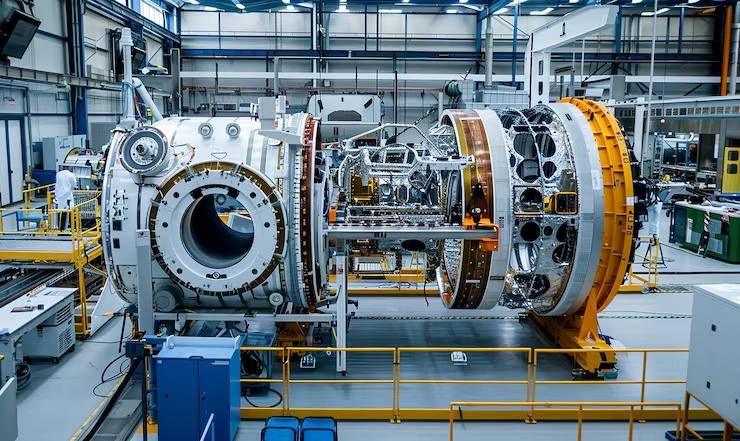
Turbine manufacturing combines mechanical engineering, metallurgy, precision machining, materials science, fluid dynamics, and quality assurance. Components must be manufactured to specified dimensions and material properties because small defects or dimensional variations can affect performance, reliability, and operational safety.
How turbines convert energy
Turbines operate by transferring energy from a moving fluid to a rotating rotor. The exact process depends on the turbine type and the characteristics of the fluid.
In a steam turbine, pressurized steam expands through stationary and rotating blade passages, transferring energy to the rotor. In a gas turbine, hot combustion gases expand through turbine stages after passing through the combustion system. In a hydraulic turbine, flowing or falling water transfers energy to a runner, while wind turbines use aerodynamic forces on their blades to produce rotation.
The rotating shaft transfers mechanical power to connected equipment. When connected to an electrical generator, this rotation produces electricity through electromagnetic induction.
Main types of industrial turbines
Different turbine designs are suited to different energy sources and operating environments.
Steam turbines: Use expanding steam to produce mechanical power. They are common in thermal power plants, industrial cogeneration facilities, and some process industries.
Gas turbines: Use hot gases produced by combustion to drive a rotor. They are used in power generation, aircraft propulsion, and certain industrial applications.
Hydraulic turbines: Convert the energy of flowing or falling water into rotation. Common designs include Francis, Kaplan, and Pelton turbines.
Wind turbines: Capture energy from moving air through rotor blades and convert it into mechanical and electrical power.
Microturbines: Small gas turbine systems used in certain distributed power generation and combined heat and power applications.
Marine turbines: Include steam and gas turbine systems used in selected marine propulsion and power applications.
Each category requires different engineering methods, materials, manufacturing equipment, and testing procedures.
Importance of Turbine Manufacturing
Turbine manufacturing plays an important role in electricity production, transportation, industrial processing, and renewable energy development. Turbines help convert energy from fuels, water, and wind into useful mechanical power. Their performance affects power generation, equipment availability, fuel utilization, and the reliability of connected systems.
Power stations use turbines to drive generators, while aircraft gas turbines produce the thrust required for flight. Industrial facilities may use steam turbines to generate electricity or recover energy from steam systems. Wind and hydroelectric turbines support electricity generation from renewable energy sources.
Industrial applications of turbines
Turbines are used across several major industries:
Power generation: Steam and gas turbines drive generators in electricity-producing facilities.
Aviation: Gas turbines provide propulsion for commercial aircraft, military aircraft, and certain helicopters.
Oil and gas: Turbines drive compressors and generators used in processing facilities and pipeline infrastructure.
Chemical manufacturing: Steam turbines can provide mechanical power for compressors and other large equipment.
Hydroelectric power: Hydraulic turbines convert water energy into rotational power for electrical generation.
Wind energy: Wind turbines convert aerodynamic energy into electricity through a generator system.
Marine engineering: Selected turbine systems support propulsion and onboard power generation.
Industrial cogeneration: Steam and gas turbines can generate electricity alongside useful heat for industrial processes.
Why manufacturing precision matters
Turbines often operate under demanding conditions involving high rotational speeds, temperature changes, pressure differences, and repeated mechanical loading. Components must maintain suitable strength, dimensional accuracy, and resistance to fatigue, corrosion, oxidation, or erosion.
Blade geometry is particularly important because it influences how efficiently energy transfers from the fluid to the rotor. Imbalances, cracks, material defects, or incorrect clearances can contribute to vibration, reduced performance, and mechanical damage.
Manufacturing quality also affects maintenance requirements and operating life. For this reason, turbine production involves documented material inspection, controlled machining, dimensional verification, balancing, and testing.
Turbine manufacturing compared with conventional machinery production
Turbines share manufacturing processes with other industrial machines, but their operating conditions often demand specialized controls.
Manufacturing factor | Turbine production requirement |
|---|---|
Material selection | Must match temperature, pressure, stress, and environmental conditions |
Machining | Maintains precise blade profiles, clearances, and shaft dimensions |
Joining | Requires suitable welding, brazing, or other qualified joining processes |
Balancing | Controls rotor mass distribution to limit vibration |
Inspection | Detects dimensional errors and internal or surface defects |
Testing | Evaluates mechanical, thermal, hydraulic, or aerodynamic performance |
Not every turbine requires the same manufacturing route. A wind turbine rotor, a hydraulic runner, and a high-temperature gas turbine have different material, structural, and performance requirements.
Turbine Manufacturing Processes
Turbine production involves multiple stages, beginning with engineering design and material selection and continuing through component manufacturing, assembly, and final verification. The sequence depends on turbine type, size, production volume, and operating environment.
Design and engineering
The design stage establishes the turbine's operating requirements, geometry, materials, and performance targets. Engineers use fluid dynamics, structural analysis, thermal calculations, and vibration analysis to evaluate how the equipment is expected to behave.
Computer-aided design (CAD) software creates three-dimensional models of components and assemblies. Computational fluid dynamics (CFD) helps analyze fluid flow through blades and passages, while finite element analysis (FEA) evaluates stresses, deformation, and thermal effects.
These simulations support engineering decisions, but they do not eliminate the need for physical testing and validation.
Material selection and preparation
Turbine components require materials suited to their operating conditions. Common material groups include carbon steel, alloy steel, stainless steel, nickel-based superalloys, titanium alloys, and specialized composite materials.
Material selection depends on factors such as:
Operating temperature and pressure.
Mechanical loading and fatigue resistance.
Corrosion, oxidation, and erosion exposure.
Weight restrictions and structural requirements.
Manufacturing methods and inspection needs.
Gas turbine blades exposed to extremely high temperatures may use nickel-based superalloys and specialized cooling designs. Hydraulic turbine components often require materials that withstand water exposure, mechanical stress, and potential cavitation damage. Wind turbine blades commonly use glass-fiber or carbon-fiber composites.
Casting, forging, and forming
Casting is used to create complex metal shapes by pouring molten material into a prepared mold. It is useful for certain turbine blades, housings, casings, and other components with intricate geometries.
Investment casting can produce detailed shapes and is used for selected gas turbine components. Specialized casting processes may control the grain structure of turbine blades intended for high-temperature operation.
Forging shapes heated metal through compressive forces. It is commonly used for shafts, discs, and other components that require suitable mechanical properties. Rolling, pressing, and other forming operations may also be used, depending on the part design.
Precision machining
Machining removes material to achieve the required dimensions, surface finish, and geometry. CNC milling, turning, grinding, drilling, and electrical discharge machining may be used during turbine production.
Blades often have complex curved surfaces that require multi-axis CNC machining or specialized manufacturing techniques. Shaft journals, bearing surfaces, and mating components also require close dimensional control.
After machining, components may undergo polishing, deburring, surface finishing, and dimensional inspection. These operations help confirm that the parts meet their specified design requirements.
Heat treatment and surface engineering
Heat treatment changes material properties through controlled heating and cooling. Depending on the alloy, processes may include annealing, quenching, tempering, solution treatment, and aging.
Surface treatments and protective coatings may improve resistance to oxidation, corrosion, erosion, or wear. Some gas turbine components use thermal barrier coatings to reduce the heat reaching the underlying metal. The selected treatment must be compatible with the component material and operating conditions.
Assembly and rotor balancing
After individual parts pass the necessary inspections, they are assembled into modules or complete turbine systems. Assembly may include installing blades, discs, shafts, bearings, seals, casings, and associated control components.
Rotor balancing helps reduce uneven mass distribution that can produce vibration during rotation. Depending on the design and operating requirements, balancing may take place at different assembly stages.
Final checks may include alignment verification, clearances, fastener inspection, lubrication arrangements, and control-system integration.
Production Technologies and Quality Control
Modern turbine manufacturing combines conventional metalworking with advanced production technologies. These methods help produce complex components, maintain dimensional consistency, and document quality throughout the manufacturing process.
Advanced manufacturing technologies
Several technologies are used in contemporary turbine production.
Multi-axis CNC machining: Produces complex blade profiles and precision components by controlling cutting tools along multiple axes.
Additive manufacturing: Builds selected components layer by layer from metal powders or other suitable materials. It can produce complex internal passages and specialized geometries, although qualification requirements depend on the component and application.
Robotic manufacturing: Supports repeatable welding, material handling, surface preparation, and certain inspection operations.
Non-destructive testing (NDT): Methods such as ultrasonic testing, radiographic testing, magnetic particle testing, and liquid penetrant testing help identify defects without destroying the inspected component.
Digital manufacturing systems: CAD, computer-aided manufacturing (CAM), production planning software, and digital inspection systems help coordinate design information with manufacturing operations.
Inspection and performance testing
Quality control takes place throughout the production process rather than only at the final stage. Raw materials may be checked for composition and mechanical properties, while machined components undergo dimensional inspection and suitable defect testing.
Final testing varies by turbine type. It may include rotor balancing, vibration measurements, pressure or leakage tests, hydraulic performance evaluation, and controlled operational testing. Gas turbine systems may also require specialized combustion, thermal, and mechanical verification.
Manufacturers maintain inspection records to support traceability and demonstrate compliance with applicable engineering specifications. Testing procedures must be appropriate for the component and its intended operating conditions.
Global Turbine Manufacturers and Suppliers
The global turbine industry includes companies specializing in turbine design, complete power systems, aircraft engines, wind energy equipment, hydroelectric machinery, and precision components. Their product ranges vary by technology and application.
Major companies in the turbine industry
Examples of internationally recognized companies operating in turbine-related markets include:
Siemens Energy: Develops gas turbines, steam turbines, and related power generation systems.
GE Vernova: Operates in gas power, steam power, and hydroelectric technologies.
Mitsubishi Heavy Industries: Manufactures power generation equipment, including gas and steam turbine systems.
Baker Hughes: Provides turbomachinery technologies used in energy and industrial applications.
Rolls-Royce: Develops gas turbine engines, particularly for aviation and selected power applications.
Andritz: Participates in hydropower equipment and hydraulic turbine technologies.
Vestas: Manufactures wind turbines and associated wind energy systems.
Nordex Group: Develops and manufactures wind turbine systems.
These companies operate in different segments, so they should not be considered interchangeable suppliers. Some focus on aviation engines, while others specialize in utility-scale power generation, hydropower, or wind energy.
Turbine components and supply chains
Turbine manufacturing depends on a broad supply chain that includes material producers, precision foundries, forging companies, machine shops, coating specialists, bearing manufacturers, control-system developers, and testing laboratories.
Component suppliers may manufacture blades, shafts, rotor discs, casings, seals, fasteners, and other specialized parts. Their capabilities depend on material qualifications, machining capacity, production tolerances, inspection methods, and the technical requirements of the turbine manufacturer.
Supplier evaluation commonly considers manufacturing experience, quality documentation, traceability, applicable certifications, delivery capability, and compliance with engineering specifications. Critical components may require additional qualification and inspection before being accepted into a turbine assembly.
Recent Developments in Turbine Manufacturing
From 2024 through 2026, turbine manufacturing has continued to evolve in response to power demand, renewable energy deployment, industrial efficiency requirements, and advances in materials and production technology.
Advanced materials and component production
Gas turbine development continues to focus on materials that withstand high temperatures, repeated loading, and demanding combustion environments. Nickel-based superalloys, thermal barrier coatings, improved cooling passages, and precision manufacturing methods remain important areas of engineering.
Additive manufacturing is also being explored for selected components, including parts with complex internal geometries. Its industrial use depends on material qualification, repeatable production, defect detection, and the ability to verify long-term performance.
Wind and hydroelectric turbine technologies
Wind turbine development includes larger rotor designs, improved blade structures, and manufacturing methods intended to support demanding offshore environments. Larger components also create challenges involving transport, installation, material use, and maintenance.
Hydroelectric turbine engineering continues to address hydraulic efficiency, cavitation, sediment erosion, and equipment modernization. Upgrading existing facilities can involve replacing runners, improving control systems, or refurbishing mechanical components.
Digital monitoring and predictive maintenance
Sensors and digital monitoring systems can track vibration, temperature, pressure, rotational speed, and other operating parameters. Data analysis can help identify abnormal conditions and support maintenance planning.
Digital twins can represent turbine components or complete systems for engineering analysis and operational monitoring. Their usefulness depends on model accuracy, reliable operating data, and appropriate validation against real equipment.
These technologies support inspection and maintenance decisions but do not remove the need for qualified personnel, established testing procedures, or physical examination where required.
Laws, Standards, and Safety Requirements
Turbine manufacturing is influenced by technical standards, workplace safety rules, environmental regulations, and industry-specific certification requirements. The applicable framework depends on turbine type, operating conditions, installation location, and intended use.
Important international standards
Several standards and technical codes are relevant to turbine design, manufacturing, testing, and operation.
ASME standards: Address specified mechanical engineering and pressure equipment requirements relevant to certain turbine systems and components.
ISO 9001: Establishes requirements for quality management systems used in manufacturing and other industries.
ISO 14001: Provides a framework for managing environmental impacts.
IEC 61400: Covers technical requirements for wind energy generation systems.
IEC 60034: Addresses rotating electrical machines, including relevant generator requirements.
API standards: Certain standards address turbines and turbomachinery used in petroleum, natural gas, and related industrial applications.
Not every standard applies to every turbine. Manufacturers must identify the relevant editions, contractual specifications, and regulatory requirements for each project.
Regulatory considerations in India
In India, turbine manufacturing and installation may be subject to applicable factory safety, electrical safety, environmental protection, and pressure equipment requirements. Power generation projects may also require approvals associated with grid connection, construction, and operation.
Wind and hydroelectric installations can involve additional environmental, land-use, and infrastructure requirements. Manufacturers and project operators must distinguish between product certification, factory compliance, and approvals required for a particular installation.
Quality management, material traceability, documented inspection, and qualified testing procedures are important parts of manufacturing compliance. The exact obligations depend on the equipment and its intended application.
Tools and Resources
Turbine engineering involves design software, production equipment, material testing, and inspection systems. These tools help engineers coordinate manufacturing activities and verify component quality.
Common engineering and manufacturing tools
CAD and CAM software: Used to design turbine components, prepare machining instructions, and manage engineering dimensions.
CFD software: Helps evaluate fluid flow, pressure distribution, heat transfer, and aerodynamic or hydraulic behavior.
FEA software: Supports analysis of structural stress, deformation, vibration, and thermal loading.
CNC machining systems: Produce precision shafts, discs, blades, and other components.
NDT equipment: Helps detect material defects using ultrasonic, radiographic, magnetic particle, or liquid penetrant techniques.
Condition monitoring systems: Collect operating data to identify changes in turbine vibration, temperature, pressure, and other parameters.
Factors involved in turbine selection
Selecting a turbine system requires consideration of the available energy source, required output, operating environment, maintenance requirements, and integration with other equipment. Engineers also evaluate material compatibility, efficiency across the expected operating range, noise, emissions where relevant, and applicable safety standards.
Frequently Asked Questions
What are the main types of turbines?
The main types include steam turbines, gas turbines, hydraulic turbines, wind turbines, and microturbines. Each converts energy from a different source into mechanical rotation.
How are turbine blades manufactured?
Turbine blades may be produced through investment casting, forging, precision machining, or other specialized processes. The method depends on the turbine type, blade geometry, material, and operating conditions.
Which materials are used in turbine manufacturing?
Common materials include alloy steel, stainless steel, nickel-based superalloys, titanium alloys, and composite materials. The selection depends on temperature, pressure, mechanical stress, corrosion exposure, and weight requirements.
What quality tests are performed on turbines?
Testing may include dimensional inspection, non-destructive testing, rotor balancing, vibration analysis, pressure testing, and operational performance evaluation. The required procedures depend on the turbine design and applicable standards.
What is the role of automation in turbine manufacturing?
Automation supports precision machining, robotic handling, welding, inspection, and production monitoring. It can improve process consistency, but manufacturing quality still depends on appropriate engineering controls, equipment maintenance, and inspection.
Conclusion
Turbine manufacturing combines engineering design, specialized materials, precision machining, assembly, and quality verification. Different turbine types serve applications ranging from electricity generation and aviation to industrial processing and renewable energy. Advanced manufacturing, digital monitoring, and improved materials continue to influence production methods and equipment development. Applicable standards, traceability, and testing remain essential to the reliability and safety of turbine systems.