A welding robot is a programmable mechanical system that performs welding operations with limited direct human control during the welding cycle.
It usually consists of a robotic arm, a welding torch, a power source, a controller, and safety equipment.
The robotic arm moves the torch along a programmed path while the welding system generates the heat needed to join metal parts. Depending on the application, the robot may use gas metal arc welding, gas tungsten arc welding, resistance spot welding, or laser welding technology.
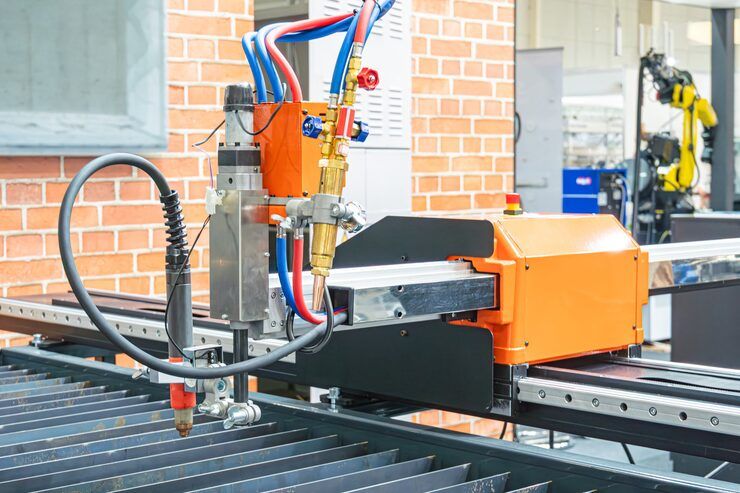
Welding robots can be installed in dedicated production cells or integrated into larger automated manufacturing lines. Some systems work independently, while others communicate with conveyors, positioners, inspection equipment, and production management software.
How Welding Robots Work
The welding process generally follows several steps:
- Component positioning: Metal parts are placed in a fixture that holds them in the correct position.
- Program execution: The controller directs the robotic arm along a predefined path.
- Welding operation: The torch or welding tool joins the components using the selected process.
- Process monitoring: Sensors and control systems monitor relevant parameters, such as torch position and welding current.
- Inspection: The completed joint is checked through visual examination or other appropriate inspection methods.
The quality of the final weld depends on several factors, including material type, joint preparation, welding parameters, fixture accuracy, and robot programming.
Main Types of Welding Robots
| Robot or system type | Main function | Common applications |
|---|---|---|
| Arc welding robots | Use an arc-based welding process | Frames, brackets, metal enclosures |
| Spot welding robots | Create localized welds between metal sheets | Vehicle bodies and sheet-metal assemblies |
| Laser welding robots | Direct a laser beam along a joint | Precision components and thin materials |
| Collaborative welding robots | Work in applications designed for collaboration with people | Small fabrication cells and flexible production |
| Gantry welding robots | Move along linear axes over large workpieces | Heavy structures and long metal assemblies |
Each type has different capabilities and operating requirements. The appropriate configuration depends on the component dimensions, material thickness, joint design, production volume, and required weld characteristics.
Importance: Why Welding Robots Matter
Consistency in Repetitive Production
Manual welding requires skill, concentration, and controlled hand movements. Repeating the same weld hundreds or thousands of times can be demanding, particularly when components have complex geometries.
A properly programmed welding robot can repeat a defined motion with consistent positioning. This helps reduce variation caused by repetitive manual movement. However, consistent robot movement does not automatically guarantee a sound weld. Correct programming, suitable welding parameters, material preparation, and inspection remain essential.
Productivity and Production Planning
Robotic welding can support continuous production by performing repetitive operations at a predictable pace. Production planners can coordinate robotic cells with component handling systems and other manufacturing equipment.
The actual production rate depends on the length of each weld, part-loading time, fixture changes, inspection requirements, and equipment availability. Some operations still require workers to load components, replace consumables, inspect joints, or respond to equipment alarms.
Worker Safety and Ergonomics
Welding involves intense light, heat, fumes, sparks, and electrical hazards. Robotic systems can move workers away from some repetitive welding activities, particularly when the process takes place inside an enclosed cell.
Automation does not eliminate workplace hazards. Personnel may still encounter risks during maintenance, programming, setup, cleaning, and troubleshooting. Proper ventilation, protective equipment, machine guarding, and safe isolation procedures are necessary.
Support for Complex Components
Robotic welding can follow programmed paths around curved surfaces, repeated joints, and complex assemblies. With suitable sensors and motion-control capabilities, certain systems can compensate for variations in component position or joint location.
These capabilities are useful when producing components that require repeatable weld placement, including automotive structures, agricultural equipment, industrial cabinets, and fabricated metal frames.
Recent Updates and Technology Trends
Sensor-Based Welding Control
Modern welding automation increasingly uses cameras, laser scanners, touch sensing, and other measurement technologies to identify component positions and joint locations.
For example, a vision system may detect a component that is slightly displaced from its expected position. The robot can then adjust its path if the hardware and control software support that function.
Sensor-based correction is especially useful when parts have small variations. However, the effectiveness of the system depends on sensor accuracy, surface conditions, calibration, and the type of joint being welded.
Artificial Intelligence and Adaptive Welding
Artificial intelligence and machine learning are being explored for weld monitoring, defect identification, process adjustment, and production analysis.
A monitoring system may analyze images or process signals to identify unusual conditions. An adaptive controller may use measured information to adjust certain welding parameters within defined limits.
These technologies should not be treated as replacements for qualified welding procedures or required inspection. Their performance must be validated for the particular materials, equipment, and production environment.
Digital Twins and Simulation
Simulation software allows engineers to create a digital representation of a robotic welding cell before installing the physical equipment. They can examine torch paths, robot reach, collision risks, cycle sequences, and equipment layout.
A digital twin may also use operating data from the real production system to help analyze performance. The level of detail varies: some models are primarily used for offline programming, while others incorporate live equipment data.
Collaborative Welding Systems
Collaborative robots are designed for applications where interaction between people and robots is considered during system design. They may support smaller fabrication operations that need to change products or welding paths frequently.
However, a collaborative robot is not automatically safe to operate beside a person while welding. The welding process introduces hazards from heat, radiation, fumes, sparks, and the surrounding equipment. A complete risk assessment and suitable protective measures are required.
Laws, Standards, and Safety Policies
Workplace Safety in India
Industrial welding operations in India must follow applicable occupational safety requirements, electrical safety provisions, environmental rules, and relevant state or industry-specific regulations.
The Occupational Safety, Health and Working Conditions Code, 2020 is an important part of India's occupational safety legislation framework. Its practical application depends on commencement notifications, applicable rules, and the circumstances of the workplace. Employers should confirm the current legal requirements that apply to their facility.
Factories using robotic welding equipment should establish procedures for machine guarding, operator training, maintenance, emergency response, ventilation, and control of hazardous energy.
International Robot Safety Standards
Several international standards are relevant to industrial robots and robotic welding cells.
- ISO 10218: Addresses safety requirements for industrial robots and robot applications.
- ISO/TS 15066: Provides supplementary guidance for collaborative robot applications.
- IEC 60204-1: Covers electrical equipment of machinery.
- ISO 3834: Addresses quality requirements for fusion welding of metallic materials.
The appropriate standards depend on the robot, the welding process, the application, and the jurisdiction. Organizations should consult current editions and determine which standards are applicable rather than assuming that every document applies to every installation.
Essential Safety Measures
A robotic welding cell should be designed around a documented risk assessment. Typical measures include:
- Physical barriers, interlocked gates, and suitable presence-sensing devices.
- Emergency-stop controls positioned for accessible use.
- Proper extraction and ventilation for welding fumes.
- Protection from arc radiation, sparks, hot surfaces, and electrical hazards.
- Lockout and isolation procedures during maintenance.
- Training for operators, programmers, technicians, and maintenance personnel.
- Regular checks of safety devices, cables, fixtures, and welding equipment.
Safety controls must be selected for the actual application and should not be bypassed to maintain production.
Tools and Resources for Welding Robot Systems
Robotic Programming Software
Offline programming software enables engineers to develop robot paths and review the welding sequence in a simulated environment. It can help identify reach limitations and potential collisions before production begins.
The software must support the specific robot controller, welding equipment, and intended programming workflow. Programs should be validated before being used on physical machinery.
Welding Power Sources and Torches
The welding power source provides the electrical characteristics required for the selected welding process. The torch or electrode assembly delivers the process to the joint.
Selection depends on material type, thickness, joint geometry, duty cycle, wire or electrode requirements, and process compatibility. Consumables, torch cleaning equipment, cable routing, and cooling arrangements also influence reliability.
Sensors and Inspection Equipment
Sensors help determine where a component or joint is located and whether the welding process is operating within expected conditions. Inspection equipment can identify surface irregularities and, where appropriate, internal discontinuities.
Different inspection methods detect different types of defects. Visual inspection alone cannot establish the absence of all internal flaws. Depending on the application, radiographic, ultrasonic, magnetic-particle, or penetrant testing may be appropriate.
Maintenance and Monitoring Systems
Maintenance software can record operating hours, alarms, consumable changes, inspection findings, and scheduled maintenance activities.
Useful records include:
- Robot operating time and cycle counts.
- Torch, nozzle, and contact-tip replacement history.
- Welding parameter deviations.
- Safety-device inspection results.
- Calibration and repair records.
- Weld inspection findings and corrective actions.
These records help identify recurring problems and support maintenance planning.
Applications Across Industries
Automotive Manufacturing
Automotive plants use welding robots for spot welding vehicle bodies and joining various structural components. Multiple robots may work in coordinated cells to complete different sections of an assembly.
Heavy Equipment and Construction
Manufacturers of agricultural machinery, construction equipment, trailers, and structural components may use robotic welding for repeated joints and large production runs. Workpiece positioners can rotate components to improve torch access.
Metal Fabrication
Fabrication facilities may use robotic systems for frames, cabinets, enclosures, brackets, and other repeated metal products. Flexible fixtures and reprogrammable paths can help accommodate product variations.
Shipbuilding and Energy Equipment
Robotic welding can support selected operations involving large metal structures, pipes, tanks, and industrial equipment. These applications may require specialized fixtures, long-reach systems, or robotic platforms capable of moving around large workpieces.
The suitability of automation depends on joint accessibility, component variation, material requirements, and the number of repeated operations.
Factors to Consider When Selecting a Welding Robot
Before introducing robotic welding, manufacturers should examine the full production process rather than choosing equipment based only on arm reach or speed.
| Selection factor | Why it matters |
|---|---|
| Workpiece dimensions | Determines the required reach and positioning arrangement |
| Material and thickness | Influences the welding process and parameters |
| Joint design | Affects torch access and path programming |
| Production volume | Helps determine whether automation is practical |
| Payload and tooling | Must accommodate the torch, cables, and attached equipment |
| Fixture accuracy | Influences joint alignment and repeatability |
| Safety requirements | Determines guarding, sensing, and cell layout |
| Maintenance capability | Affects long-term reliability and downtime |
| Inspection requirements | Defines how weld quality will be verified |
A realistic assessment should include integration, operator training, programming, maintenance, consumables, and quality assurance. A technically capable robot may still be unsuitable if components vary widely or the production process is not stable.
Frequently Asked Questions
What is the main purpose of a welding robot?
A welding robot automates the movement of a welding tool along a programmed path. It is mainly used to improve repeatability, manage repetitive work, and integrate welding into organized production processes.
Are welding robots suitable for small manufacturing facilities?
They can be suitable for smaller facilities when the work involves repeated joints, manageable component variation, and enough production demand to justify automation. Compact robotic cells and collaborative systems may be considered, but safety and integration requirements remain important.
Can welding robots work with different metals?
Yes, depending on the robot configuration and welding equipment. Steel, stainless steel, aluminum, and other metals may require different processes, consumables, shielding gases, and welding parameters. The complete setup must be validated for the intended material and joint.
Do welding robots eliminate the need for human welders?
No. Human expertise remains important for programming, fixture design, process development, inspection, maintenance, and unusual or complex repairs. Automation changes the distribution of tasks rather than removing the need for skilled personnel.
How is weld quality checked in robotic welding?
Quality assurance may include visual inspection, dimensional checks, monitoring of welding parameters, and non-destructive testing. The appropriate method depends on the joint, material, application, and applicable quality requirements.
Conclusion
Welding robots are an important part of industrial automation because they can perform repetitive welding movements with consistent positioning and predictable operating sequences. Their applications range from automotive assembly and metal fabrication to selected heavy-equipment and energy-industry operations.
Successful implementation requires more than a robotic arm. Welding equipment, sensors, fixtures, programming, worker training, safety controls, and inspection procedures must function together. Advances in adaptive control, vision systems, simulation, and digital monitoring are expanding the capabilities of robotic welding, while human supervision and sound engineering practices remain essential.